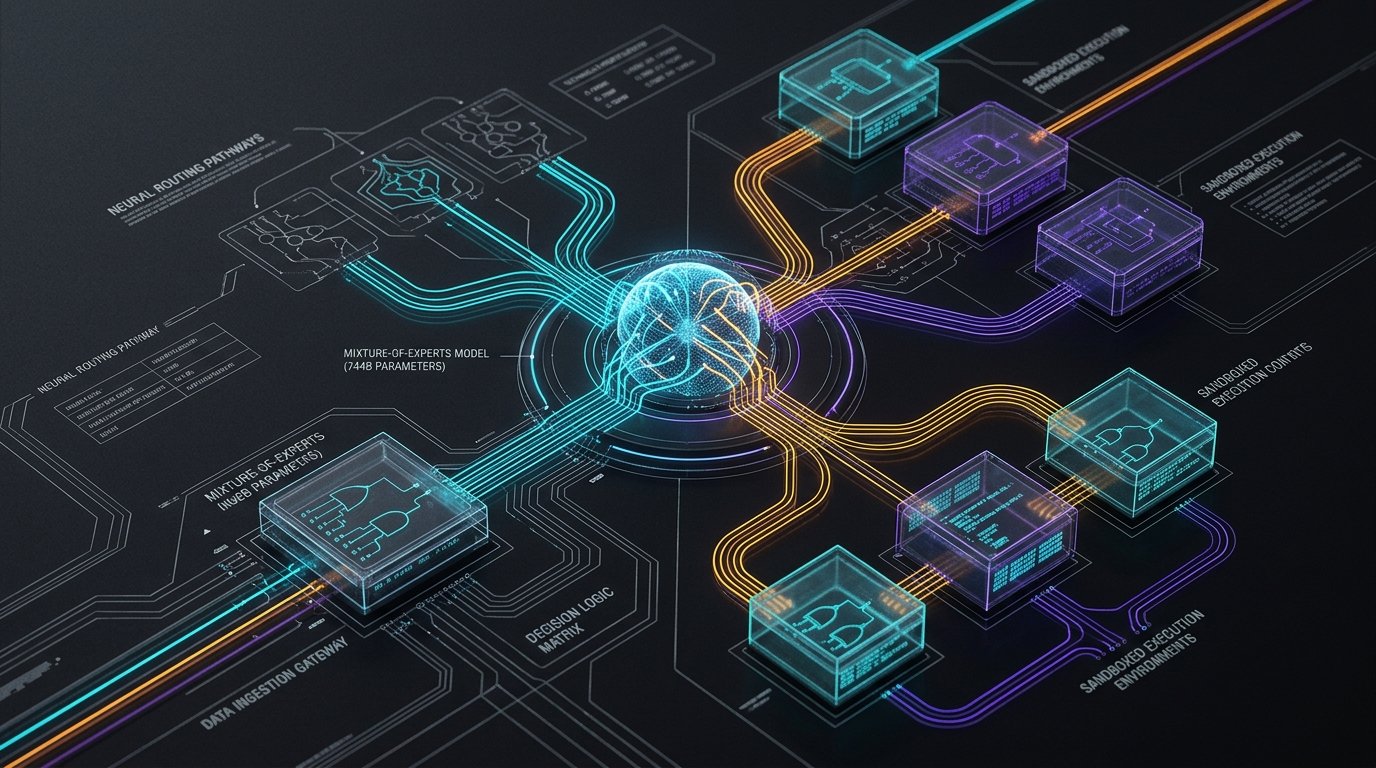
Simplified Overview (ELI5)
Written by Abrar Akhunji
Imagine you hire two different people to fix a broken, water-leaking engine inside a submarine:
Person A: The "Book-Smart Conversationalist" (Traditional LLM)
Person A has read every textbook in the world about engines. When you ask them to fix the leak, they speak with total confidence, describe gorgeous mechanical drawings, and write a 10-page essay declaring: "I have tightened bolt #4. The leak is now completely solved!"
- The Catch: Person A is blindfolded and locked in an office! They never actually picked up a wrench. When you open the submarine door, water is still pouring in—and you drown.
Person B: The "Sandboxed Robotic Scientist" (Atria Dawn 744B)
Person B doesn't just talk. They pick up physical tools inside a pressure chamber.
- They turn bolt #4 with a torque wrench.
- They look at the pressure gauge: Still leaking! Exit code: 1.
- They don't pretend it's fixed. Instead, they say: "My first hypothesis failed. Inspecting gasket seal..."
- They replace the gasket, re-pressurize the tank, and watch the gauge hit zero: Exit code: 0. Verified!
- Only then do they tell you the job is done.
How AI Models Learn & Execute Work:

Traditional LLM (RLHF / Chat Tuning):
[ Problem ] ──> [ Guess Solution ] ──> [ Confident Essay ] ──> [ Did it actually work? Who knows! ]

Atria Dawn (Verifiable Experience Pipeline - VEP):
[ Problem ] ──> [ Plan ] ──> [ Run in Sandbox ] ──> [ Gauge / Test Fails? ] ──> [ Self-Correct ] ──> [ Verified Success! ]
                                   ▲                                                  │
                                   └──────────────── Retry Loop ──────────────────────┘
The Atria Dawn Breakthrough
In late September 2026, researchers at the Shanghai Artificial Intelligence Laboratory (with over 140 scientists) unveiled Atria Dawn Preview (arXiv:2609.15818), released under an open-source MIT license.
Instead of being trained on polite chat logs, Atria Dawn is trained on executable reality through a breakthrough system called the Verifiable Experience Pipeline (VEP):
- 744 Billion Parameters (Mixture of Experts): It has an enormous brain with hundreds of specialized teams. But during every millisecond, only the 8 best experts for that exact problem are woken up—keeping it fast and computationally efficient.
- The Compiler is the Judge: It doesn't rely on human "thumbs-up" ratings. It is rewarded only when code compiles, automated test suites pass, mathematical proofs hold, or security vulnerabilities are verifiably patched.
- The 4 Mission Rooms: It is purpose-built for four intense disciplines: Discovery (deep scientific research), Creation (writing and testing full-stack software), Delivery (generating structured reports), and Cybersecurity (hunting bugs and fixing exploits).
Let's dive beneath the surface and examine the Mixture-of-Experts routing, IndexShare attention mechanisms, and closed-loop reinforcement learning math behind Atria Dawn.
The 5-Stage VEP Execution Lifecycle in Atria Dawn
- Autonomous Problem Formulation: The agent parses uncurated problem specifications (e.g., GitHub bug reports, CVE descriptions, or raw scientific papers) into a directed acyclic graph (DAG) of verifiable sub-hypotheses.
- Instrumented Sandbox Provisioning: A disposable execution container is instantiated with exact dependency lockfiles, compilers, GDB/LLVM toolchains, and sanitized environment variables.
- Hypothesis-Driven Tool Dispatch: Atria Dawn dispatches discrete shell commands, file edits, or network calls via standard MCP (Model Context Protocol) interfaces, capturing raw stdout/stderr streams.
- Deterministic Verification Matrix: Automated verifiers evaluate the environmental delta: AST parsing checks, linter status, ASAN/TSAN sanitizers, and regression test suites execute without human intervention.
- Self-Correction or Artifact Finalization: If verifiers signal failure, the error trace feeds directly into the next forward pass for iterative refinement. Upon universal verifier pass, a clean, auditable patch is committed.
Section 3: The Four Operational Pillars
Atria Dawn avoids the generic "general-purpose chatbot" trap by hyper-specializing its MoE routing space across four high-leverage technical domains:
+---------------------------------------------------------------------------------------------------+
| ATRIA DAWN CORE CAPABILITY MATRIX                                                                 |
+-------------------+-----------------------------------+-------------------------------------------+
| Operational Pillar| Core Operational Objectives       | Verification Mechanism                    |
+-------------------+-----------------------------------+-------------------------------------------+
| 1. DISCOVERY      | Academic literature synthesis,    | Citation graph verification, mathematical |
|                   | scientific hypothesis generation, | proof checking (Lean 4), reproducible     |
|                   | empirical workflow design.        | experiment script execution.              |
+-------------------+-----------------------------------+-------------------------------------------+
| 2. CREATION       | End-to-end software engineering,  | Compilers, AST differential analyzers,    |
|                   | full-stack architecture design,   | unit/integration test suites (SWE-bench), |
|                   | automated test-driven development.| visual regression headless testing.       |
+-------------------+-----------------------------------+-------------------------------------------+
| 3. DELIVERY       | Executive reporting, verifiable   | Cross-referencing against source artifacts|
|                   | data synthesis, structured tech   | and reproducible code execution outputs.  |
|                   | documentation authoring.          |                                           |
+-------------------+-----------------------------------+-------------------------------------------+
| 4. CYBERSECURITY  | CVE root-cause analysis, binary   | Proof-of-Concept exploit execution        |
|                   | vulnerability discovery, exploit  | (ExploitBench), AddressSanitizer logs,    |
|                   | verification, defensive patching. | automated security regression checking.   |
+-------------------+-----------------------------------+-------------------------------------------+
Pillar 1: Discovery (Empirical Scientific Research)
In discovery tasks, Atria Dawn operates as an automated research partner. When presented with an open scientific question:
- It queries academic indexes via API, downloads and parses PDF literature into structured markdown corpora.
- It identifies contradictions across published literature and formulates testable empirical hypotheses.
- It authors automated data-processing pipelines (Python / NumPy / PyTorch) to test hypotheses on public datasets, autonomously executing the code and verifying statistical significance.
Pillar 2: Creation (Software Engineering & SWE-bench)
On benchmarked software engineering suites like SWE-bench Verified, Atria Dawn does not simply guess code edits. It enforces a strict Reproduce-First Policy:
- It navigates the codebase using AST-aware grep and symbol navigation.
- It writes a standalone minimal reproducing test case that demonstrates the bug (verifying that the test fails before touching production code).
- It makes surgical modifications to production source files.
- It executes the reproducing test case (verifying that it now passes).
- It runs the entire project test suite to verify zero regressions.
Pillar 3: Delivery (Verifiable Technical Synthesis)
Technical documentation generated by Atria Dawn is directly tied to runtime state. Instead of hallucinating performance numbers or API parameters, the model embeds executable benchmark scripts, captures the stdout output into data tables, and builds documentation with verified code examples.
Pillar 4: Cybersecurity (ExploitBench & Vulnerability Defense)
Cybersecurity is where Atria Dawn's verifiable execution yields the most staggering competitive advantage. On ExploitBench and real-world CVE remediation:
- The model analyzes target source code or binary disassembly to discover vulnerabilities (e.g., integer overflows, use-after-free, SQL injection, SSRF).
- It generates a functional Proof-of-Concept (PoC) script and triggers the flaw inside a monitored container.
- It captures the crash dump via GDB or AddressSanitizer (ASAN) to verify exploitability.
- It drafts a defensive patch, recompiles the binary, and verifies that the PoC fails while all legitimate functional unit tests succeed.
Frontier Agentic Benchmark Comparison (September 2026)
Comparative evaluation of Atria Dawn 744B against frontier proprietary and open models across SWE-bench Verified, ExploitBench (Cybersecurity), GAIA (General Agentic), and OSWorld (Desktop/OS Tooling)
| benchmark | Atria Dawn 744B (Shanghai AI Lab) | Claude 3.5 Sonnet (Anthropic) | Qwen-2.5-Coder-32B (Alibaba) | DeepSeek-V3-671B (DeepSeek) |
|---|---|---|---|---|
| SWE-bench Verified (Resolved %) | 54.8 | 49.2 | 38.6 | 42.4 |
| ExploitBench (PoC Discovery %) | 62.4 | 41 | 28.5 | 34.2 |
| GAIA Benchmark (Level 3 %) | 58.7 | 54 | 39.2 | 46.5 |
| OSWorld (Autonomous Task %) | 38.2 | 34.5 | 21 | 25.8 |
Section 4: The Human-AI Epistemic Partnership
A unique contribution of the Atria Dawn technical report is its empirical investigation into human-AI collaboration dynamics. Rather than evaluating the model solely in synthetic automated environments, the researchers logged 769 real-world engineering tasks across 56 research engineers collaborating with Atria Dawn over six months.
HUMAN-AGENT TASK DECOMPOSITION & EPISTEMIC BOUNDARY:

           HUMAN RESEARCHER / SENIOR ENGINEER
       ┌─────────────────────────────────────────┐
       │ - High-level problem definition         │
       │ - Epistemic bounds & ethical safety     │
       │ - Architectural constraint setting      │
       │ - Terminal validation & sign-off        │
       └────────────────────┬────────────────────┘
                            │ (Goals, Constraints, Feedback)
                            ▼
       ┌─────────────────────────────────────────┐
       │         ATRIA DAWN 744B (AGENT)         │
       │ - Multi-step hypothesis generation      │
       │ - Sandbox tool invocation & execution   │
       │ - Iterative compiler/test debugging     │
       │ - Self-repair upon verifier failure     │
       └─────────────────────────────────────────┘
1. The 33% Infeasibility Threshold
Of the 769 engineering tasks recorded, researchers determined that roughly one-third (33%) of the tasks were fundamentally infeasible without AI assistance. These tasks were characterized by:
- Massive exploratory search spaces across unfamiliar codebases exceeding 500,000 lines of code.
- Exhaustive dependency conflict resolution across legacy C++ / CUDA / PyTorch environments.
- High-combinatorial parameter sweeping where human engineers would have experienced cognitive exhaustion before identifying the working configuration.
2. The Division of Epistemic Labor
The study revealed a sharp, highly consistent division of labor between human engineers and Atria Dawn:
- Where the Agent Dominates (Execution & Iteration): The agent generated exploratory implementation attempts, parsed thousands of compiler warnings, wrote boilerplate unit tests, and resolved environmental dependency issues. In over 82% of sessions, the agent made 4 or more iterative repair loops before presenting a working artifact.
- Where Humans Retain Absolute Authority (Intent & Direction): In 100% of successful long-horizon projects, human engineers held the steering wheel. When agents drifted into technically valid but strategically unproductive optimizations (e.g., over-optimizing an unused utility function), human engineers intervened to reset the problem bounds.
This empirical finding disproves the myth that autonomous agentic models replace senior software engineers. Instead, Atria Dawn acts as an infinite-stamina mechanical amplifier, allowing senior architects to orchestrate complex software systems with zero implementation friction.
Section 5: Production Deployment & Inference Sizing
For infrastructure architects and platform teams seeking to self-host Atria Dawn, here is the complete systems sizing, cluster topology, and serving configuration.
1. Hardware Sizing & Memory Footprint
ATRIA DAWN 744B MEMORY SIZING & QUANTIZATION:

Full Precision (FP16 / BF16):
- Weights: 744B parameters × 2 bytes = 1,488 GB VRAM
- Minimum Hardware: 24x 80GB H100 (3 nodes of 8x H100)

Production FP8 Quantization (Recommended):
- Weights: 744B parameters × 1 byte = 744 GB VRAM
- Overhead (Activation Buffers + KV Cache @ 256K): ~250 GB
- Target Cluster: 4 nodes of 8x NVIDIA H100/H200 (32x GPUs total)
- Partitioning: Tensor Parallelism (TP=8) × Pipeline Parallelism (PP=4)
Because only 8 experts are active per token (plus 1 shared expert), the active compute cost per forward pass is comparable to an 80B parameter dense model, delivering inference throughput of 22–35 tokens/sec per stream on NVIDIA H100 clusters.
2. Deploying Atria Dawn via vLLM with DeepEP
Below is a production cluster configuration launching Atria Dawn using vLLM with DeepEP (DeepSeek Expert Parallelism) kernel acceleration:
#!/usr/bin/env bash
# Production launch script for Atria Dawn 744B MoE on 4x 8-GPU Nodes
# Set environment variables for multi-node NCCL & DeepEP
export NCCL_IB_DISABLE=0
export NCCL_IB_HCA=mlx5_0,mlx5_1,mlx5_2,mlx5_3,mlx5_4,mlx5_5,mlx5_6,mlx5_7
export NCCL_IB_GID_INDEX=3
export VLLM_ATTENTION_BACKEND=FLASH_ATTN
export VLLM_MOE_BACKEND=DEEPEP

python3 -m vllm.entrypoints.openai.api_server \
    --model internlm/atria-dawn-preview-fp8 \
    --tensor-parallel-size 8 \
    --pipeline-parallel-size 4 \
    --max-model-len 262144 \
    --gpu-memory-utilization 0.92 \
    --kv-cache-dtype fp8 \
    --trust-remote-code \
    --port 8000 \
    --host 0.0.0.0
3. Closed-Loop Agent Client Loop (Python + MCP)
To interact with Atria Dawn within a closed-loop execution sandbox, developers can implement the following Python runner orchestrating the Model Context Protocol (MCP):
import json
import subprocess
from typing import Any, Dict, List
import requests

API_ENDPOINT = "http://localhost:8000/v1/chat/completions"
MODEL_NAME = "internlm/atria-dawn-preview-fp8"

SYSTEM_PROMPT = """You are Atria Dawn, an autonomous agentic superintelligence.
You operate via closed-loop sandbox execution. For every task:
1. Reason step-by-step about the root cause.
2. Emit exact bash commands or file patches using the tool schema.
3. Observe execution return codes and stderr.
4. Self-correct upon failure until all verifiers pass.
"""

def execute_sandboxed_bash(command: str) -> Dict[str, Any]:
    """Executes a command inside an isolated container and captures deterministic outputs."""
    try:
        proc = subprocess.run(
            ["docker", "exec", "atria_sandbox", "bash", "-c", command],
            stdout=subprocess.PIPE,
            stderr=subprocess.PIPE,
            text=True,
            timeout=120
        )
        return {
            "exit_code": proc.returncode,
            "stdout": proc.stdout,
            "stderr": proc.stderr
        }
    except subprocess.TimeoutExpired:
        return {"exit_code": -1, "stdout": "", "stderr": "Execution timed out after 120s"}

def run_agentic_loop(task_description: str, max_iterations: int = 15):
    """Executes the closed-loop Verifiable Experience Pipeline with Atria Dawn."""
    messages = [
        {"role": "system", "content": SYSTEM_PROMPT},
        {"role": "user", "content": f"TASK: {task_description}"}
    ]

    for iteration in range(max_iterations):
        print(f"\n--- [Iteration {iteration + 1}/{max_iterations}] Querying Atria Dawn 744B ---")

        payload = {
            "model": MODEL_NAME,
            "messages": messages,
            "temperature": 0.2,
            "max_tokens": 4096
        }

        response = requests.post(API_ENDPOINT, json=payload).json()
        choice = response["choices"][0]["message"]
        assistant_content = choice.get("content", "")
        print(f"[Agent Response]:\n{assistant_content}")

        messages.append({"role": "assistant", "content": assistant_content})

        # Check for task completion marker
        if "### TASK COMPLETE" in assistant_content:
            print("\n[SUCCESS] Agent signaled terminal verification pass!")
            break

        # Parse command blocks from markdown
        if "```bash" in assistant_content:
            cmd = assistant_content.split("```bash")[1].split("```")[0].strip()
            print(f"[Executing Tool Command]: {cmd}")

            result = execute_sandboxed_bash(cmd)
            tool_feedback = (
                f"COMMAND EXECUTION RESULT:\n"
                f"Exit Code: {result['exit_code']}\n"
                f"STDOUT:\n{result['stdout']}\n"
                f"STDERR:\n{result['stderr']}"
            )
            print(f"[Verifier Output]: Exit code {result['exit_code']}")

            messages.append({
                "role": "user",
                "content": f"[ENVIRONMENT VERIFIER FEEDBACK]\n{tool_feedback}"
            })
        else:
            print("[Warning]: No executable command found in response. Halting.")
            break

if __name__ == "__main__":
    test_task = (
        "In the repository /workspace/auth-service, reproduce CVE-2026-8912 (JWT algorithm confusion). "
        "Write a failing unit test, apply the security patch, and verify zero regressions."
    )
    run_agentic_loop(test_task)
Section 6: Key Architectural Takeaways for Senior AI Systems Engineers
The release of Atria Dawn 744B marks a decisive inflection point in artificial intelligence engineering:
- The Death of Scalar Chat Tuning for Agents: Training models on human conversation logs creates articulate sycophants. Building agents that reliably manipulate production systems requires closed-loop environmental verifiers (compilers, AST linters, unit tests, and exploit sandboxes).
- MoE + IndexShare is the Scalability Blueprint: Activating only 8 of 744 billion parameters per token allows Atria Dawn to run at the latency and token economics of an 80B model, while IndexShare attention compresses KV-cache overhead across 256K contexts.
- Differential Step-Level Credit Assignment is Non-Negotiable: Episode-level scalar rewards dilute the training signal across multi-turn trajectories. By rewarding intermediate state advancements (reproducing tests, syntax validation), models learn robust self-correction mechanics.
- Open-Weights Democratization: By releasing Atria Dawn under the MIT license, the Shanghai AI Laboratory has equipped enterprise engineering teams with an un-neutered, self-hostable agentic powerhouse for cybersecurity and mission-critical software engineering.
The era of chatbot toys is drawing to a close. The era of Verifiable Autonomous Systems Engineering has officially begun. :::