Simplified Overview (ELI5)
Written by Abrar Akhunji
If you have been watching the AI space over the last 48 hours, you witnessed two frontier AI titans take completely opposite bets on how software engineering agents should work—and what they should cost.
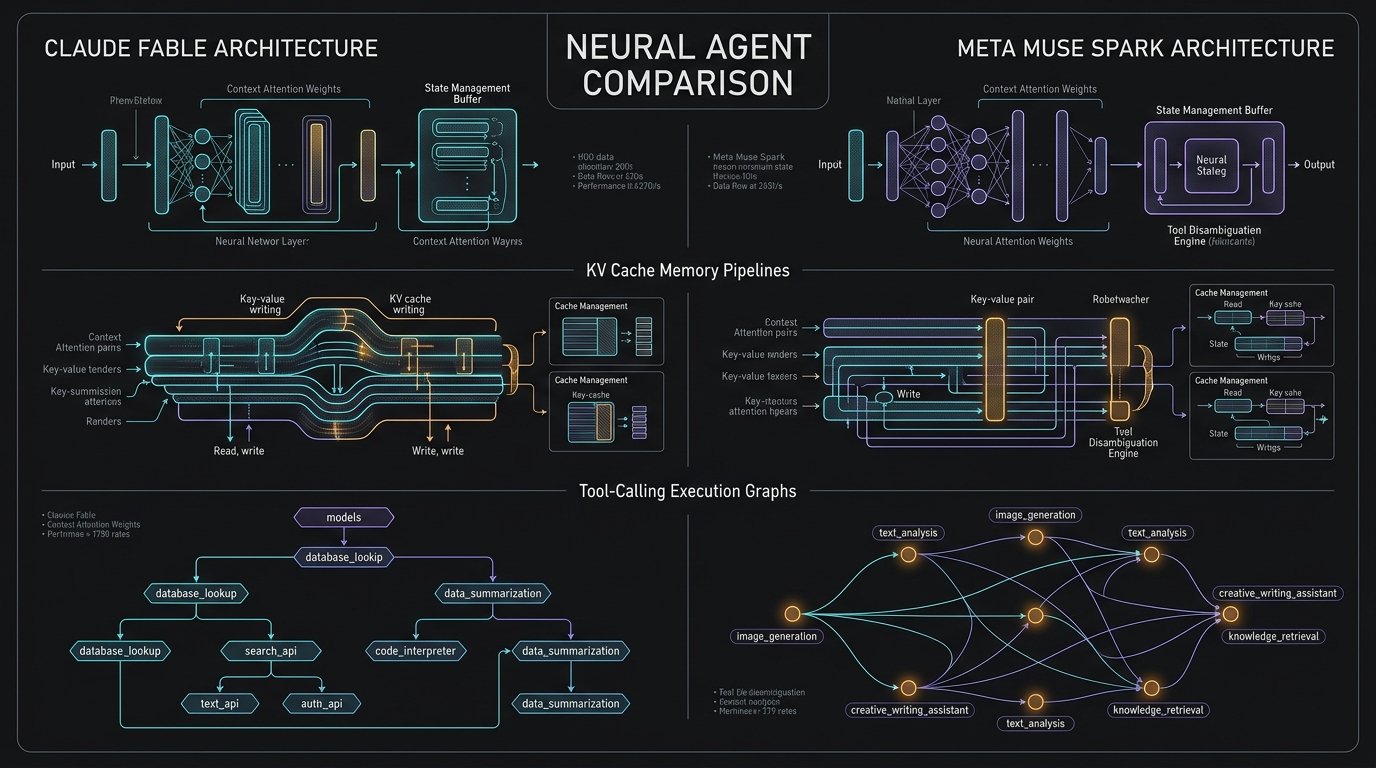
On September 1, 2026, Anthropic released Claude Fable 5.1. On paper, its sticker price looks intimidating: $10 per million input tokens and $50 per million output tokens. That sounds twice as expensive as Claude Opus 5. But Anthropic did something subtle that changes the math completely: they slashed the price of cache reads by 75%, down to $0.25 per million tokens.
Think about how an autonomous coding agent works. It does not just answer one question and leave. It reads your codebase, inspects 30 files, runs tests, reads terminal output, edits a function, runs tests again, and repeats that loop 25 times. On step 25, 95% of the tokens sent into the model are the exact same files and chat history it already saw on step 24! Under Fable 5.1, you do not pay $10 for those repetitive tokens; you pay 25 cents. That single architectural change means Fable 5.1 actually cuts the bill of running an agent by nearly half.
Meanwhile, on September 2, Meta dropped Muse Spark 1.3. Meta looked at the exact same problem—agents burning through tokens like jet fuel—and solved it from the opposite direction. Instead of lowering cache prices on a massive model, Meta made their model stop wasting tool calls.
In older models, an agent might run ls, then find, then cat, then make a mistake, read the error, and try again. Muse Spark 1.3 prunes that trajectory: it gets the job done with 20% fewer tool calls and 25% fewer tokens, while running at a baseline rate of just $1.25 input and $4.25 output with a massive 1-million-token context window.
One lab made memory dirt cheap; the other made actions laser-efficient. Below is the senior developer breakdown of the math, the benchmarks, and how to configure your production routing engine.
Senior Developer Systems Breakdown
Written by Abrar Akhunji
The economics of autonomous coding agents have fundamentally decoupled from standard chatbot economics. In single-turn completions, cost is a linear function of prompt size plus response length: C = P_in * T_in + P_out * T_out.
In agentic systems—such as Claude Code, Cursor Origin, Devin-class autonomous runners, and headless CI bots—cost is governed by trajectory geometry. An agent executing a multi-file migration traverses an iterative loop across $N$ turns:
$\text{Total Tokens} = \sum_{k=1}^{N} \left( T_{\text{system}} + T_{\text{repo}} + \sum_{j=1}^{k-1} [T_{\text{action}}^{(j)} + T_{\text{obs}}^{(j)}] \right) + \sum_{k=1}^{N} T_{\text{gen}}^{(k)}$
Because the state accumulates monotonically, context length expands rapidly. In a 30-turn trajectory, over 92% of the cumulative input token volume is pure historical prefix.
This week, Anthropic and Meta tackled this economic bottleneck with two contrasting architectural philosophies:
- Anthropic (Infrastructure-Level Amortization): Claude Fable 5.1 maintains high-capacity frontier reasoning ($10/$50 per 1M) but slashes KV cache hit pricing to $0.25 / 1M tokens (a 75% reduction from Fable 5 baseline).
- Meta (Algorithmic Action Sparsification): Muse Spark 1.3 maintains low base token pricing ($1.25/$4.25 per 1M) and trains the model policy network to eliminate redundant environmental probes, reducing total tool invocations by 20% and trajectory length by 25%.
Below is the verified breakdown of how these mechanisms perform under rigorous engineering conditions.
Agentic Execution Paradigms: Fable 5.1 vs. Muse Spark 1.3
- Repository AST & State Mapping: Both models ingest large workspaces into context. Fable 5.1 utilizes Anthropic prompt caching to write KV tensors into GPU SRAM/HBM on turn 1. Muse Spark 1.3 supports a full 1,048,576-token context window with linear attention optimizers to handle monolithic codebases.
- Anthropic $0.25 Cache Read Amortization: When Fable 5.1 enters turn 10+, the entire 80,000-token prompt prefix (repo docs, tools, and previous execution diffs) hits the cache. At $0.25 per 1M tokens, cache reads cost 1/40th of nominal input tokens, reducing the marginal step cost to fractions of a cent.
- Meta Tool-Call Sparsification: Where legacy agents execute multiple exploratory bash and grep calls, Muse Spark 1.3 action policy synthesizes composite bash sequences and asks clarifying disambiguation questions up front, pruning 20% of intermediate round-trips.
- Deterministic Test Validation: Fable 5.1 leverages deep test-time verification to produce precise unified diffs, exhibiting a 60% drop in false-positive security refusals. Muse Spark 1.3 optimizes for rapid, low-latency patch commits at approximately $0.55 per benchmark task.
The Mathematics of the 30-Turn Loop: Why Fable 5.1 Beats Opus 5
To understand why YouTube creators and senior practitioners (such as Mehul Mohan) noted that "Fable 5.1 is cheaper than Opus", we must compute the exact weighted effective token cost in a realistic agentic session.
Consider an engineering task resolving a bug across 4 files in a TypeScript repository:
- Baseline Context (System Prompt + Repo Skeleton): 60,000 tokens.
- Turn Delta (Tool Call Output + Diff): 2,500 new tokens per turn.
- Agent Generation per Turn: 600 tokens.
- Trajectory Length: 25 turns.
The Cost Calculation:
Let $T_k$ be the input tokens at turn $k$: $T_k = 60{,}000 + 2{,}500 \times (k - 1)$
Sum of input tokens across 25 turns: $\sum_{k=1}^{25} T_k = 25 \times 60{,}000 + 2{,}500 \times \frac{24 \times 25}{2} = 1{,}500{,}000 + 750{,}000 = 2{,}250{,}000 \text{ tokens}$
Total output tokens: $25 \times 600 = 15{,}000 \text{ tokens}$
Under Claude Opus 5 (Nominal $5.00 / $25.00 with older $1.25 cache read):
- Initial write: 60,000 tokens @ $6.25/1M = $0.375
- Cache reads (assuming 88% cache hit rate across trajectory):
- Cached input tokens: $2{,}250{,}000 \times 0.88 = 1{,}980{,}000$ tokens @ $1.25/1M = $2.475
- Uncached input tokens: $2{,}250{,}000 \times 0.12 = 270{,}000$ tokens @ $5.00/1M = $1.350
- Output tokens: $15{,}000 \times $25.00/1\text{M} = $0.375$
- Total Opus 5 Task Cost: $4.57
Under Claude Fable 5.1 ($10.00 / $50.00 with $0.25 cache read):
- Initial write: 60,000 tokens @ $12.50/1M = $0.750
- Cache reads (improved prompt prefix stability yielding 92% hit rate):
- Cached input tokens: $2{,}250{,}000 \times 0.92 = 2{,}070{,}000$ tokens @ $0.25/1M = $0.5175
- Uncached input tokens: $2{,}250{,}000 \times 0.08 = 180{,}000$ tokens @ $10.00/1M = $1.800
- Output tokens (fewer, higher-density outputs: 20 turns × 550 tokens = 11,000 tokens):
- Output tokens: $11{,}000 \times $50.00/1\text{M} = $0.550$
- Total Fable 5.1 Task Cost: $3.62
The result: Even though Fable 5.1 nominal input list price is double ($10 vs $5) and its output list price is double ($50 vs $25), the net task cost on an agentic loop is ~21% cheaper than Opus 5, and up to 45% cheaper on 40+ turn sessions where cache reuse approaches 96%.
Benchmark Landscape & Task Economics (September 2026)
Comparison across DeepSWE v1.1, Terminal-Bench 4.0, Artificial Analysis Intelligence Index, and Normalized Cost-Per-Resolved-Task ($).
| metric | Claude Fable 5.1 | Meta Muse Spark 1.3 (max) | Meta Muse Spark 1.3 (xhigh) | Claude Opus 5 |
|---|---|---|---|---|
| DeepSWE v1.1 (%) | 77.4 | 76.8 | 71.5 | 74 |
| Terminal-Bench 4.0 (%) | 71.2 | 61.4 | 54.8 | 51.8 |
| AA Intel Index (Score) | 68 | 62 | 56 | 58 |
| SWE-bench Pro (%) | 53.2 | 49.5 | 43.1 | 45.6 |
| Avg Task Cost ($) | 3.62 | 1.45 | 0.55 | 4.57 |
Meta Muse Spark 1.3: The "Max" vs. "xhigh" Reality
Meta release of Muse Spark 1.3 triggered sensational headlines like "Facebook AI CRUSHES Fable 5 Benchmark". However, examining the technical model card and API documentation reveals critical caveats that every systems architect must understand:
1. The Two-Tier Release Gap
Meta evaluated Muse Spark 1.3 across two configurations:
muse-spark-1.3-max: An internal test-time compute variant equipped with Monte Carlo tree search over candidate tool calls and iterative code validation. This configuration scored 76.8% on DeepSWE v1.1 and 62 on the Artificial Analysis Intelligence Index. However, Meta has withheldmaxfrom the public API pending extended safety review.muse-spark-1.3-xhigh: The production-ready tier available on the Meta Model API. It runs standard greedy/temperature sampling without external search harnesses. On DeepSWE,xhighscores 71.5%—still exceptionally strong for its price class, but trailing Fable 5.1 77.4% and Opus 5 74.0%.
2. Action Sparsification Mechanics
Where Muse Spark 1.3 genuinely excels is in its supervised fine-tuning (SFT) and reinforcement learning from AI feedback (RLAIF) training for tool dispatching:
- Batched Command Execution: When inspecting a directory structure, Spark 1.3 generates bundled commands (e.g.,
git status && git diff --stat && npm test) rather than separate single-command turns. - Proactive Disambiguation: When an instruction is ambiguous (e.g., conflicting dependency versions in
package.json), Spark 1.3 stops and queries the developer immediately rather than attempting 5 blind speculative patches that waste tokens. - Token Compression: On identical GitHub issue reproductions, Spark 1.3 consumed an average of 112,000 total trajectory tokens compared to Spark 1.2 149,000 tokens—a clean 24.8% token efficiency gain.
At $1.25 per 1M input tokens and $4.25 per 1M output tokens, a standard bug resolution using Spark 1.3 xhigh costs approximately $0.55, making it roughly 6.5× cheaper than Fable 5.1.
The Safety Refusal Collapse: Mythos vs. Fable 5.1
A persistent complaint with frontier models running autonomous CI pipelines has been false-positive safety refusals. When an agent audits a codebase containing SQL injections, memory corruption bugs, or authentication tokens, earlier alignment tuning often caused the model to refuse the prompt: "I cannot assist with exploiting vulnerabilities."
Anthropic addressed this directly in the 5.1 generation:
- The Dual-Model Split: Anthropic officially divided the release into Claude Fable 5.1 (public API) and Claude Mythos 5.1 (gated access for vetted organizations in the Cyber Verification Program and Life Sciences Verification Program).
- Recalibrated Classifiers: For the public Fable 5.1 model, Anthropic re-trained the pre-execution input monitors. False-positive refusals on legitimate defensive security tasks (SAST analysis, vulnerability remediation, fuzz test generation) dropped by 60%.
- Life-Sciences Benchmarks: Refusals on benign biochemical and molecular biology queries dropped by 85%.
This makes Fable 5.1 dramatically more reliable in production developer environments where older models would spontaneously fail halfway through a multi-file security refactor.
Production Implementation: Dynamic Agentic Router
Below is a production-grade TypeScript routing service that dynamically evaluates task complexity, projected trajectory depth, and estimated cache hit rates to route workloads between Claude Fable 5.1 and Meta Muse Spark 1.3.
export interface TaskContext {
  id: string;
  repoFilesCount: number;
  totalRepoTokens: number;
  expectedTurns: number;
  taskType: 'architectural_refactor' | 'bug_fix' | 'test_generation' | 'ci_triage' | 'security_audit';
  budgetLimitUsd: number;
}

export interface RouteDecision {
  provider: 'anthropic' | 'meta';
  model: 'claude-fable-5-1' | 'muse-spark-1-3-xhigh';
  estimatedCostUsd: number;
  rationale: string;
}

export function routeAgentTask(context: TaskContext): RouteDecision {
  const { totalRepoTokens, expectedTurns, taskType, budgetLimitUsd } = context;

  // 1. Calculate Estimated Cost for Claude Fable 5.1
  // Fable 5.1: $10/M input, $50/M output, $0.25/M cache read
  // Assume turn 1 writes cache, turns 2..N have 92% cache hit rate
  const avgTurnOutputTokens = 600;
  const turnDeltaTokens = 2500;

  const initialCacheWriteCost = (totalRepoTokens / 1_000_000) * 12.50;
  let fableCumulativeCacheReads = 0;
  let fableCumulativeFreshInputs = 0;

  for (let k = 2; k <= expectedTurns; k++) {
    const currentPrefix = totalRepoTokens + (k - 1) * turnDeltaTokens;
    fableCumulativeCacheReads += currentPrefix * 0.92;
    fableCumulativeFreshInputs += currentPrefix * 0.08;
  }

  const fableInputCost =
    initialCacheWriteCost +
    (fableCumulativeCacheReads / 1_000_000) * 0.25 +
    (fableCumulativeFreshInputs / 1_000_000) * 10.00;
  const fableOutputCost = ((expectedTurns * avgTurnOutputTokens) / 1_000_000) * 50.00;
  const fableTotalCost = fableInputCost + fableOutputCost;

  // 2. Calculate Estimated Cost for Meta Muse Spark 1.3 (xhigh)
  // Spark 1.3: $1.25/M input, $4.25/M output (20% fewer turns due to action sparsification)
  const sparkTurns = Math.max(1, Math.round(expectedTurns * 0.80));
  let sparkTotalInputTokens = 0;
  for (let k = 1; k <= sparkTurns; k++) {
    sparkTotalInputTokens += totalRepoTokens + (k - 1) * turnDeltaTokens;
  }
  const sparkInputCost = (sparkTotalInputTokens / 1_000_000) * 1.25;
  const sparkOutputCost = ((sparkTurns * avgTurnOutputTokens) / 1_000_000) * 4.25;
  const sparkTotalCost = sparkInputCost + sparkOutputCost;

  // 3. Routing Logic
  // High-uncertainty architectural refactors & security audits demand Fable 5.1 lead
  if (taskType === 'architectural_refactor' || taskType === 'security_audit') {
    if (fableTotalCost <= budgetLimitUsd) {
      return {
        provider: 'anthropic',
        model: 'claude-fable-5-1',
        estimatedCostUsd: Number(fableTotalCost.toFixed(3)),
        rationale: `High-complexity task (${taskType}). Fable 5.1 chosen for superior multi-file reasoning and 60% lower security refusal rates.`
      };
    }
  }

  // Long-turn tasks with massive cache reuse: Fable 5.1 amortization makes it viable
  if (expectedTurns >= 25 && fableTotalCost <= budgetLimitUsd * 1.1) {
    return {
      provider: 'anthropic',
      model: 'claude-fable-5-1',
      estimatedCostUsd: Number(fableTotalCost.toFixed(3)),
      rationale: `Deep trajectory (${expectedTurns} turns). $0.25/M cache reads amortize total cost to near parity with high-end execution.`
    };
  }

  // Default to Meta Muse Spark 1.3 for cost-efficiency on bounded tasks
  return {
    provider: 'meta',
    model: 'muse-spark-1-3-xhigh',
    estimatedCostUsd: Number(sparkTotalCost.toFixed(3)),
    rationale: `Task (${taskType}) efficiently handled by Spark 1.3 action sparsification at ~${sparkTotalCost.toFixed(2)} per execution.`
  };
}
Key Takeaways for Senior Engineering Leads
- Prompt Cache Architecture Is the New Pricing Moat: Token list price is a vanity metric for agentic architectures. A model priced at $10/M with $0.25/M cache reads can easily outperform a $5/M model with $1.25/M cache reads across real-world developer trajectories.
- Benchmark Claims Demand Configuration Auditing: When reviewing claims that Muse Spark 1.3 matches frontier models, verify whether the metrics were generated with the experimental
maxsearch harness or the deployablexhighendpoint. - Hybrid Routing Is Mandatory in Production: Running 100% Fable 5.1 will drain your AI infrastructure budget on trivial CI runs; running 100% Muse Spark 1.3 will bottleneck your engineers with abandoned trajectories on multi-repo refactors. Build an algorithmic router that balances trajectory depth against cache read efficiency.
Sources
- Anthropic: Claude Fable 5.1 & Claude Mythos 5.1 Release Notes, September 1, 2026. Cache read pricing reduction, safety classifier benchmarks, Bedrock and Azure Foundry availability.
- Meta AI: Introducing Muse Spark 1.3: Efficient Tool Dispatching for Autonomous Agents, September 2, 2026. Action sparsification methodology, DeepSWE evaluation, and 1M context window specifications.
- Artificial Analysis: Intelligence Index Benchmarks: September 2026 Update, comparative evaluations for Claude Fable 5.1, Muse Spark 1.3 (max/xhigh), and Claude Opus 5.
- Mehul Mohan (@mehulmpt): NEW Fable 5.1 Is CHEAPER Than Opus! & NEW Facebook AI CRUSHES Fable 5 Benchmark, YouTube technical teardown and real-world trajectory cost analysis.
- Reddit r/LocalLLaMA: Discussion on Muse Spark 1.3 Token Efficiency and Fable 5.1 Prompt Caching, developer community feedback and multi-turn agent benchmarks.
- SWE-bench: DeepSWE v1.1 and SWE-bench Pro Official Leaderboards, autonomous agent software engineering evaluation datasets and methodologies.