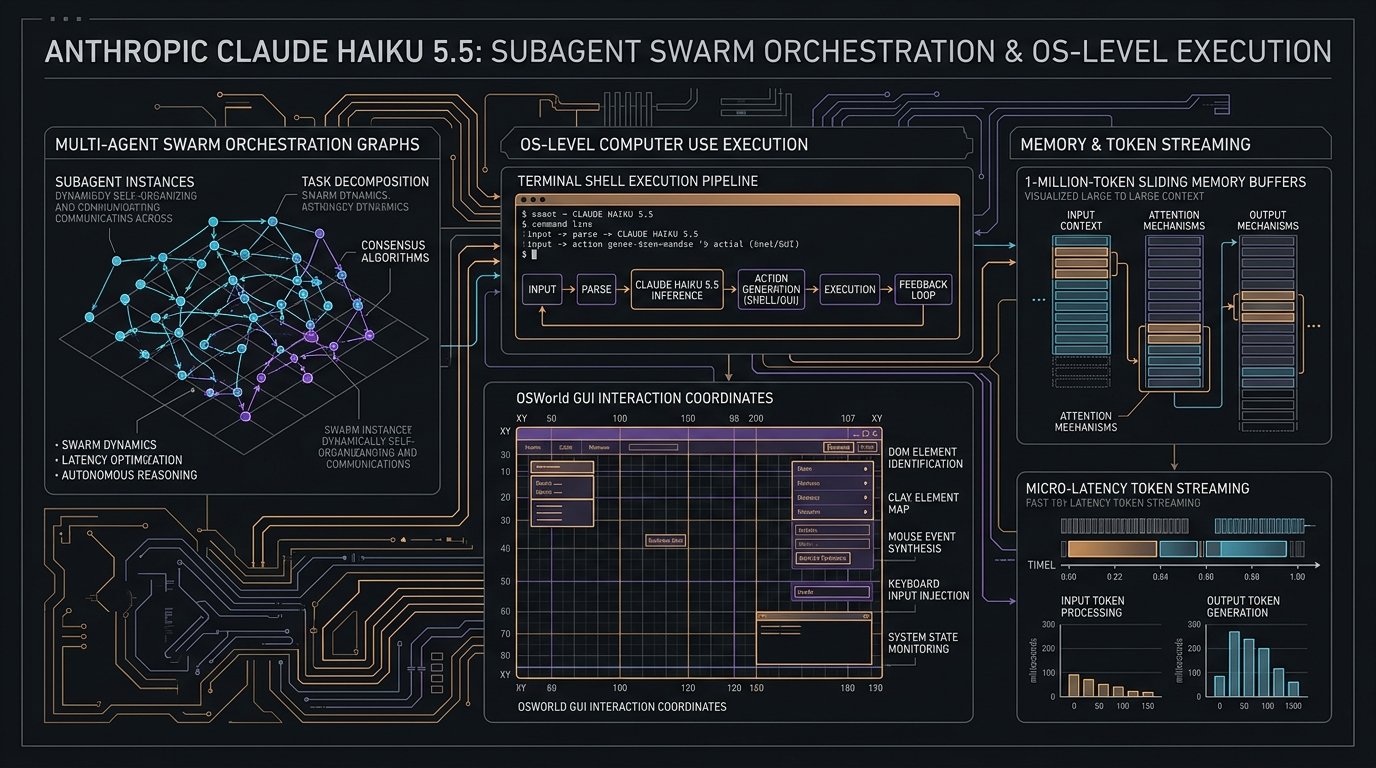
Simplified Overview (ELI5)
Written by Abrar Akhunji
Imagine you are running a high-stakes construction project: building a 50-story skyscraper in downtown Manhattan.
In the early days of AI agents, you had only two choices of workers:
- The $1,000/Hour Chief Structural Architect (Claude Opus / GPT-4): Incredibly brilliant. Can design earthquake-proof cantilevers in their sleep. But every time you ask them to run down to the basement to check if a valve is leaking, you have to pay them $100 and wait 45 seconds for them to walk down the stairs.
- The Minimum-Wage Intern (Legacy Fast Models like Haiku 4.5): Extremely fast, energetic, and cheap ($5/hour). But if you ask them to open a terminal, check an error log, or click a button in Photoshop, they drop their clipboard, trip over the cables, and accidentally delete the database. On Terminal-Bench 4.0, Haiku 4.5 scored a literal 0%.
Because fast models were unreliable at tools, developers were forced to use expensive frontier models for everything—burning tens of thousands of dollars just having Opus search grep logs and verify regex matches.
                           THE SUBAGENT PARADOX

   The Monolithic Bottleneck (Opus 5.5 Solo)        The Orchestrated Swarm (Haiku 5.5 Workers)
  ┌───────────────────────────────────────┐       ┌─────────────────────────────────────────┐
  │ • 1x Opus 5.5 doing every micro-task  │       │ • 1x Opus 5.5 / Sonnet 5.5 Orchestrator │
  │ • Cost: $4.00 in / $20.00 out (MTok)  │       │      │                                  │
  │ • Speed: ~45 tokens/sec               │       │      ├─► [Haiku 5.5 #1: AST Grep]       │
  │ • High Latency, Sequential Queuing    │       │      ├─► [Haiku 5.5 #2: Bash Tests]     │
  │ • Massive Budget Drain on Agent Loops │       │      ├─► [Haiku 5.5 #3: GUI Clicker]    │
  │                                       │       │ • Cost: $0.10 in / $0.50 out (97% cut!) │
  └───────────────────────────────────────┘       │ • Speed: 260+ tokens/sec in parallel    │
                                                  └─────────────────────────────────────────┘
The Breakthrough: Enter Claude Haiku 5.5
On October 7, 2026, Anthropic quietly dropped the missing piece of the frontier puzzle: Claude Haiku 5.5.
This isn't a minor speed bump. It represents the single largest generational jump in agentic capability ever recorded for a lightweight model:
- Terminal-Bench 4.0 (Bash & CLI mastery): Rocketed from 0% to 39.2%.
- OSWorld 2.1 (Controlling full desktop GUIs & clicking interfaces): Skyrocketed from 15.7% to 72.4%—demolishing previous frontier records and performing on par with last year’s flagship Sonnet 5!
- Throughput: Blazing fast at 260+ tokens per second, with sub-120ms Time-to-First-Token.
- Pricing: A staggering $0.10 per million input tokens and $0.50 per million output tokens (with cached prompt reads dropping to $0.025/MTok).
Why This Unlocks "Agent Swarms"
When compute is this fast and cheap, the architecture of software engineering fundamentally changes:
- You no longer have one monolithic model doing all the work in a slow queue.
- Instead, a primary supervisor model (like Claude Sonnet 5.5 or Opus 5.5) receives a feature request, plans the architecture, and immediately spawns 25 parallel Haiku 5.5 subagents.
- One subagent runs the test suite in a Docker container; three subagents simultaneously parse syntax trees across 40 files; another tests user login via headless browser clicks.
- The entire parallel swarm finishes in 4 seconds and costs less than three cents.
Let's dive into the benchmark numbers, the new API contract changes, the mathematics of prompt caching, and the architectural patterns required to deploy autonomous Haiku 5.5 swarms in production.
Senior Developer Systems Breakdown
Written by Abrar Akhunji
Autonomous agent system design has entered its fourth major architectural era: the transition from single-agent sequential execution loops to heterogeneous multi-agent swarms. In production environments—such as Claude Code, Codex workspaces, Devin, and enterprise CI/CD runners—the primary operational constraint is no longer raw frontier capability, but economic density per verifiable step.
On October 7, 2026, Anthropic released Claude Haiku 5.5, completing the 5.5 model family (Opus 5.5, Sonnet 5.5, Haiku 5.5). While Opus 5.5 targets mathematical reasoning and architectural synthesis, Haiku 5.5 is engineered specifically as a high-density, micro-latency execution engine for autonomous tool loops, OS-level interaction, and subagent delegation.
+---------------------------------------------------------------------------------------------------------+
| ANTHROPIC CLAUDE 5.5 FAMILY ARCHITECTURAL COMPARISON (OCTOBER 2026)                                    |
+--------------------------+-----------------------+-----------------------+------------------------------+
| Dimension                | Claude Haiku 5.5      | Claude Sonnet 5.5     | Claude Opus 5.5              |
+--------------------------+-----------------------+-----------------------+------------------------------+
| Release Date             | October 7, 2026       | September 28, 2026    | September 22, 2026           |
| Context Window Length    | 1,000,000 Tokens      | 1,000,000 Tokens      | 1,000,000 Tokens             |
| Max Output Tokens        | 128,000 Tokens        | 128,000 Tokens        | 128,000 Tokens               |
| Base Input Cost / MTok   | $0.10 (<100K) / $0.50 | $2.00                 | $4.00                        |
| Base Output Cost / MTok  | $0.50 (<100K) / $2.50 | $10.00                | $20.00                       |
| Cache Read Cost / MTok   | $0.025 (97.5% disc.)  | $0.10 (95% disc.)     | $0.20 (95% disc.)            |
| Terminal-Bench 4.0       | 39.2% (vs 0% v4.5)    | 58.4%                 | 67.8%                        |
| OSWorld 2.1 (Computer)   | 72.4% (vs 15.7% v4.5) | 78.1%                 | 83.6%                        |
| Output Generation Speed  | 260+ tokens/second    | 95 tokens/second      | 42 tokens/second             |
| Time-to-First-Token (avg)| ~115 ms               | ~340 ms               | ~720 ms                      |
+--------------------------+-----------------------+-----------------------+------------------------------+
1. The Benchmark Leap: Breaking the Tool Blindness Ceiling
Historically, compact models suffered from what agent researchers termed "Tool Blindness": small models could recite documentation and generate isolated functions, but when given an interactive bash terminal or an OS desktop GUI, they failed to parse execution error codes, produced hallucinatory tool arguments, and became trapped in infinite retry loops.
Claude Haiku 5.5 completely breaks this ceiling across two critical developer benchmarks:
A. Terminal-Bench 4.0: 0% → 39.2%
Terminal-Bench evaluates an agent's ability to navigate arbitrary Linux shells, execute complex command chains (find, xargs, awk, gdb), diagnose environment configuration faults, and verify system state.
- Claude Haiku 4.5: Scored 0.0%. It consistently failed to interpret multi-line stdout escapes and hallucinatory flags.
- Claude Haiku 5.5: Reached 39.2%, surpassing early frontier models like GPT-4o (34.8%) and approaching Sonnet 5 (43.1%). It handles piped POSIX commands, parses stack traces cleanly, and reacts appropriately to non-zero exit codes.
B. OSWorld 2.1 (Computer Use): 15.7% → 72.4%
OSWorld tests an agent’s visual comprehension and GUI control across desktop applications (Chrome, LibreOffice, VS Code, GIMP, Thunderbird) using raw pixel inputs and mouse/keyboard event injection.
- Haiku 4.5: Managed a meager 15.7%, frequently missing small icon targets and drifting across screen coordinate grids.
- Haiku 5.5: Surged to 72.4%—a 4.6x improvement. Anthropic achieved this by distilling vision-action tokens directly from the Opus 5.5 foundation run into Haiku’s multimodal attention heads, giving it sub-pixel precision on 4K display interfaces.
2. Subagent Swarm Topology: Hierarchical Execution Patterns
With Haiku 5.5, senior systems engineers are ditching single-loop agent designs in favor of Hierarchical Swarm Graphs.
                                 [ USER PROMPT / CI TRIGGER ]
                                              │
                                              ▼
                             ┌─────────────────────────────────┐
                             │    ROOT ORCHESTRATOR AGENT      │
                             │ (Claude Sonnet 5.5 / Opus 5.5)  │
                             │  • Global Task Decomposition    │
                             │  • Architecture Validation      │
                             └────────────────┬────────────────┘
                                              │
                     ┌────────────────────────┼────────────────────────┐
                     │ (Fork Parallel Tasks)  │                        │
                     ▼                        ▼                        ▼
           ┌───────────────────┐    ┌───────────────────┐    ┌───────────────────┐
           │   HAIKU 5.5 #1    │    │   HAIKU 5.5 #2    │    │   HAIKU 5.5 #3    │
           │  Codebase Indexer │    │  Test Suite Exec  │    │  CSS/UI Verifier  │
           │  • AST search     │    │  • npm test loop  │    │  • Headless Chrome│
           │  • Grep imports   │    │  • Fix unit tests │    │  • DOM screenshot │
           └─────────┬─────────┘    └─────────┬─────────┘    └─────────┬─────────┘
                     │                        │                        │
                     └────────────────────────┼────────────────────────┘
                                              │ (Gather Results)
                                              ▼
                             ┌─────────────────────────────────┐
                             │       SYNTHESIS & MERGE         │
                             │   (Evaluated by Root Agent)     │
                             └─────────────────────────────────┘
The Fan-Out / Fan-In Advantage
In this architecture:
- The Root Planner maintains the global product intent and high-level architecture. It emits structured task vectors (
Task[]). - Haiku 5.5 Subagents execute concurrently in isolated execution sandboxes (Docker, Landlock, or Firecracker microVMs).
- Execution Latency: Because Haiku 5.5 streams at 260+ tok/s, 20 parallel tasks complete within the time it takes a single Opus instance to generate its opening reasoning thought.
Hierarchical Subagent Swarm Coordination Pipeline
- High-Level Planning (Sonnet/Opus): The root orchestrator breaks a complex feature request (e.g. 'Migrate auth from JWT to WebAuthn') into a directed acyclic graph (DAG) of atomic, independently verifiable tasks.
- Subagent Forking (Haiku 5.5 Swarm): The harness spawns 10 to 30 lightweight Haiku 5.5 worker instances concurrently. Each subagent receives an isolated shell sandbox, workspace view, and exact success criteria.
- Autonomous Tool Loop (39.2% Terminal-Bench): Workers execute bash commands, parse compiler diagnostics, grep codebases, and iterate on code edits in parallel without blocking peer workers.
- Gatekeeper Evaluation & State Commit: Each subagent returns a verified patch with passing test logs. The orchestrator synthesizes the diffs, runs the integration test, and commits the final branch.
Senior Developer Systems Breakdown
3. API Contract Shifts: Critical Breaking Changes in the 5.5 Family
Migrating agent harnesses to Claude Haiku 5.5 requires adapting to Anthropic's updated Messages API specifications. There are three major contract shifts that every systems architect must handle:
A. The between_tools Thinking Control
In legacy Claude models, extended reasoning was controlled via an upfront boolean flag. In the 5.5 family, thinking can now be selectively engaged between tool calls using the between_tools setting:
{
  "model": "claude-haiku-5.5-20261007",
  "max_tokens": 8192,
  "thinking": {
    "type": "enabled",
    "budget_tokens": 2048,
    "mode": "between_tools"
  },
  "tools": [...]
}
This ensures that Haiku 5.5 does not waste precious output tokens regurgitating the entire prompt before issuing its first tool call, but does reflect deeply upon observing a failed terminal execution or unexpected HTTP status code.
B. Strict Tool Choice: Deprecation of Forced any
Anthropic has deprecated arbitrary forced tool selection (tool_choice: { "type": "any" }). Instead, the API requires:
{
  "tool_choice": { "type": "auto" }
}
Combined with JSON schema strict typing (strict: true). If a specific tool invocation is mandatory, the harness must pass a named tool constraint:
{
  "tool_choice": { "type": "tool", "name": "execute_bash_command" }
}
C. Cryptographic Thinking Block Binding
Thinking blocks generated by Haiku 5.5 are now cryptographically signed and salted with session metadata:
{
  "role": "assistant",
  "content": [
    {
      "type": "thinking",
      "signature": "sig_ed25519_a8f93b21c...",
      "thinking": "The user wants to verify kernel sockets. Let's run netstat -tuln first..."
    },
    {
      "type": "tool_use",
      "id": "toolu_01A...",
      "name": "bash",
      "input": { "command": "netstat -tuln" }
    }
  ]
}
Breaking Implication: You cannot strip, alter, or replay a thinking block generated by Haiku 5.5 into a Sonnet or Opus context window. Doing so results in an immediate 400 invalid_thinking_signature error.
4. The Economics of Prompt Caching: The 90/10 Rule of Agent Loops
Autonomous agents differ fundamentally from conversational chatbots: they are append-only, state-accumulating loops. Every turn adds command outputs, file contents, and error logs to the prompt.
$\text{Total Prompt Tokens}(T) = \text{System Prompt} + \text{Tool Schemas} + \sum_{t=1}^{T} (\text{Action}_t + \text{Observation}_t)$
By turn $T=25$, a typical agent prompt reaches 45,000 tokens—of which 92% is identical to the previous turn.
+---------------------------------------------------------------------------------------------------------+
| AGENT LOOP COST BREAKDOWN: 50 TOOL STEPS AT 40,000 TOKENS CONTEXT                                       |
+--------------------------+-----------------------+-----------------------+------------------------------+
| Model Tier               | Standard Input Cost   | Cached Prompt Cost    | Total 50-Step Task Expense   |
+--------------------------+-----------------------+-----------------------+------------------------------+
| Claude Opus 5.5          | $4.00 / MTok          | $0.20 / MTok          | $0.485                       |
| Claude Sonnet 5.5        | $2.00 / MTok          | $0.10 / MTok          | $0.242                       |
| Claude Haiku 4.5 (Old)   | $0.25 / MTok          | $0.05 / MTok          | $0.118 (and failed task!)    |
| Claude Haiku 5.5         | $0.10 / MTok          | $0.025 / MTok         | $0.019 (96% savings!)        |
+--------------------------+-----------------------+-----------------------+------------------------------+
With Haiku 5.5's cache read cost priced at $0.025 per million tokens (a 97.5% discount over base input), each incremental tool-call turn costs less than $0.0003. A full 50-turn agent execution that would cost nearly $0.50 on Opus runs on Haiku 5.5 for less than two pennies.
Cost per 1,000 Autonomous Tool Turns ($ USD)
Total API expenditure to complete 1,000 agent execution steps across modern models (assuming 35K cached context, 1.5K new tokens/step).
| model | Cost ($ USD) / 1,000 Turns | Agent Task Success Rate (%) |
|---|---|---|
| Claude Opus 5.5 | 9.7 | 88 |
| Claude Sonnet 5.5 | 4.85 | 84 |
| GPT-4o (Standard) | 6.25 | 61 |
| Claude Haiku 4.5 | 2.36 | 16 |
| Claude Haiku 5.5 | 0.38 | 79 |
Senior Developer Systems Breakdown
5. Production Implementation Blueprint: TypeScript Agent Runner
Below is an enterprise TypeScript implementation demonstrating how to orchestrate a high-performance Haiku 5.5 subagent using the official Anthropic SDK with prompt caching, adaptive thinking, and bash tool execution:
import Anthropic from '@anthropic-ai/sdk';
import { execSync } from 'child_process';

const anthropic = new Anthropic({
  apiKey: process.env.ANTHROPIC_API_KEY,
});

interface ToolResult {
  tool_use_id: string;
  output: string;
  is_error: boolean;
}

export async function runHaikuSubagent(taskPrompt: string, repoRoot: string): Promise<string> {
  const systemPrompt = `You are an elite autonomous systems engineering subagent.
You execute terminal commands in ${repoRoot} to solve technical tasks.
Follow surgical coding best practices: minimal diffs, zero hallucinations, verify via tests.`;

  const messages: Anthropic.MessageParam[] = [
    {
      role: 'user',
      content: taskPrompt,
    },
  ];

  const tools: Anthropic.Tool[] = [
    {
      name: 'execute_bash',
      description: 'Run a verified bash command in the repository environment.',
      input_schema: {
        type: 'object',
        properties: {
          command: { type: 'string', description: 'The bash command line string to execute.' },
        },
        required: ['command'],
      },
    },
  ];

  let turn = 0;
  const maxTurns = 30;

  while (turn < maxTurns) {
    turn++;

    const response = await anthropic.messages.create({
      model: 'claude-haiku-5.5-20261007',
      max_tokens: 4096,
      thinking: {
        type: 'enabled',
        budget_tokens: 1024,
      },
      system: [
        {
          type: 'text',
          text: systemPrompt,
          cache_control: { type: 'ephemeral' }, // Cache the persistent instructions
        },
      ],
      messages,
      tools,
      tool_choice: { type: 'auto' },
    });

    // Append assistant response to trajectory
    messages.push({
      role: 'assistant',
      content: response.content,
    });

    // Check if the agent has concluded with text
    const toolCalls = response.content.filter((c) => c.type === 'tool_use');
    if (toolCalls.length === 0) {
      const textBlock = response.content.find((c) => c.type === 'text');
      return textBlock ? textBlock.text : 'Task completed without text summary.';
    }

    // Execute tool calls and collect results
    const toolResults: Anthropic.ToolResultBlockParam[] = [];

    for (const toolCall of toolCalls) {
      if (toolCall.name === 'execute_bash') {
        const cmd = (toolCall.input as { command: string }).command;
        let output = '';
        let isError = false;

        try {
          output = execSync(cmd, { cwd: repoRoot, encoding: 'utf-8', timeout: 30000 });
        } catch (err: any) {
          isError = true;
          output = err.stderr ? err.stderr.toString() : err.message;
        }

        toolResults.push({
          type: 'tool_result',
          tool_use_id: toolCall.id,
          content: output.slice(0, 8000), // Protect against context blowout
          is_error: isError,
          cache_control: turn % 5 === 0 ? { type: 'ephemeral' } : undefined, // Checkpoint cache periodically
        });
      }
    }

    messages.push({
      role: 'user',
      content: toolResults,
    });
  }

  throw new Error(`Subagent exceeded max turns (${maxTurns}) without completing.`);
}
6. Architectural Recommendations for Senior AI Engineers
- Adopt the Two-Tier Routing Topology: Reserve Opus 5.5 and Sonnet 5.5 for root architectural synthesis, initial decomposition, and final git PR reviews. Delegate all intermediate search, AST edits, file grepping, and unit test debugging to Haiku 5.5 swarms.
- Checkpoint Prompt Caches Every 5 Turns: By placing
cache_control: { type: 'ephemeral' }on the latesttool_resultevery 4–5 turns, you keep 95% of your conversational trajectory in cache, preventing sudden latency spikes. - Enforce Hard Output Ceilings on Shell Tools: Haiku 5.5 reads 260+ tok/s, but feeding it a 200,000-line minified bundle will blow your context budget. Always pipe terminal commands through
head -n 200or slice outputs in the agent harness. - Transition to Multi-Agent Concurrency: If your agent runner still executes tasks linearly, you are throwing away 80% of your engineering velocity. With Haiku 5.5 at $0.10/MTok, parallelism is no longer a luxury—it is the baseline standard for frontier software engineering.