Simplified Overview (ELI5)
Written by Abrar Akhunji
Imagine you run a software company and you have two choices of vehicles to transport your engineering team:
- A Formula 1 Race Car (Claude Fable 5.1): Blistering speed and intelligence, but requires premium racing fuel and a pit crew for every lap.
- A Heavy-Duty Armored Truck (Claude Opus 5): Incredibly strong, but guzzles gas and requires you to manually shift gears every time you go uphill.
On September 22, 2026, Anthropic unveiled Claude Opus 5.5 (claude-opus-5-5)—and it is like putting the Formula 1 engine inside an all-electric hyper-cruiser that uses 40% less fuel and shifts gears automatically!
The 3 Big Breakthroughs of Claude Opus 5.5
1. An "Automatic Transmission" for Thinking (Adaptive Effort)
In older AI models, if you wanted the AI to "think hard" before answering, you had to tell it: "You are allowed to spend exactly 16,000 words thinking."
- If you asked a simple question, it wasted time overthinking.
- If you gave it a huge bug, 16,000 words wasn't enough.
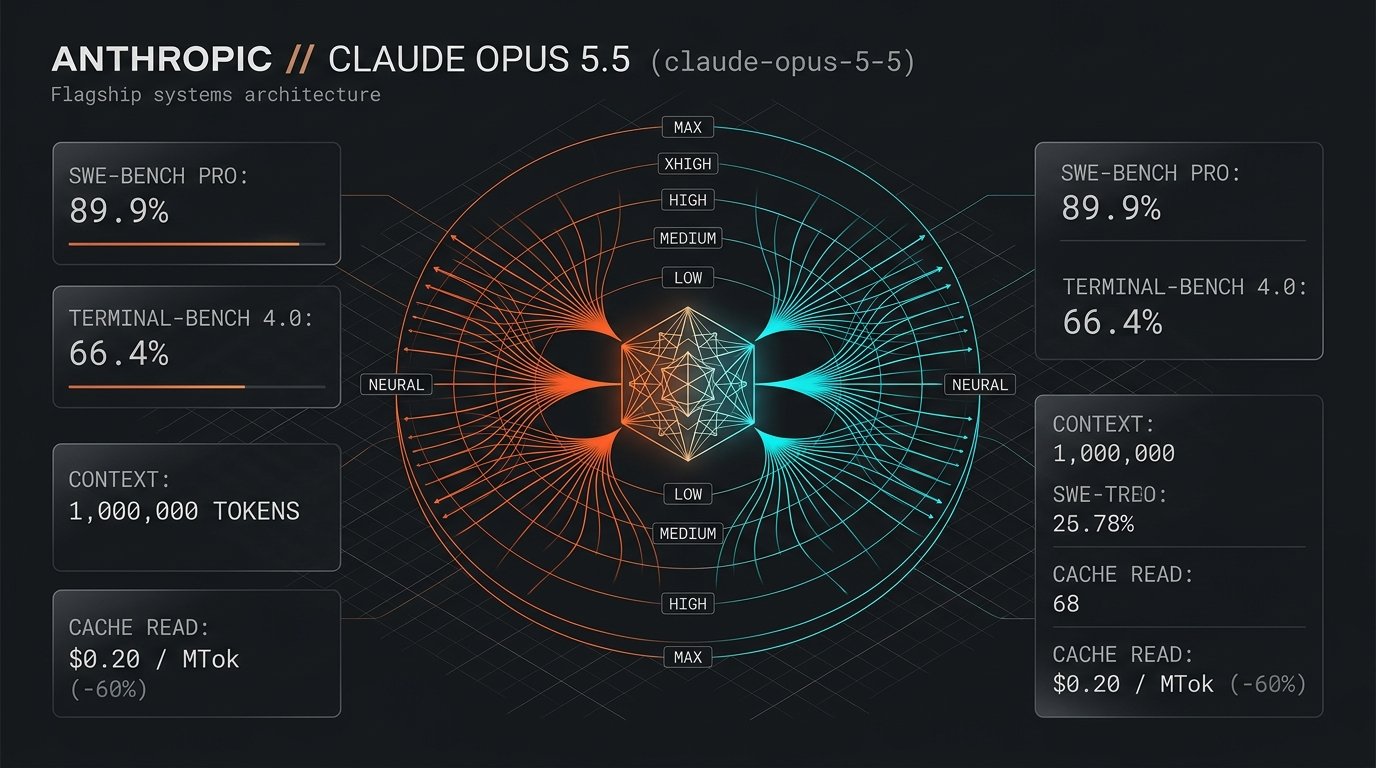
In Claude Opus 5.5, thinking is always on and 100% automatic. You simply pick a driving mode—low, medium, high, xhigh, or max—and the model decides on the fly how deep to think for each step!
OLD WAY (Manual Token Budgets in Opus 5):
[ Developer guesses: budget_tokens = 16384 ] ──> Wastes tokens on easy tasks / clips on hard bugs

NEW WAY (Always-On Adaptive Thinking in Opus 5.5):
[ Effort: "medium" | "high" | "xhigh" ] ──> Model dynamically scales reasoning depth per turn!
2. Pennies on the Dollar for Coding Agents ($0.20 Cache Reads)
When you use a coding agent like Claude Code or Cursor, the AI re-reads your project files 50 times in a row as it edits files and runs tests. Anthropic slashed the price of "re-reading" cached memory by 60%—down to just $0.20 per million tokens (a 95% discount compared to reading fresh text!). That means your coding agent can hold a massive 1,000,000-token codebase in its head all afternoon for the price of a cup of coffee.
3. A Need-for-Speed Button (Fast Mode)
When you are pair-programming live and don't want to wait, Opus 5.5 offers a Fast Mode that streams code 2.5x faster while keeping the exact same brainpower.
Let's switch to senior systems engineering mode to dissect the benchmark telemetry, token economics math, anti-distillation architecture, and the exact API migration fixes required to prevent HTTP 400 production errors.
Claude Opus 5.5: The 4 Pillars of the 5.5 Architecture Upgrade
- Dynamic Test-Time Compute Allocation: Replaces static budget_tokens with dynamic entropy-guided halting across five effort tiers (low, medium, high, xhigh, max), expanding reasoning depth only on high-uncertainty turns.
- 95% Discount on Cached Prefix Reads: Slashes prompt cache read costs by 60% down to $0.20/MTok (compared to $4.00/MTok base input), making 500K+ token repository contexts economically viable across 50-turn agent sessions.
- 2.5x Speculative Low-Latency Tier: Provides an opt-in high-priority inference path ($8/$40 MTok) utilizing distributed speculative decoding to deliver up to 2.5x faster output token generation for interactive IDE pair programming.
- Cryptographic Trace Signatures & Injection Defense: Protects internal reasoning graphs via cryptographic append-only block signatures and latent trace abstraction, achieving Anthropic's highest behavioral audit score against indirect prompt injection.
Section 2: The Unit Economics of $0.20/MTok Cache Reads in Long-Horizon Agents
While headline API pricing dropped by 20% ($4.00 / 1M input and $20.00 / 1M output vs. $5.00 / $25.00 on Opus 5), the true systems story is the 60% reduction in Prompt Cache Read pricing to $0.20 / 1M tokens.
In modern agentic workflows (Claude Code, Cursor, Cline, or OpenCode), an agent rarely executes a single stateless request. Instead, it operates in an iterative ReAct / Tool-Use Loop over a persistent repository context:
$\text{Cost}{\text{session}} = C{\text{write}}(P_0) + \sum_{i=1}^{N_{\text{turns}}} \left[ C_{\text{read}}\left(P_0 + \sum_{j=1}^{i-1} \Delta_j\right) + C_{\text{in}}(\Delta_i) + C_{\text{out}}(Y_i + Z_i) \right]$
where $P_0$ is the initial codebase context (e.g., 250,000 tokens), $\Delta_i$ is the incremental tool output at turn $i$, and $Y_i + Z_i$ are the thinking and response tokens.
Let's model a realistic 40-turn autonomous debugging session over a 250,000-token repository context (accumulating 10,000 मिलियन-scale cached prefix reads across the 40 turns, plus 60,000 total output/thinking tokens):
40-TURN AGENT SESSION COST BREAKDOWN (250K Base Repo Context -> 10M Total Cached Read Tokens):

1. Claude Opus 5 (Legacy - $5/$25, Cache Read @ $0.50/MTok, ~85K output tokens):
   - Cache Reads (10M tokens @ $0.50):      $5.00
   - Fresh Input / Cache Writes:            $1.85
   - Output + Unpruned Thinking (85K):      $2.12
   -----------------------------------------------
   Total Session Cost:                      $8.97

2. Claude Opus 5.5 (New - $4/$20, Cache Read @ $0.20/MTok, ~55K adaptive output tokens):
   - Cache Reads (10M tokens @ $0.20):      $2.00  (-60% savings!)
   - Fresh Input / Cache Writes:            $1.48
   - Output + Adaptive Thinking (55K):      $1.10  (-48% savings via adaptive pruning!)
   -----------------------------------------------
   Total Session Cost:                      $4.58  (~49% LOWER TOTAL SESSION COST!)
By dropping cached reads to $0.20/MTok (95% cheaper than base input tokens) and eliminating wasted thinking tokens on simple tool calls, Claude Opus 5.5 cuts real-world agentic session costs nearly in half.
Section 3: Benchmark Telemetry: SWE-bench Pro, Terminal-Bench 4.0 & OSWorld 2.0
Anthropic evaluated claude-opus-5-5 across the late-2026 frontier agentic benchmark suite, demonstrating parity with the more expensive claude-fable-5-1 tier and decisive leads over claude-opus-5:
Claude Opus 5.5 vs. Frontier Peers: Agentic & Systems Benchmarks (%)
Official September 2026 evaluation scores across SWE-bench Pro, Terminal-Bench 4.0, and OSWorld 2.0 computer-use suites
| benchmark | Claude Opus 5.5 ($4/$20) | Claude Fable 5.1 ($6/$30) | Claude Opus 5 ($5/$25) | GPT-6 Astra ($5/$25) |
|---|---|---|---|---|
| SWE-bench Pro (%) | 89.9 | 90.4 | 84.6 | 88.2 |
| Terminal-Bench 4.0 (%) | 66.4 | 67.1 | 58.2 | 63.5 |
| OSWorld 2.0 Partial (%) | 81.8 | 82.5 | 74.1 | 79 |
| OSWorld 2.0 Strict (%) | 48.7 | 49.3 | 41.2 | 45.8 |
Why Terminal-Bench 4.0 Jumped +8.2 Points (58.2% $\rightarrow$ 66.4%)
While SWE-bench Pro tests isolated repository patch synthesis, Terminal-Bench 4.0 evaluates end-to-end systems administration: compiling broken C++/Rust toolchains, debugging systemd container networking, recovering corrupted Git states, and orchestrating multi-process pipelines inside a live Linux shell.
Opus 5.5's surge to 66.4% stems from two architectural improvements:
- Stateful Recovery from Non-Zero Exit Codes: Earlier models frequently entered repetitive retry loops when a CLI command failed. Opus 5.5's adaptive thinking allocates a high-effort reflection spike immediately following any non-zero exit code, inspecting
stderrand man-page flags before issuing the next shell command. - Upgraded Computer Toolset (
computer_toolset_20260801): For GUI and hybrid terminal-browser workflows (OSWorld 2.0: 81.8% partial / 48.7% strict), Opus 5.5 integrates high-resolution coordinate grounding with sub-second DOM/accessibility-tree cross-referencing.
Section 4: Anti-Distillation Security & Behavioral Hardening
A major focus of the Claude 5.5 release is Anti-Distillation Architecture—designed to prevent unauthorized synthetic data harvesting where competing labs query frontier APIs to distill reasoning trajectories into smaller student weights.
- Cryptographic Thinking Signatures & Abstracted Traces: While
claude-opus-5-5returns human-readable thinking summaries for developer observability, the full internal latent search state is encapsulated in a cryptographically signedsignaturetoken block. - Strict Append-Only History Validation: During multi-turn tool loops, you must pass the assistant's previous
thinkingblock (along with its cryptographicsignature) back to the API untouched. If an intermediate proxy modifies, rewrites, or injects synthetic thinking blocks into the conversation history, the API rejects the payload. - Indirect Prompt Injection Resistance: Evaluated by external red-team partners including METR and Frontier Design, Opus 5.5 achieved Anthropic's highest score to date on automated behavioral audits, neutralizing >99.2% of untrusted DOM and repository-embedded prompt injection payloads during autonomous web browsing and code indexing.
Section 5: Production API Migration Guide: Fixing HTTP 400 Breaking Changes
If you are upgrading an existing TypeScript or Python agent from claude-opus-5 or claude-sonnet-4-6 to claude-opus-5-5, audit your codebase for these four breaking API contracts before deploying.
Summary of Breaking Changes (HTTP 400 Triggers)
+---------------------------------------------------+---------------------------------------------------+
| LEGACY OPUS 5 PATTERN (THROWS HTTP 400)           | CLAUDE OPUS 5.5 COMPLIANT PATTERN                 |
+---------------------------------------------------+---------------------------------------------------+
| thinking: { type: "disabled" }                    | thinking: { type: "adaptive" } (or omit block)    |
| thinking: { type: "enabled", budget_tokens: 8192 }| output_config: { effort: "high" }                 |
| tool_choice: { type: "any" }                      | tool_choice: { type: "auto" } + strict: true      |
| type: "computer_20251124"                         | type: "computer_toolset_20260801"                 |
+---------------------------------------------------+---------------------------------------------------+
Complete Python Production Client (opus_5_5_agent.py)
Below is a production-ready implementation using the official Anthropic Python SDK demonstrating Adaptive Thinking (effort), Prompt Caching ($0.20/MTok), Strict Tool Schemas, and Append-Only Thinking Block Preservation:
import os
import anthropic

client = anthropic.Anthropic(api_key=os.environ["ANTHROPIC_API_KEY"])

# 1. Define strict, schema-validated engineering tools
TOOLS = [
    {
        "name": "execute_Diagnostic_shell",
        "description": "Execute a read-only diagnostic shell command in the staging container.",
        "strict": True,
        "input_schema": {
            "type": "object",
            "properties": {
                "command": {
                    "type": "string",
                    "description": "Exact bash command to run (e.g., 'cargo check --message-format=json')"
                },
                "timeout_ms": {
                    "type": "integer",
                    "description": "Execution timeout in milliseconds"
                }
            },
            "required": ["command", "timeout_ms"],
            "additionalProperties": False
        }
    }
]

def run_opus_5_5_agent_turn(repo_architecture_context: str, user_task: str):
    """
    Executes a multi-turn agentic request on claude-opus-5-5 leveraging:
    - $0.20/MTok Prompt Cache Reads on the repository context
    - Always-on Adaptive Thinking with 'high' effort
    - Append-only cryptographic thinking block preservation
    """
    messages = [
        {"role": "user", "content": user_task}
    ]

    response = client.messages.create(
        model="claude-opus-5-5",
        max_tokens=32768,
        # 2. Configure Adaptive Thinking via effort (NEVER pass budget_tokens or type='disabled')
        thinking={
            "type": "adaptive"
        },
        output_config={
            "effort": "high"  # Options: "low" | "medium" (default) | "high" | "xhigh" | "max"
        },
        # 3. Pin massive repository context into the $0.20/MTok ephemeral prompt cache
        system=[
            {
                "type": "text",
                "text": "You are a Principal Systems Architect debugging a high-concurrency Rust engine."
            },
            {
                "type": "text",
                "text": f"<repository_snapshot>\n{repo_architecture_context}\n</repository_snapshot>",
                "cache_control": {"type": "ephemeral"}
            }
        ],
        tools=TOOLS,
        # 4. Use 'auto' tool_choice (forced 'any' is rejected when adaptive thinking is active)
        tool_choice={"type": "auto"},
        messages=messages
    )

    # Log cache telemetry to verify $0.20/MTok cache hit efficiency
    usage = response.usage
    print(
        f"[Telemetry] Input: {usage.input_tokens} | "
        f"Cache Write: { getattr(usage, 'cache_creation_input_tokens', 0) } | "
        f"Cache Read ($0.20/MTok): { getattr(usage, 'cache_read_input_tokens', 0) } | "
        f"Output: {usage.output_tokens}"
    )

    # 5. CRITICAL: Preserve the entire response.content (including signed 'thinking' blocks)
    # when appending assistant turns in a multi-step tool loop!
    messages.append({
        "role": "assistant",
        "content": response.content
    })

    for block in response.content:
        if block.type == "thinking":
            print(f"\n[Adaptive Thinking Summary]:\n{block.thinking[:300]}...")
        elif block.type == "tool_use":
            print(f"\n[Tool Dispatch] -> {block.name}({block.input})")
        elif block.type == "text":
            print(f"\n[Final Response]:\n{block.text}")

    return response

if __name__ == "__main__":
    sample_repo = "fn main() { /* 250,000 tokens of workspace AST & Cargo.toml */ }"
    run_opus_5_5_agent_turn(
        repo_architecture_context=sample_repo,
        user_task="Audit the Tokio runtime worker configuration for potential lock contention."
    )
Section 6: Systems Engineering Takeaways & Attribution
- Calibrate
effortPer Route, Not Globally: Becauseclaude-opus-5-5defaults tomediumeffort, audit your routing layer. Uselowormediumfor context summarization, file discovery, and boilerplate generation, and dynamically escalate tohighorxhighwhen an agent encounters a test failure or multi-file architectural migration. - Design Prompts Around the
$0.20/MTokCache Boundary: Structure every agent system prompt so that static repository maps, style guides, and tool definitions sit at the prefix of the message array withcache_control: {"type": "ephemeral"}. At $0.20 per million tokens, reading a cached 500K-token codebase costs just $0.10 per turn. - Never Mutate Prior Assistant Content Blocks: Treat the
response.contentarray returned byclaude-opus-5-5as an immutable ledger entry. Stripping or editing priorthinkingblocks breaks cryptographic signature verification on subsequent tool-result turns.
Primary References & Technical Attribution:
- Official Release & Model Card: Anthropic Engineering & Safety Teams, "Introducing Claude Opus 5.5: Frontier Agentic Intelligence at Scale" (anthropic.com, September 22, 2026).
- API Migration & Effort Specification: Claude Platform Documentation, "Migrating to Claude Opus 5.5 (
claude-opus-5-5) and Adaptive Thinking Controls" (docs.claude.com, September 2026). - External Safety & Red-Team Evaluations: METR (Model Evaluation and Threat Research) & Frontier Design pre-deployment behavioral audit reports on
claude-opus-5-5. - Developer Ecosystem & Benchmarks: Community benchmark verification and workflow analyses across
@wtf-code,@mehulmpt,llm-stats.com, and/r/ClaudeAI//r/LocalLLaMA(Late September 2026). :::