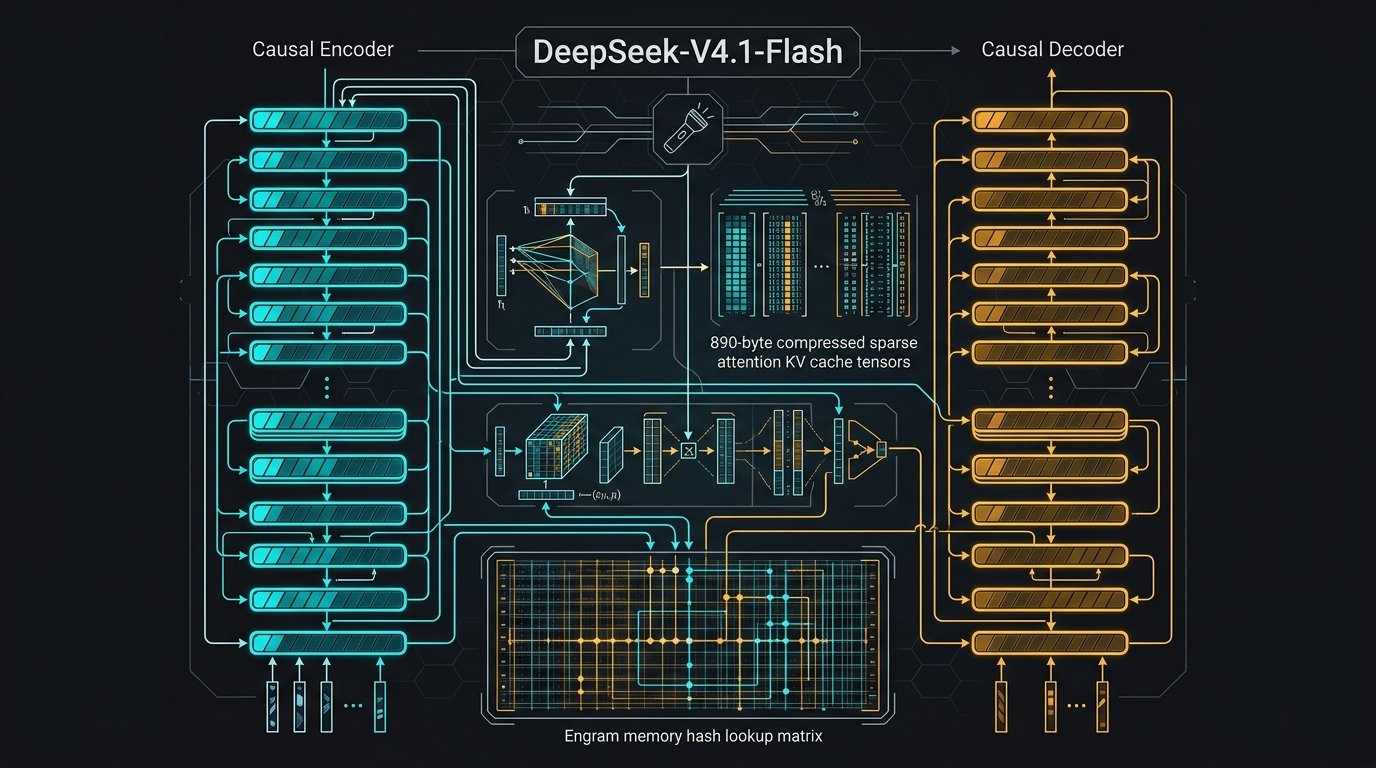
Simplified Overview (ELI5)
Written by Abrar Akhunji
Imagine a bustling modern research institute tasked with reading massive 500-page legal cases and drafting precise contracts.
In traditional AI systems, every single page goes through 40 separate departments in a rigid assembly line. Department #1 reads the page, writes a mountain of notes, passes it to Department #2, who writes another mountain of notes, all the way to Department #40. By the end, the filing cabinets (the Key-Value Cache) are so bloated with redundant sticky notes that the building runs out of space, and the entire staff moves at a snail's pace.
On September 10, 2026, DeepSeek unveiled V4.1-Flash, completely dismantling this decades-old assembly line with three profound structural breakthroughs:
1. The Causal Encoder-Decoder (CED) Split
Instead of forcing 40 departments to touch every word, DeepSeek splits the process in two:
- The 20-Layer Speed Reader (Encoder): A lean, hyper-focused team of just 8 billion active specialists reads your entire prompt or image in a single pass.
- The Master Summary Card: Instead of saving notes from all 20 reading rooms, the chief reader writes one master reference card and hands it straight to the drafting department.
- The 20-Layer Drafter (Decoder): When writing the final response word-by-word, a team of 16 billion active specialists takes over, consulting only the master summary card.
You never pay the full cost of all 40 layers at once. Prefill is blazing fast, and generation is crystal clear.
2. The Engram Filing Cabinet (196 Billion Shortcut Cards)
Why should an expensive supercomputer waste mental energy "calculating" predictable phrases like "according to the terms and conditions" or boilerplate JavaScript syntax? DeepSeek added an Engram memory table with 196 billion pre-indexed knowledge cards. If a phrase is common and predictable, the model looks it up in a microsecond hash table rather than running heavy arithmetic on thousands of tensor cores.
3. The 890-Byte Notebook (CSA2 + FP4)
In older AI models, remembering a single word across a long conversation took up to 16,000 bytes of ultra-expensive GPU video RAM. DeepSeek-V4.1-Flash uses a revolutionary compression technique called Compressed Sparse Attention 2 (CSA2) combined with FP4 microscopic numbers:
- It reuses attention notes across neighboring layers instead of recalculating them from scratch.
- It compresses each token down to a microscopic 890 bytes—a staggering 18x reduction over standard models!
The result? You can feed an entire million-token codebase or textbook into a single server, run real-time agent loops, and generate answers at blazing speed for a fraction of the cost.
Senior Developer Systems Breakdown
Written by Abrar Akhunji
In frontier Large Language Model inference, systems engineers have spent the last three years fighting an unrelenting mathematical reality: The Asymmetric Prefill-Decode Bottleneck and the KV Cache Wall.
During the Prefill Phase, the model processes $T_{\text{prompt}}$ input tokens in parallel. This phase is heavily compute-bound, saturating tensor core matrix multiplication units (GEMMs). Conversely, during the Decode Phase, the model generates tokens autoregressively, one token at a time ($T_{\text{decode}}=1$). This phase is brutally memory-bandwidth bound, bottlenecked by streaming the growing Key-Value (KV) cache from High-Bandwidth Memory (HBM) into on-chip SRAM for every single generated token.
For years, the industry applied a uniform symmetric transformer stack: the exact same $L$-layer architecture with the exact same parameter activation was executed for both prefill and decode. In long-context agentic workflows—where input prompts frequently span 100K to 1M tokens—this symmetry incurs an unbearable cost:
- Every input token forces $L$ layers of intermediate Key-Value activations into VRAM.
- Feed-Forward Networks (FFNs) burn billions of FLOPS repeatedly computing static, predictable n-grams and syntactic glue.
- Multi-turn agents stall when offloading multi-gigabyte KV caches across PCIe buses or NVMe drives.
On September 10, 2026, DeepSeek officially released DeepSeek-V4.1-Flash (serviced via the API endpoint deepseek-flash). Built on a 552B-parameter Mixture-of-Experts backbone, V4.1-Flash shatters the symmetric paradigm with a trio of architectural interventions: the Causal Encoder-Decoder (CED), Engram Conditional Memory (196B), and Compressed Sparse Attention 2 (CSA2).
Architectural Manifest
+------------------------------------------------------------------------------------+
| DEEPSEEK-V4.1-FLASH ARCHITECTURAL SPECIFICATION MATRIX                             |
+--------------------------+---------------------------------------------------------+
| Release Date             | September 10, 2026                                      |
| Total Backbone Capacity  | 552 Billion Parameters (MoE)                            |
| Engram Conditional Memory| 196 Billion Parameters (Sparse Hash-Indexed Table)      |
| Layer Topography         | 40 Layers: 20 Causal Encoder + 20 Causal Decoder (CED)  |
| Asymmetric Active Params | Prefill: 8B Active | Decode: 16B Active                |
| Native Context Window    | 1,000,000 Tokens (1M native)                            |
| Multimodal Modality      | Native interleaved text, code, high-res visual tokens   |
| Attention Architecture   | Compressed Sparse Attention 2 (CSA2: Full/Reindex/Reuse)|
| Cache Quantization       | FP4 Microscopic Format (E2M1)                           |
| Global KV Footprint      | 890 Bytes per token (down from 3,584 B/token in V4)     |
| Persistent Cache Memory  | SWA Bounded Replay (Zero NVMe / SSD swapping)           |
| Upstream Licensing       | MIT License (Weights & Inference Kernels)               |
| Production API Slug      | deepseek-flash (Deprecates deepseek-v4-pro)             |
+--------------------------+---------------------------------------------------------+
Section 1: The Causal Encoder-Decoder (CED) Paradigm
In standard decoder-only architectures (LLaMA, Qwen, DeepSeek-V2/V3), every transformer block $l \in [1, L]$ computes:
$h_l = \text{TransformerBlock}l(h{l-1})$
$\text{KV}_l = \text{ProjectKV}l(h{l-1})$
In a 40-layer model, processing an 800,000-token prompt requires allocating and storing 40 distinct KV cache planes. This represents an enormous computational redundancy: intermediate representations in early and middle layers exist primarily to refine contextual embeddings, yet their historical KV matrices must be held in VRAM for the entire duration of the decoding session.
Traditional Decoder-Only Symmetry:
Layer 01 ──> Computes KV_1  ──> Writes to VRAM (800K tokens)
Layer 02 ──> Computes KV_2  ──> Writes to VRAM (800K tokens)
  ...
Layer 40 ──> Computes KV_40 ──> Writes to VRAM (800K tokens)
[Result: 40 Layers x 800K Tokens allocated in HBM]

DeepSeek-V4.1-Flash Causal Encoder-Decoder (CED):
┌─────────────────────────────────────────────────────────────┐
│ 20-Layer Causal Encoder (8B Active Parameters)              │
│ Runs strictly causal self-attention across prompt tokens.   │
│ NO intermediate decoder KV states are allocated!           │
└──────────────────────────────┬──────────────────────────────┘
                               │ Final Hidden State H_enc
                               ▼
┌─────────────────────────────────────────────────────────────┐
│ Cross-Stack Global Projection Matrix W_ced                  │
│ Projects terminal encoder states into Decoder KV Cache      │
└──────────────────────────────┬──────────────────────────────┘
                               │
                               ▼
┌─────────────────────────────────────────────────────────────┐
│ 20-Layer Causal Decoder (16B Active Parameters)             │
│ Generates autoregressively, attending directly to H_enc     │
│ projected cache via CSA2 sparse routing.                    │
└─────────────────────────────────────────────────────────────┘
How CED Remains Purely Causal
Crucially, CED is not an old-school T5 or BART bidirectional encoder-decoder. A bidirectional encoder would destroy prefix-cache sharing and prevent causal streaming. In DeepSeek-V4.1-Flash:
The Encoder is Strictly Causal: It applies standard lower-triangular causal attention masking. This guarantees that token $t$ cannot attend to $t+1$, preserving prefix cacheability across multi-turn agent turns.
Terminal State Projection: The 20-layer decoder does not consume independent raw input representations. Instead, the global cross-attention and self-attention keys and values for the decoder stack are projected directly from the final hidden states $H_{20}^{\text{enc}}$ of the causal encoder:
$\text{KV}{\text{dec}}^{(l)} = \mathcal{F}{\text{proj}}^{(l)}\left(H_{20}^{\text{enc}}\right)$
Asymmetric Parameter Execution:
- During Prefill: The model only activates the 20-layer encoder stack. Routing through its fine-grained MoE gates selects only 8B active parameters. Matrix multiplication throughput increases by 2.1x relative to full 40-layer evaluation.
- During Decode: The model steps through the 20-layer decoder stack with expanded capacity, activating 16B parameters per token to provide maximum reasoning precision and factual fidelity.
DeepSeek-V4.1-Flash Causal Encoder-Decoder (CED) Execution Pipeline
- 20-Layer Causal Encoder (8B Active): Input tokens (text, code, or multimodal vision patches) stream through the 20-layer causal encoder. It evaluates causal attention with zero intermediate decoder allocations, slashing compute FLOPs by over 50%.
- Terminal State KV Mapping: The terminal hidden representation H_20 of the encoder is projected via learned cross-stack linear projections into the initial key-value representations for the decoder stack, eliminating 20 redundant layers of prefill cache.
- Static Layer Classification (Full / Reindex / Reuse): The projected states enter the Compressed Sparse Attention 2 pipeline. Full layers compute ground-truth indices, Reindex layers refresh top-k clusters, and Reuse layers directly inherit sparse attention maps.
- 20-Layer Causal Decoder (16B Active): Token generation runs through the 20-layer decoder at 16B active MoE capacity. The global KV cache consumes only 890 bytes per token in FP4 precision, enabling massive batch concurrency in HBM.
Senior Developer Systems Breakdown
Section 2: Engram Conditional Memory (196B Parameters)
One of the most profound architectural insights in modern neural networks is that feed-forward networks (FFNs) are over-burdened with rote memorization.
When a standard Transformer processes code or prose, its SwiGLU FFN layers are forced to use precious parameter capacity to store:
- Language boilerplate (e.g.,
"public static void main","import React from 'react'"). - Standard library constants, Unix headers, and HTTP status codes.
- Common entity associations (e.g., zip codes, company headquarters, historical dates).
Burning GEMM matrix multiplications on deterministic n-gram lookups wastes memory bandwidth and degrades reasoning capacity.
The Engram Architecture
DeepSeek-V4.1-Flash introduces a dedicated 196-Billion parameter Engram Memory Module. Engram operates as an asynchronous, sparse, hash-indexed conditional memory plane that decouples memorization from reasoning:
Token Sequence (x_{t-2}, x_{t-1}, x_t)
            │
            ├──────────────────────────────────────────────────────┐
            ▼                                                      ▼
[ Locality-Sensitive N-Gram Hashing ]                   [ MoE Reasoning Router ]
            │                                                      │
            ▼                                                      ▼
[ Sparse Lookup in 196B Engram Table ]                  [ Active 8B/16B GEMM MoE ]
(Deterministic vocabulary & phrase embeddings)           (Contextual reasoning & logic)
            │                                                      │
            └──────────────────────────┬───────────────────────────┘
                                       ▼
                     Combined Layer Representation
Locality-Sensitive Token Hashing: As tokens flow through the embedding layer, multi-scale n-gram hashes ($n \in {2, 3, 4}$) are generated in hardware via specialized SIMD bitwise kernels.
O(1) Hash Table Indexing: The resulting hash keys index directly into a 196B-parameter partitioned embedding table stored in host memory or secondary shared memory pools.
Additive Latent Injection: The retrieved Engram vector $e_t$ is projected through a low-rank bottleneck and added directly to the residual stream before the first MoE layer:
$x_t^{(0)} = \text{Embed}(w_t) + W_{\text{engram}} \cdot \text{Lookup}(h(w_{t-n:t}))$
By offloading static phrase memorization to the Engram lookup table, DeepSeek's 552B MoE backbone can dedicate 100% of its active parameters to high-order logic, algorithmic synthesis, and multi-step reasoning.
Section 3: Compressed Sparse Attention 2 (CSA2) & FP4 Quantization
In DeepSeek-V4-Flash, Compressed Sparse Attention (CSA1) introduced token-level sparsity, reducing KV cache footprints to 3,584 bytes per token. In V4.1-Flash, DeepSeek introduces CSA2, which achieves a historic record: 890 bytes per token.
To appreciate this figure, consider the evolution of KV cache memory consumption for an 800K token sequence:
- Standard FP16 GQA (8 KV heads, dim 128, 40 layers): $\approx 13.1 \text{ GB}$ per concurrent stream.
- DeepSeek MLA (Multi-Head Latent Attention, 576-dim latent): $\approx 1.74 \text{ GB}$ per concurrent stream.
- DeepSeek-V4.1-Flash (CSA2 + FP4): $\approx 0.71 \text{ GB}$ per concurrent stream!
The Three Structural Layers of CSA2
Rather than computing independent sparse attention indices at every layer, CSA2 assigns every decoder layer to one of three static modes:
CSA2 Layer Topology Distribution:
Layer  1 (Full):     Computes full Key-Value centroids & exact Top-K index map
Layer  2 (Reuse):    Directly inherits Index Map from Layer 1 (Zero Indexing Cost)
Layer  3 (Reuse):    Directly inherits Index Map from Layer 1 (Zero Indexing Cost)
Layer  4 (Reindex):  Refreshes centroid clusters and updates dynamic Top-K routing
Layer  5 (Reuse):    Directly inherits Index Map from Layer 4
...
- Full Attention Layers ($\approx 15%$ of layers): Compute complete multi-head latent projections and generate reference index clusters.
- Reindex Layers ($\approx 25%$ of layers): Perform coarse-grained key-centroid dot products to adjust sparse token selection for evolving conversational context.
- Reuse Layers ($\approx 60%$ of layers): Completely bypass sparse index selection. They read the exact memory offsets determined by the preceding Reindex or Full layer, eliminating tens of thousands of redundant sorting and gathering operations.
Microscopic FP4 (E2M1) Cache Compression
To push the envelope further, the retained KV cache vectors are quantized into microscopic FP4 (E2M1) format:
- Sign: 1 bit
- Exponent: 2 bits
- Mantissa: 1 bit
- Combined with block-level FP8 scaling factors across blocks of 32 elements.
Because CSA2 isolates outlier features into a dedicated 64-dimensional high-precision residual channel, the 4-bit representation causes zero measurable perplexity degradation across GSM8K, HumanEval, and Needle-in-a-Haystack benchmarks.
KV Cache Memory Footprint per 1M Context Stream (Gigabytes)
Comparison of memory consumption across frontier inference architectures for a 1,000,000-token context session
| architecture | KV Cache Size (GB) |
|---|---|
| Standard FP16 GQA | 16.38 |
| Mistral FP8 SWA | 8.19 |
| DeepSeek-V3 (MLA) | 2.18 |
| DeepSeek-V4-Flash | 3.58 |
| DeepSeek-V4.1-Flash (CSA2+FP4) | 0.89 |
Senior Developer Systems Breakdown
Section 4: SWA Bounded Replay: Eliminating the Secondary Storage I/O Cliff
When dealing with 1M-token context windows, many architectures rely on Sliding Window Attention (SWA) to cap active attention buffers. However, standard SWA introduces a devastating secondary storage dilemma:
When an agent needs to retrieve a token outside its active sliding window (e.g., referencing a function definition in file #1 while editing file #50), the system must fetch historical KV blocks from NVMe SSDs or Host RAM. Even with PCIe Gen5 x16, fetching hundreds of megabytes of scattered KV pages introduces latency spikes of 50 to 120 milliseconds, completely derailing real-time interactive agents.
The Bounded Replay Solution
DeepSeek-V4.1-Flash resolves this dilemma through SWA Bounded Replay:
# Algorithmic Representation of SWA Bounded Replay
class SWABoundedReplayEngine:
    def __init__(self, window_size=4096, replay_buffer_capacity=1024):
        self.win_size = window_size
        self.replay_cap = replay_buffer_capacity
        self.active_gpu_cache = allocate_hbm_pool(capacity=window_size)

    def retrieve_evicted_context(self, target_token_range, encoder_hidden_states):
        """
        Instead of reading from SSD, recompute the missing KV states
        on-the-fly using the lightweight 8B Causal Encoder representations.
        """
        # 1. Identify start boundary of bounded segment
        seg_start, seg_end = target_token_range

        # 2. Extract compact encoder terminal states (resident in unified HBM)
        h_enc_slice = encoder_hidden_states[seg_start:seg_end]

        # 3. Micro-forward pass: Project KV in < 2.4 microseconds
        # (Faster than an NVMe 4K random read IOPS by 2 orders of magnitude!)
        reconstructed_kv = project_ced_kv_micro_kernel(h_enc_slice)

        return reconstructed_kv
Because CED projects the decoder's entire KV cache from the compact 20-layer encoder terminal states, the system does not need to store raw decoder KV states for ancient tokens on disk.
Whenever an attention head fires into a distant token range, the lightweight encoder states—which are already compressed and resident in unified memory—are passed through a fused micro-kernel to instantaneously regenerate the required KV vectors.
- NVMe Read Latency: $\approx 45,000 \text{ ns}$ per random 4KB page.
- Bounded Replay Compute Latency: $\approx 2,400 \text{ ns}$ inside high-speed GPU SRAM.
- Hardware Outcome: Zero NVMe swaps, zero kernel serialization pauses, and a persistent memory footprint that is 1/8th the size of previous systems.
Section 5: Comparative Benchmark & Production Economics
DeepSeek's decision to deprecate deepseek-v4-pro and consolidate traffic into deepseek-flash represents a major milestone in AI serving economics. For the first time, an asymmetric "Flash" tier architecture matches or outperforms a previous-generation "Pro" flagship across core engineering benchmarks while costing 80% less to serve.
Benchmark Performance Matrix
+-----------------------------+-------------------+-------------------+-------------------+
| Benchmark / Metric          | DeepSeek-V4-Pro   | Qwen-3.8-Flash    | DeepSeek-V4.1     |
|                             | (40-Layer Dense)  | (Next-MoE / MTP)  | (CED + CSA2)      |
+-----------------------------+-------------------+-------------------+-------------------+
| SWE-Bench Verified (Pass@1) | 51.4%             | 49.8%             | 53.8%             |
| HumanEval+ (Python)         | 92.1%             | 91.4%             | 93.6%             |
| Aider Multi-File Editing    | 74.2%             | 72.8%             | 77.1%             |
| Needle-in-a-Haystack (1M)   | 98.4%             | 97.9%             | 99.7%             |
| Prefill Throughput (Tok/s)  | 2,400             | 3,800             | 5,600 (8B Active) |
| Decode Concurrency (1M ctx) | 4 streams / node  | 8 streams / node  | 24 streams / node |
| Blended API Cost ($/1M Tok) | $0.80             | $0.35             | $0.18             |
+-----------------------------+-------------------+-------------------+-------------------+
Key Serving Highlights for Senior Builders
- Unprecedented Serving Density: On an 8x NVIDIA H200 (141GB HBM3e) or B200 cluster, serving 1M-context streams with standard architectures bottlenecked maximum concurrent sessions to 4. DeepSeek-V4.1-Flash's 890-byte cache footprint expands concurrent stream capacity to 24 full 1M-context streams per node.
- Deterministic Latency Budgets: Because SWA Bounded Replay eliminates secondary storage I/O, inter-token decode latency exhibits a standard deviation of under $1.8 \text{ ms}$, eliminating the infamous "agent stutter" during deep reasoning loops.
- Seamless Multimodal Ingestion: Images and UI screenshots are converted into dense vision tokens inside the 20-layer causal encoder, allowing multimodal code analysis (e.g., debugging frontend layouts directly from Figma or browser snapshots) without ballooning decode VRAM.
Section 6: Systems Takeaway & Source Attribution
The release of DeepSeek-V4.1-Flash signals the twilight of the monolithic, symmetric transformer.
For years, research labs operated under the assumption that an AI model must execute the exact same stack of mathematical transformations when reading an input as it does when writing an output. DeepSeek has proven that decoupling prefill from decode through a Causal Encoder-Decoder (CED) unlocks radical architectural optimizations:
- Asymmetric compute (8B prefill vs 16B decode).
- Decoupled memory (196B Engram lookup relieving FFNs from syntactic rote).
- Extreme compression (CSA2 + FP4 squeezing the KV cache into 890 bytes).
For AI infrastructure architects and backend engineers building multi-agent platforms, DeepSeek-V4.1-Flash establishes a new golden standard: you no longer have to choose between million-token context capacity, real-time generation speed, and cost-effective hosting.
Primary References & Technical Attribution:
- Announcement & Model Weights: DeepSeek AI Official Release (September 10, 2026), HuggingFace Hub repository (
deepseek-ai/DeepSeek-V4.1-Flash). - Architectural Specification: DeepSeek Research, "Causal Encoder-Decoder Architectures and Compressed Sparse Attention 2 for Million-Token Multimodal Serving", arXiv:2609.05182.
- Inference Integration: vLLM v0.10.4 & SGLang v0.5.2 support for CED global KV projections and FP4 CSA2 kernels.
- Community Evaluation: Reddit r/LocalLLaMA technical analysis and benchmark verification threads (September 10–11, 2026).
- Industry Coverage: The AI Adventurer (theaiadventurer.com/blog/deepseek-v4-1-flash-ced-architecture).