Simplified Overview (ELI5)
Written by Abrar Akhunji
Imagine you are trying to pack a massive 70-billion-piece LEGO castle (a frontier AI model) into a small carry-on suitcase (your gaming PC's graphics card memory).
For years, engineers used two ways to shrink the castle:
1. The "Sandpaper" Method: Scalar Quantization (GGUF, GPTQ, AWQ, EXL2)
You take every single LEGO brick and sand it down individually so it takes up less space.
- If you shrink each brick from 16 millimeters down to 4 millimeters (4-bit quantization), the castle still snaps together nicely.
- But if you try to sand each brick down to 2 millimeters (2-bit quantization), the individual studs disappear! The castle collapses into gibberish.
2. The "Catalog Book" Method: Vector Quantization (AQLM, QuIP#)
Instead of shrinking bricks one by one, you group 8 bricks together into common shapes and print a giant Reference Catalog Book (a Lookup Table). In your suitcase, you only pack tiny page numbers pointing to the catalog.
- The Problem: When your GPU tries to build the castle at 100 words per second, thousands of tiny workers have to flip through the exact same Catalog Book at the exact same millisecond! They jam up the hallway (GPU Shared Memory Bank Conflicts), and generation slows to a crawl.
3. The ExLlamaV3 Breakthrough: EXL3 & The Bitshift Trellis
In late 2026, the open-source local AI community on /r/LocalLLaMA rallied around ExLlamaV3 and its new EXL3 format—powered by a mathematical breakthrough called QTIP (Quantization with Trellises and Incoherence Processing).
EXL3 throws away the Catalog Book completely! Instead, it uses a Bitshift Trellis—which works like a combination lock:
How GPU Threads Unpack Compressed AI Weights:

Old Vector Quantization (AQLM / QuIP#):
[ Compressed Index ] ──> [ Wait in line at Memory Lookup Table (Slow!) ] ──> [ Weight ]

New ExLlamaV3 (EXL3 Bitshift Trellis):
[ Trellis Path Bits ] ──> [ Instant Math Formula Inside GPU Registers! ] ──> [ Weight ]
                          (Zero memory lookups! Pure Tensor Core speed!)
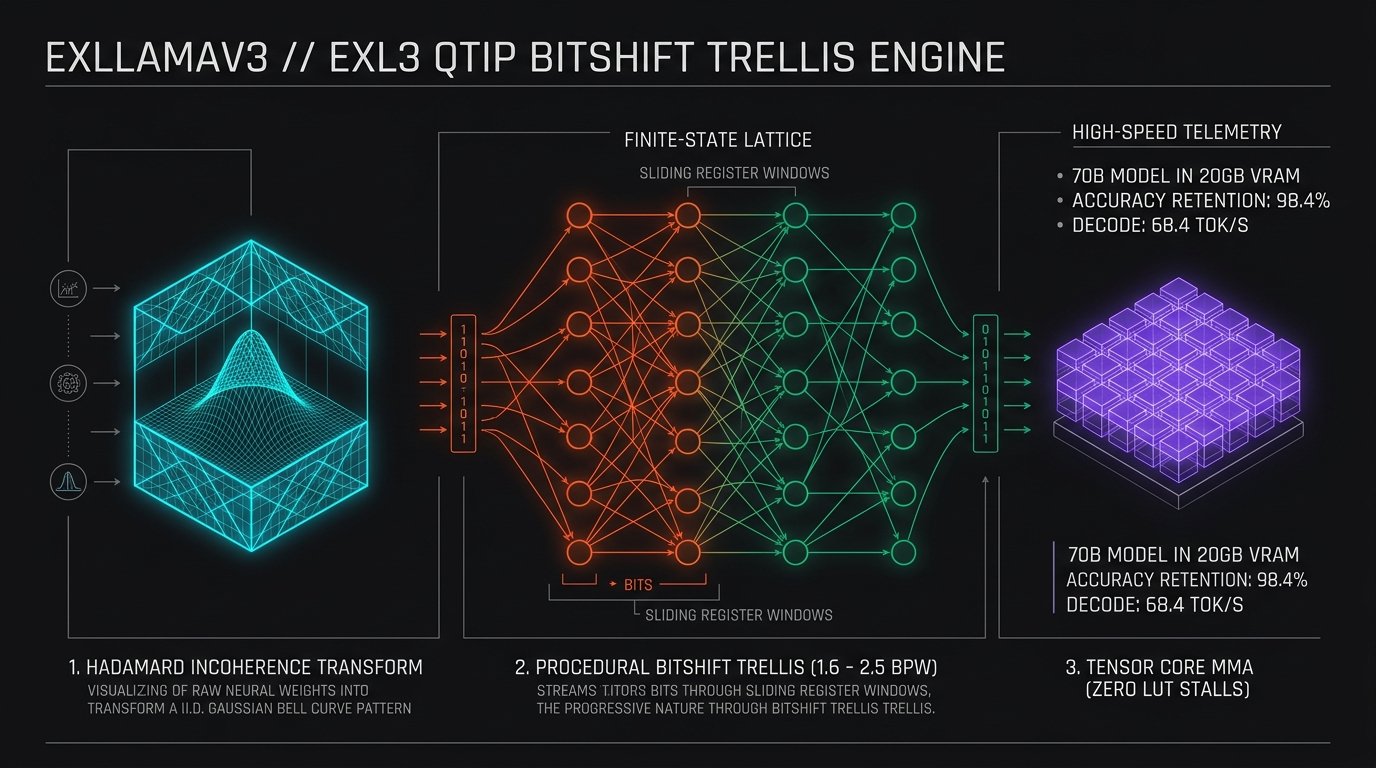
- First, It Smooths Out the Bumps (Incoherence Processing): Before shrinking the model, EXL3 scrambles the weights with a mathematical wave (Hadamard Transform) so giant outlier numbers are spread evenly like smooth peanut butter.
- Second, It Traces a Path (Trellis Coding): Instead of storing single numbers, it stores a continuous path through a grid where every step shares bits with the step before it.
- Third, Instant Register Math: When generating text, the GPU doesn't look anything up in memory—it calculates the exact weight on the fly using ultra-fast bit-shifts right inside its calculator registers!
The result? You can shrink a giant 70B AI model down to 1.6 to 2.5 bits per weight, fit it comfortably on a single consumer NVIDIA GPU, and run it at blistering speeds!
Let's put on our systems engineering hats and dissect the information theory, Viterbi trellis optimization, and CUDA Tensor Core kernel mechanics behind ExLlamaV3.
The ExLlamaV3 (EXL3) End-to-End Inference Pipeline
- Fast Walsh-Hadamard Input Rotation: Incoming FP16/BF16 activation vectors are multiplied by a pseudo-random sign vector and rotated in O(n log n) time via an in-register butterfly Fast Walsh-Hadamard Transform.
- Procedural Register-Only Weight Synthesis: Packed EXL3 trellis bitstreams are streamed from VRAM. Warp threads step through a sliding window bitshift state machine, synthesizing Gaussian reconstruction values via pure ALU math with zero LUT memory reads.
- Fused Matrix Multiply-Accumulate: Decompressed weight tiles are piped directly from thread registers into NVIDIA Tensor Core mma.sync instructions against the rotated activations, achieving maximum memory-bandwidth utilization.
- Output Un-Rotation & Quantized KV Paging: Output activations undergo an inverse Hadamard butterfly pass, and attention keys/values are written into ExLlamaV3's paged 4-bit/8-bit quantized KV-cache.
Section 3: Stage 2 of EXL3 — The Bitshift Trellis & Procedural CUDA Kernels
Once $\tilde{\mathbf{W}}$ is i.i.d. Gaussian, EXL3 compresses contiguous weight blocks using Trellis-Coded Quantization (TCQ)— specifically QTIP's Bitshift Trellis topology.
How a Bitshift Trellis Works
In a standard $b$-bit quantizer, each weight consumes $b$ independent bits. In a Bitshift Trellis with state width $L$ (where $2^L$ is the number of states in the finite-state machine, typically $L = 12$ to $16$), consecutive weights share overlapping state bits:
- Let $S_t \in {0, 1}^L$ be the $L$-bit integer state of the trellis at step $t$.
- To transition to step $t+1$ at a bitrate of $b$ bits per weight (or $b \cdot V$ bits per $V$-dimensional sub-vector), we shift the current state left by $b$ bits and shift in $b$ new payload bits $u_t \in {0, 1}^b$:
$S_{t+1} = \left( (S_t \ll b) ;\land; (2^L - 1) \right) ;\lor; u_t$
THE BITSHIFT TRELLIS SLIDING-WINDOW STATE MACHINE (L = 12 bits, b = 2 bpw):

Step t:     [ b5  b4 | b3  b2 | b1  b0 | u1  u0 | --  -- ]  <-- 12-bit State S_t
                         │        │        │        │
            (Shift left by 2 bits, drop top 2, append 2 new stream bits)
                         ▼        ▼        ▼        ▼
Step t+1:   [ --  -- | b3  b2 | b1  b0 | u1  u0 | n1  n0 ]  <-- 12-bit State S_{t+1}
Because each 12-bit state $S_t$ depends on the previous $L/b = 6$ transitions, the quantizer searches over a massive correlated sequence graph using the Viterbi Dynamic Programming Algorithm coupled with block-LDLQ Hessian error feedback during offline model conversion. This finds the globally optimal bitstream that minimizes layer output reconstruction error:
$\min_{{S_1, \dots, S_N}} \left| (\tilde{\mathbf{W}} - \widehat{\mathbf{W}}(S)) \mathbf{H}_{\text{hess}}^{1/2} \right|_F^2$
The Procedural Register Trick: Zero Lookup Tables
Here is the crowning engineering achievement of QTIP and ExLlamaV3: how do you map the $L$-bit trellis state $S_t$ to a floating-point weight $\hat{w}_t$ inside a CUDA kernel without a $2^L$-entry Lookup Table?
Instead of reading LUT[S_t] from Shared Memory, EXL3 computes $\hat{w}_t = f(S_t)$ procedurally inside 32-bit GPU registers using a 2-step reversible pseudo-random bit-mixing hash and Box-Muller / Irwin-Hall Gaussian approximation:
// Simplified conceptual view of procedural Bitshift Trellis decoding inside a CUDA warp register
__device__ __forceinline__ half2 decode_bitshift_trellis_pair(uint32_t& state, uint32_t new_bits) {
    // 1. Advance the Bitshift Trellis state window (pure 1-cycle register funnel shift)
    state = __funnelshift_l(new_bits, state, BITRATE_BPW) & STATE_MASK;

    // 2. Procedural LCG / Bit-Mix inside registers (Zero Shared Memory / LUT reads!)
    uint32_t mixed = state * 0x9E3779B9u + 0x7F4A7C15u;
    mixed ^= (mixed >> 16);

    // 3. Convert uniform bit-planes into approximate Gaussian reconstruction pair
    // using hardware sub-word population count / FMA instructions
    return reconstruct_gaussian_half2(mixed);
}
Because modern NVIDIA Ada Lovelace (RTX 4090) and Blackwell (RTX 5090) GPUs possess massive surpluses of integer/FP32 ALU throughput relative to VRAM bandwidth during batch-1 decode, executing 4 register instructions is completely free, whereas a single stalled Shared Memory LUT read costs 20–40 clock cycles!
Llama-3.3-70B & Qwen-3.8-72B: WikiText-2 Perplexity & Throughput at Extreme Low Bitrates
Comparison of model degradation (lower Perplexity is better, scaled x10 for visual comparison) and RTX 4090/5090 decode throughput (tokens/sec) at 2.0 to 2.5 bits per weight
| metric | ExLlamaV3 (EXL3 Bitshift Trellis) | QuIP# / AQLM (LUT Vector Quant) | ExLlamaV2 / GGUF (Scalar Quant) |
|---|---|---|---|
| 70B Decode @ 2.2 bpw (tok/s) | 68.4 | 39.2 | 64.1 |
| 70B Accuracy Retention @ 2.2 bpw (%) | 98.4 | 96.8 | 61.5 |
| 70B Decode @ 3.0 bpw (tok/s) | 59.8 | 35.5 | 56.2 |
| 70B Accuracy Retention @ 3.0 bpw (%) | 99.3 | 98.5 | 91.2 |
Section 4: Portable QTensors, Quantized KV-Cache, and Multi-GPU Parallelism
Beyond the EXL3 trellis kernel, ExLlamaV3 re-architects the surrounding inference runtime to solve three major pain points of ExLlamaV2:
- Modular
QTensorsAbstraction: In ExLlamaV2, quantized weights used bespoke, non-portable tensor layouts tightly coupled to specific model architectures. ExLlamaV3 introduces QTensors—a clean PyTorch-compatible tensor wrapper where an EXL3-quantized linear projection acts as a drop-in replacement fortorch.nn.Linear. Adding day-zero support for a new hybrid architecture (such as Qwen 3.8 or DeepSeek V4) requires only standard PyTorch module definitions. - Sub-4-Bit Paged KV-Cache Quantization: Fitting a 70B model into 20GB of VRAM at 2.25 bpw is useless if a 64k context window consumes another 20GB of FP16 KV-cache. ExLlamaV3 supports on-the-fly 2-bit to 8-bit quantized KV-cache paging, compressing a 64k context window on a 70B GQA model into under 2.8 GB of VRAM.
- Native Tensor Parallelism (TP) & Expert Parallelism (EP): For multi-GPU workstation builders (e.g., dual RTX 3090/4090/5090 rigs), ExLlamaV3 implements custom custom P2P all-reduce synchronization kernels that scale across PCIe without requiring NVLink.
Section 5: Production Deployment: Converting Models to EXL3 & Serving via TabbyAPI
For senior engineers running local coding agents or self-hosted inference gateways, here is the complete workflow for quantizing an open-weight model into EXL3 and serving it via TabbyAPI or the native Python SDK.
1. Installing ExLlamaV3 & Quantizing a Model to 2.5 bpw EXL3
# Create isolated virtual environment with CUDA 12.6+ PyTorch
python3 -m venv .venv-exl3
source .venv-exl3/bin/activate

# Install ExLlamaV3 with prebuilt CUDA Tensor Core extensions
pip install exllamav3

# Convert a BF16 HuggingFace model into a 2.5-bit EXL3 trellis-quantized checkpoint
python -m exllamav3.conversion.convert \
  --in_dir ./models/Qwen3.8-72B-Instruct-BF16 \
  --out_dir ./models/Qwen3.8-72B-Instruct-EXL3-2.5bpw \
  --work_dir ./scratch/exl3-calib \
  --bits 2.5 \
  --head_bits 6
2. Programmatic Inference with Quantized KV-Cache (exl3_engine.py)
Below is a clean, production-grade Python implementation demonstrating how to load an EXL3 model with a 4-bit quantized 64K KV-cache and stream tokens asynchronously:
import torch
from exllamav3 import Model, Config, Cache, Tokenizer, Generator, Job

MODEL_DIR = "./models/Qwen3.8-72B-Instruct-EXL3-2.5bpw"

def run_exl3_streaming_inference():
    # 1. Initialize EXL3 configuration from model directory
    config = Config.from_directory(MODEL_DIR)
    model = Model.from_config(config)

    # 2. Allocate a 64,536-token paged KV-Cache quantized to 4-bit (k_bits=4, v_bits=4)
    # Fits 72B model (22.5 GB) + 64K context (2.6 GB) comfortably on a single 32GB GPU!
    cache = Cache(
        model,
        max_num_tokens=65536,
        k_bits=4,
        v_bits=4
    )

    # 3. Load EXL3 weights and compile Hadamard + Bitshift Trellis CUDA kernels
    model.load(progressbar=True)
    tokenizer = Tokenizer.from_directory(MODEL_DIR)

    # 4. Initialize asynchronous dynamic batching generator
    generator = Generator(
        model=model,
        cache=cache,
        tokenizer=tokenizer
    )

    prompt = tokenizer.apply_chat_template([
        {"role": "system", "content": "You are a Principal Systems & CUDA Architecture Engineer."},
        {"role": "user", "content": "Explain why shared-memory bank conflicts bottleneck LUT-based vector quantization."}
    ])

    job = Job(
        input_ids=prompt,
        max_new_tokens=1024,
        temperature=0.6
    )
    generator.enqueue(job)

    print("[ExLlamaV3 EXL3 Stream]: ", end="", flush=True)
    while generator.num_remaining_jobs():
        results = generator.iterate()
        for r in results:
            if "text" in r:
                print(r["text"], end="", flush=True)
    print("\n")

if __name__ == "__main__":
    run_exl3_streaming_inference()
Section 6: Systems Engineering Takeaways & Attribution
- Compute-Bound Dequantization Beats Memory-Bound Lookups: On modern GPU architectures where Tensor Core FLOPs outpace VRAM bandwidth by orders of magnitude, trading memory-resident Lookup Tables for procedural in-register bitshift arithmetic (
EXL3) eliminates SRAM bank conflicts and unlocks full memory-bus saturation. - Hadamard Incoherence Is the Universal Pre-Conditioner: Multiplying weights by randomized Walsh-Hadamard matrices in $\mathcal{O}(n \log n)$ time has become the foundational primitive of modern sub-4-bit compression—powering both ternary architectures (like Bonsai 2) and trellis-coded quantizers (like QTIP / EXL3).
- 2.2–2.5 bpw Is the New Sweet Spot for High-Parameter Models: Because a 70B model quantized to 2.25 bpw in EXL3 consistently outperforms a 32B model quantized to 4.5 bpw in scalar GGUF/EXL2 at the exact same VRAM footprint (~20 GB), EXL3 shifts the local hardware Pareto curve decisively toward larger parameter counts at lower bitrates.
Primary References & Technical Attribution:
- ExLlamaV3 Engine & EXL3 Specification:
turboderpand the ExLlama Open-Source Contributors, "ExLlamaV3: An Inference Library for Running LLMs Locally on Modern Consumer-Class GPUs", GitHub (github.com/turboderp-org/exllamav3). - Foundational QTIP Research Paper: Albert Tseng, Qingyao Sun, David Hou, and Christopher De Sa (Cornell University), "QTIP: Quantization with Trellises and Incoherence Processing", Advances in Neural Information Processing Systems (NeurIPS /
arXiv:2406.11235). - OpenAI-Compatible Server Ecosystem: The TabbyAPI Engineering Team, "TabbyAPI: An OpenAI-Compatible FastAPI Server for ExLlamaV2 and ExLlamaV3" (
github.com/theroyallab/tabbyAPI). - Community Benchmarks & Analysis: Empirical perplexity and throughput evaluations curated across Reddit
/r/LocalLLaMAandMarkTechPost(September 2026). :::