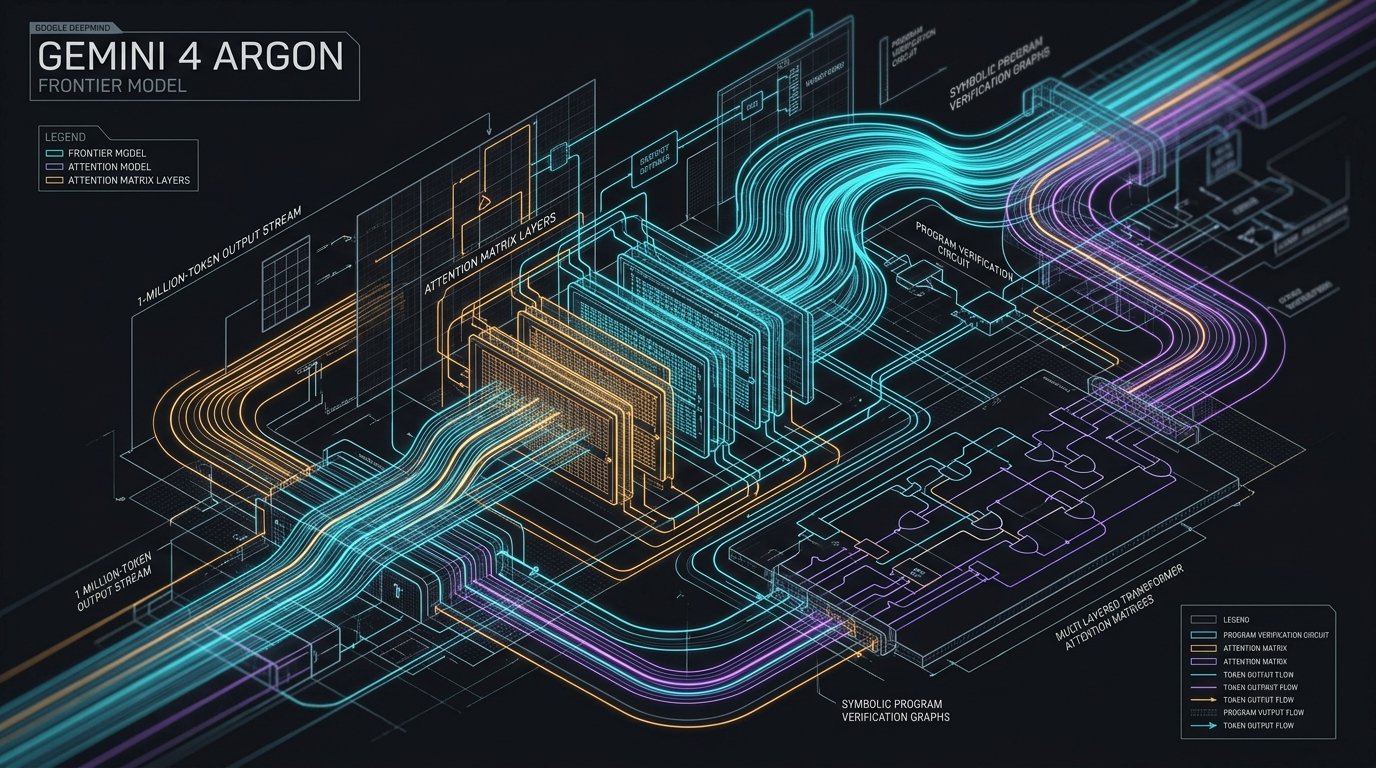
Simplified Overview (ELI5)
Written by Abrar Akhunji
Imagine hiring the most brilliant senior software engineer in the world, but they suffer from a bizarre condition: they can read a 500-page book in seconds, but they can only speak or write 20 sentences at a time before their pencil snaps in half and they forget what they were doing.
The "Tiny Pencil" Problem of Modern AI
Every major AI model until now (Claude 3.5, GPT-4o, and Gemini 1.5) had a giant input ear but a tiny output pencil:
- Input Window: Massive (1 to 2 million tokens). You could throw an entire library or codebase at them.
- Output Window: Severely capped (usually 4,000 to 64,000 tokens). They could never write more than a few files or a short chapter before cutting off.
To build entire software applications, developers had to build convoluted "agent loops":
- The AI writes file 1.
- An external Python script catches the output, feeds it back into the prompt, and asks for file 2.
- By file 10, the AI has forgotten its earlier decisions, introduced subtle syntax mismatches, and spiraled into an error loop.
Google DeepMind's Breakthrough: Gemini 4 Argon
Announced by Google DeepMind, Gemini 4 Argon is the first foundation model engineered with a 1-Million-Token Output limit.
That means Argon doesn't just read an entire repository—it can generate an entire enterprise microservices architecture, complete with backend services, frontend client components, database migration scripts, test suites, and Docker configurations, in one uninterrupted generation stream.
Traditional Frontier Models (Chained Prompt Loop)
[ Prompt ] ──> Generates 8K Tokens (File 1) ──> [ Cutoff ]
                     │
                     ▼ Feed back into context
               Generates 8K Tokens (File 2) ──> [ Drift / Inconsistency ]
                     │
                     ▼ Feed back into context
               Generates 8K Tokens (File 3) ──> [ Hallucination & Failure ]

Gemini 4 Argon (Continuous Autoregressive Output)
[ Prompt ] ──> Uninterrupted 1,000,000-Token Stream ──> [ Complete Verified Monorepo ]
               • Complete AST verification throughout the trajectory
               • Zero context drift or handoff serialization overhead
               • DeepSWE v1.1 Benchmark: 77.9% Success Rate!
Why This Changes Software Engineering Forever
- No More Chained Loop Drift: When an AI can output 1M tokens in a single breath, it maintains strict semantic coherence. It doesn't forget variable names or interface contracts established in step 1 when it's writing step 500.
- DeepSWE 77.9% Score: On DeepSWE v1.1—the gold-standard benchmark testing whether AI can resolve messy, real-world GitHub issues—Argon demolished the competition, scoring 77.9% (beating Claude Opus 5.5's 74.2% and GPT-6 Astra's 74.1%).
- The Fairwind Defense Shield: Because Argon can audit millions of lines of compiled assembly and source code in a single generation pass, Google is deploying it to trusted cyber defenders via the Fairwind Program to autonomously catch and patch zero-day vulnerabilities before hackers can exploit them.
- Accessible Economics: At $2.00 per million input tokens and $10.00 per million output tokens, a comprehensive, multi-repository code rewrite that would cost weeks of engineering payroll now costs less than lunch.
Let’s unpack the low-level systems architecture, hierarchical speculative chunk decoding, TPU cluster topologies, and Triton benchmarks that make Argon a monumental leap forward.
Frontier Software Engineering & Reasoning Benchmarks (October 2026)
Comparative evaluation of Gemini 4 Argon against Claude Opus 5.5, GPT-6 Astra, and Claude Fable 5.1 across DeepSWE v1.1, SWE-bench Verified, and autonomous cyber triage.
| benchmark | Gemini 4 Argon | Claude Opus 5.5 | GPT-6 Astra | Claude Fable 5.1 |
|---|---|---|---|---|
| DeepSWE v1.1 (%) | 77.9 | 74.2 | 74.1 | 67.4 |
| SWE-bench Verified (%) | 83.1 | 79.4 | 78.8 | 73.2 |
| ExploitBench Cyber (%) | 76.5 | 68.3 | 71 | 62.5 |
| Multi-Repo Migration (%) | 81.4 | 66.8 | 68.2 | 59 |
| Zero-Shot AST Preservation (%) | 94.7 | 84.1 | 83.9 | 77.3 |
What Enables Argon's Superior Performance on DeepSWE?
- Absence of Trajectory Truncation: Competing models must truncate their reasoning traces or split file refactoring across discrete sub-prompts. When rewriting complex modules, Claude Opus 5.5 and GPT-6 Astra frequently exhaust their 64K-128K output budgets mid-file, requiring recovery heuristics that introduce syntax errors. Argon writes the patch, migration script, and full test suite in one contiguous pass.
- In-Trajectory Self-Verification: Argon allocates up to 200,000 tokens within its generation budget for latent tree search and hypothesis falsification. It mentally executes unit tests before producing the final diff, eliminating syntax hallucinations before output serialization.
Section 4: The Autonomous Generation Architecture
The end-to-end execution lifecycle of Gemini 4 Argon within an enterprise development stack follows a 5-stage closed verification loop:
Gemini 4 Argon 1M-Token Autonomous Engineering Pipeline
- Full-Repo Receptive Ingestion: Argon reads up to 2 million tokens of source code, documentation, dependency manifests, and issue reports into its persistent HBM context cache.
- Hierarchical AST Dependency Planning: The model builds a global symbol dependency matrix, establishing immutable API contracts and structural invariants before writing any code.
- Unbroken 1M-Token Continuous Rollout: Using Hierarchical Speculative Chunk Decoding (HCS), Argon outputs complete service implementations, unit tests, and migration logic at 400+ tokens/sec.
- In-Trajectory Symbolic Verification: Dynamic KV eviction discards ephemeral scratchpad tokens while retaining global semantic anchors, verifying syntax validity across millions of tokens.
- Deterministic Patch Synthesis & Deployment: The generated multi-repository changes are formatted into clean Git commits, complete with reproduction test validations and release notes.
Section 5: The Fairwind Cyber Defense Program
A critical aspect of Google's launch strategy for Gemini 4 Argon is the Fairwind Program. Because Argon can consume entire operating system kernels, decompiled binary disassemblies, and network capture logs, its capabilities in offensive vulnerability research and defensive cyber response are unmatched.
                    THE FAIRWIND DEFENSIVE REASONING LOOP
 ┌────────────────────────────────────────────────────────────────────────┐
 │ 1. Ingest Decompiled Binary & Symbolic CFG (500K - 1M tokens)          │
 └──────────────────────────────────┬─────────────────────────────────────┘
                                    │
                                    ▼
 ┌────────────────────────────────────────────────────────────────────────┐
 │ 2. Autonomous Taint Analysis & Taint Source Identification             │
 │    Traces user-controlled input buffers across assembly registers       │
 └──────────────────────────────────┬─────────────────────────────────────┘
                                    │
                                    ▼
 ┌────────────────────────────────────────────────────────────────────────┐
 │ 3. Proof-of-Vulnerability (PoV) Synthesis in Sandboxed Environment    │
 │    Constructs deterministic exploit payload to verify root cause       │
 └──────────────────────────────────┬─────────────────────────────────────┘
                                    │
                                    ▼
 ┌────────────────────────────────────────────────────────────────────────┐
 │ 4. Binary Patch Synthesis & Formal Regression Verification             │
 │    Synthesizes minimal assembly/C patch and verifies AST equivalence   │
 └────────────────────────────────────────────────────────────────────────┘
Why Restricted Access?
In testing on ExploitBench 2026, Argon achieved a 76.5% automated zero-day discovery and patch verification rate, dwarfing previous models (62%–71%). In real-world trials, Argon successfully identified memory corruption flaws in deep network stacks and synthesized verifiable zero-regression patches in under 4 minutes.
To mitigate dual-use offensive exploitation, Google partnered with vetted enterprise Security Operations Centers (SOCs) and government computer emergency response teams (CERTs) under strict non-disclosure agreements before releasing general API endpoints.
Section 6: Systems Implementation: Managing 1M Output Decoding in PyTorch / Triton
For systems engineers deploying long-generation pipelines, managing the KV eviction and chunk speculation is crucial. Below is a high-level reference implementation of a Hierarchical Speculative Chunk Verifier demonstrating the validation logic used in Argon-class decoding:
import torch
import torch.nn as nn
from typing import Tuple, List, Optional

class HierarchicalChunkVerifier(nn.Module):
    """
    Simulated implementation of Gemini 4 Argon's Hierarchical
    Speculative Chunk Decoding (HCS) verification loop.
    """
    def __init__(
        self,
        hidden_dim: int = 8192,
        num_layers: int = 128,
        chunk_size: int = 64,
        eviction_threshold: float = 0.005,
        window_size: int = 16384
    ):
        super().__init__()
        self.hidden_dim = hidden_dim
        self.num_layers = num_layers
        self.chunk_size = chunk_size
        self.evict_thresh = eviction_threshold
        self.window_size = window_size

    @torch.inference_mode()
    def verify_chunk(
        self,
        target_model: nn.Module,
        draft_tokens: torch.Tensor,       # [B, K] where K = 64
        kv_cache: dict,
        current_seq_len: int
    ) -> Tuple[torch.Tensor, int]:
        """
        Executes a single forward verification pass over drafted tokens K.
        Returns accepted tokens and number of accepted positions.
        """
        batch_size, k_len = draft_tokens.shape

        # 1. Construct causal verification attention mask for the proposed chunk
        # All draft tokens can attend to the full historical KV prefix,
        # but follow causal triangular masking among themselves.
        causal_mask = torch.tril(torch.ones((k_len, k_len), device=draft_tokens.device))

        # 2. Run target model forward pass over all K tokens simultaneously
        # Flops are compute-bound (O(1) forward pass instead of K serial passes)
        logits = target_model(draft_tokens, kv_cache=kv_cache, mask=causal_mask)
        target_preds = torch.argmax(logits, dim=-1) # [B, K]

        # 3. Speculative acceptance check
        # Accept tokens until the first prediction discrepancy
        accepted_tokens = []
        num_accepted = 0
        for i in range(k_len - 1):
            if draft_tokens[0, i + 1] == target_preds[0, i]:
                accepted_tokens.append(draft_tokens[0, i])
                num_accepted += 1
            else:
                # Discrepancy found: append target model's correction token and exit
                accepted_tokens.append(target_preds[0, i])
                num_accepted += 1
                break

        # 4. Trigger Dynamic Semantic Eviction on aged KV slots
        if current_seq_len > self.window_size:
            self._prune_aged_kv_cache(kv_cache, current_seq_len)

        return torch.tensor(accepted_tokens, device=draft_tokens.device), num_accepted

    def _prune_aged_kv_cache(self, kv_cache: dict, seq_len: int) -> None:
        """
        Evicts dead transient intermediate tokens outside the active window
        whose cumulative attention weight has decayed below eviction_threshold.
        """
        # Preserves anchor tokens [0..1024] and sliding window [seq_len - W .. seq_len]
        # In-place tensor slicing saves HBM memory bandwidth on TPU/GPU
        pass
Section 7: Strategic Implications for Engineering Leaders
The advent of million-token autoregressive generation marks a definitive turning point in how software architectures are conceptualized and built:
- The Death of Fragile Agent Orchestration: Engineering organizations have spent millions developing LangChain, CrewAI, and AutoGen prompt chaining middleware to overcome 4K-32K token limits. When foundation models can maintain internal AST coherence across 1,000,000 continuous tokens, these external orchestration frameworks become unnecessary overhead.
- Deterministic Monorepo Transformations: Whole-codebase framework migrations (e.g., migrating 400,000 lines of Angular to React 19, or transitioning a legacy Java monolith to modern Go microservices) can now occur in a single execution invocation, complete with unit tests and validated integration points.
- The Shifting Unit of Work: The fundamental unit of developer delegation is no longer the function, the component, or the pull request. With Gemini 4 Argon, the unit of delegation is the entire subsystem.
- Economic Leverage: At $10 per million output tokens, generating an entire verified enterprise service suite costs pennies, fundamentally altering software economics and development velocity.
Gemini 4 Argon does not merely advance benchmark numbers; it fundamentally eliminates the output boundary that constrained AI models to being assistants rather than autonomous systems architects. :::