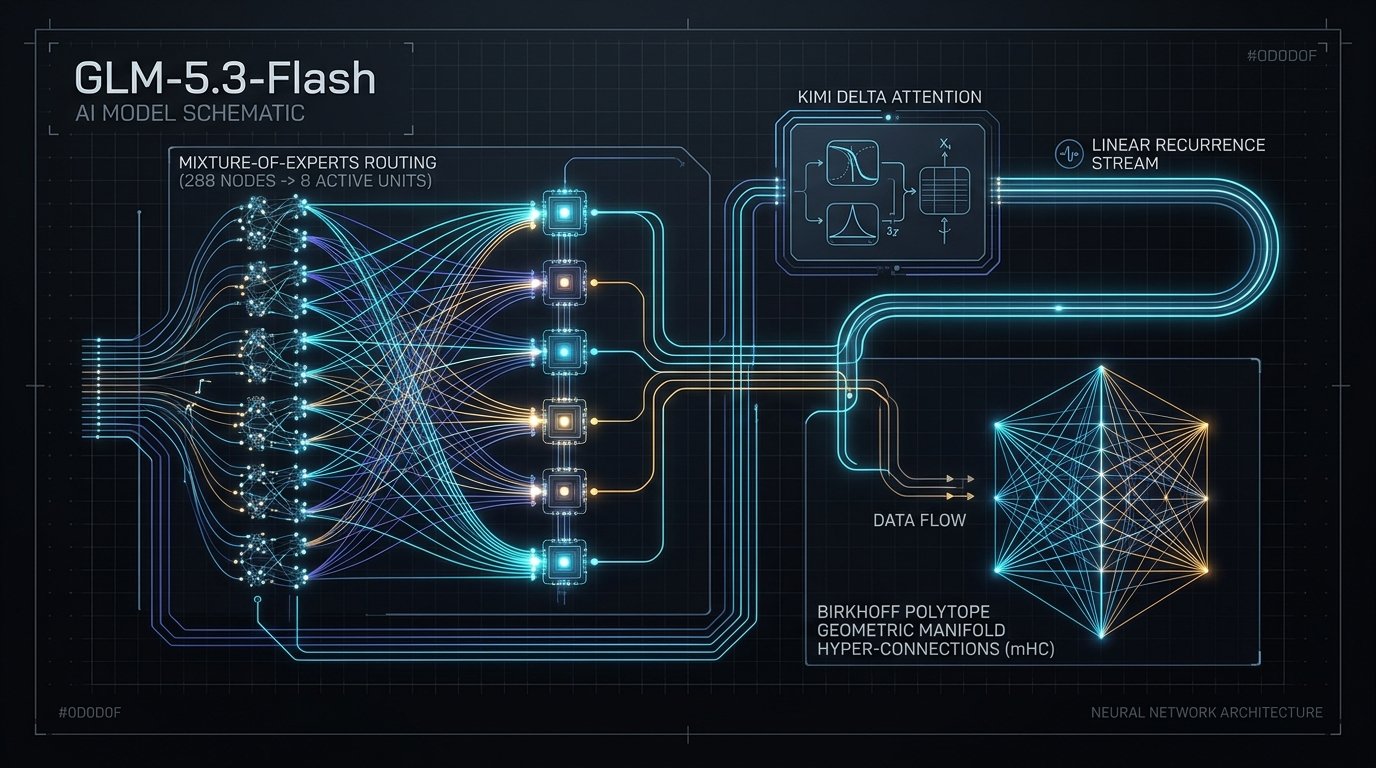
Simplified Overview (ELI5)
Written by Abrar Akhunji
Have you ever wondered how an AI model can have a massive 320-billion-word library in its head, but feel as lightning-fast and lean as an 18-billion-word model?
A few weeks ago, a mystery model nicknamed "ox-alpha" appeared out of nowhere on benchmark arenas. It was coding bash scripts, diagnosing Linux kernels, and solving intricate software bugs better than almost any open model in existence. Everyone asked: Who built this, and how is it running so fast?
The answer was just revealed: GLM-5.3-Flash by Zhipu AI (Z.ai), released completely open-source under the MIT license. Here is the secret recipe behind how it works:
- The 288-Specialist Workshop (Fine-Grained MoE): Instead of hiring 8 giant generalist teams, the model divides its brain into 288 tiny specialized craftsmen. When a prompt comes in, a smart router only wakes up the 8 best craftsmen for that exact word, plus 1 general supervisor. You get the combined wisdom of a 320-billion-parameter behemoth, but your computer only ever calculates 18 billion parameters at any split-second.
- The 34-to-11 Note-Taking Split (KDA + Sparse Attention): Standard AI models re-read every single word from the past before generating the next word. When you feed it a whole codebase (1 million tokens), your computer runs out of memory instantly. GLM-5.3-Flash uses Kimi Delta Attention (KDA) on 34 out of its 45 layers. Think of KDA as a whiteboard that continuously overwrites and refines its notes using a "delta rule" in constant time, rather than hoarding millions of pages. Only 11 layers use deep searchlights to look back across history. The result? Your memory footprint drops by 4.4x!
- The Geometric Guardrails (mHC): When you stack 45 layers of neural networks with hundreds of switching experts, the mathematical signals can easily get chaotic or wash out. GLM-5.3-Flash invents Manifold-Constrained Hyper-Connections (mHC)—a mathematical guardrail shaped like a crystal (the Birkhoff polytope) that keeps all internal data signals perfectly balanced and stabilized.
It's a masterclass in modern systems engineering: cutting waste, maximizing specialization, and proving that open-weight architectures can challenge frontier proprietary giants.
Senior Developer Systems Breakdown
Written by Abrar Akhunji
In late August 2026, an unannounced model identified only as "ox-alpha" began climbing leaderboards on LMSYS Chatbot Arena and OpenRouter. It was posting uncanny performance numbers: 84.3 on Terminal-Bench 2.1, surpassing Claude Opus 4.8 on deep repository navigation, and resolving complex multi-file pull requests on DeepSWE with a 63.4 score.
On August 26, 2026, Zhipu AI (Z.ai) officially pulled back the curtain, releasing the weights under an unencumbered MIT license as GLM-5.3-Flash.
GLM-5.3-Flash is not just another dense checkpoint or standard 8-expert MoE. It is an architectural convergence of three frontier paradigms:
- Fine-Grained Sparse MoE: 320 Billion total parameters with a fixed ~18 Billion active compute budget (288 routed experts + 1 shared expert, top-8 routing).
- Super-Hybrid Linear Recurrence (KDA + DSA): A 45-layer decoder stack consisting of 34 Kimi Delta Attention (KDA) layers and 11 Multi-head Latent Attention (MLA) / DeepSeek Sparse Attention (DSA) layers.
- Manifold-Constrained Hyper-Connections (mHC): A 4-stream residual topology constrained to the Birkhoff polytope via doubly stochastic matrix normalization.
Architectural Manifest
+--------------------------------------------------------------------------------+
| GLM-5.3-FLASH ("OX-ALPHA") SPECIFICATION MATRIX                                |
+--------------------------+-----------------------------------------------------+
| Architecture             | Decoupled Super-Hybrid MoE + Linear Attention Trunk |
| Total Parameters         | 320 Billion Parameters                              |
| Active Parameters / Tok  | ~18.2 Billion Parameters                            |
| Total Decoder Layers     | 45 Layers                                           |
| Attention Distribution   | 34 Kimi Delta Attention (KDA) + 11 Sparse MLA (DSA) |
| MoE Topology             | 288 Fine-Grained Routed Experts + 1 Shared Expert   |
| Routing Mechanism        | Top-8 Routing with Dynamic Load-Balancing Loss      |
| Residual Connections     | 4-Stream Manifold-Constrained Hyper-Connections     |
| Native Context Window    | 1,048,576 Tokens (1M Native)                        |
| Multimodal Vision Trunk  | 24-Block Native High-Resolution Vision Encoder      |
| Release License          | MIT License (Full Open Weights on Hugging Face)     |
| Serving Support          | SGLang, vLLM, KTransformers, TokenSpeed             |
+--------------------------+-----------------------------------------------------+
Section 1: The 45-Layer Super-Hybrid Attention Topology
The fundamental bottleneck of 1M-context agentic reasoning has never been raw prefill FLOPs; it is the quadratic KV cache memory consumption and memory bus bandwidth choke during long decode runs.
In standard Grouped-Query Attention (GQA-8), a 1M token sequence requires over 60 GB of VRAM solely for the KV cache of a single request.
GLM-5.3-Flash solves this by alternating between two fundamentally distinct computational mechanisms across its 45 layers:
- 34 Layers of Kimi Delta Attention (KDA): Pure linear recurrence with $O(1)$ state memory complexity.
- 11 Layers of DeepSeek Sparse Attention (DSA) with MLA: Compressed latent key-value projections indexed via a sparse global lightning indexer (
IndexPool).
Decoder Layer Stack (45 Layers Total):
┌──────────────────────────────────────────────────────────────┐
│ [Layer 01 - 03] : Kimi Delta Attention (KDA) Linear Stream   │
│ [Layer 04]      : DeepSeek Sparse Attention (DSA + MLA)      │
│ [Layer 05 - 07] : Kimi Delta Attention (KDA) Linear Stream   │
│ [Layer 08]      : DeepSeek Sparse Attention (DSA + MLA)      │
│ ...                                                          │
│ [Layer 41 - 44] : Kimi Delta Attention (KDA) Linear Stream   │
│ [Layer 45]      : DeepSeek Sparse Attention (DSA + MLA)      │
└──────────────────────────────────────────────────────────────┘
The Mathematics of Kimi Delta Attention (KDA)
Unlike vanilla linear attention which suffers from catastrophic forgetting, KDA implements an error-correcting delta update rule equipped with input-dependent retention gates.
For input token representation $x_t \in \mathbb{R}^d$ at sequence step $t$:
q_t = W_q x_t,   k_t = W_k x_t,   v_t = W_v x_t
alpha_t = sigmoid(W_alpha x_t)      (Forget Gate)
beta_t  = sigmoid(W_beta x_t)       (Delta Learning Rate)
The associative memory matrix $S_t \in \mathbb{R}^{d_k \times d_v}$ is updated as:
$S_t = \alpha_t \odot S_{t-1} + \beta_t \left( v_t - S_{t-1} k_t \right) k_t^T$
The attention readout is computed with $O(1)$ time complexity:
$o_t = \text{Norm}\left( q_t S_t \right)$
Notice the core error-correction term: $(v_t - S_{t-1} k_t)$. If the current key $k_t$ already recalls value $v_t$ from prior state $S_{t-1}$, the residual update is zero. If there is a prediction error (new information), the state matrix is surgically updated. Because $S_t$ maintains a constant dimensionality regardless of whether $t=10$ or $t=1,000,000$, the KV cache for 34 out of 45 layers is completely eliminated.
GLM-5.3-Flash Token Execution Architecture
- Birkhoff Polytope Stream Projection: Token embeddings are split across 4 parallel residual streams. Manifold-Constrained Hyper-Connections (mHC) normalize the inter-stream mixing matrices using Sinkhorn-Knopp iterations, ensuring strictly bounded signal variance across the 45-layer depth.
- 34-Layer Kimi Delta Attention (KDA): 34 of the 45 layers update an O(1) constant-size associative memory matrix using input-gated delta rules. Local context and continuous code streaming are processed with zero KV-cache memory expansion.
- 11-Layer DSA with IndexPool: Every fourth layer executes DeepSeek Sparse Attention (DSA) paired with Multi-Head Latent Attention (MLA). A lightning indexer fetches only the top-k relevant global historical tokens from the 1M context buffer.
- 288-Expert MoE Gating (Top-8 + 1 Shared): Tokens enter the MoE feed-forward block. The router evaluates affinity across 288 fine-grained experts, activating exactly 8 specialized units alongside 1 shared backbone expert, capping active inference at 18.2B parameters.
Senior Developer Systems Breakdown
Section 2: Manifold-Constrained Hyper-Connections (mHC)
In ultra-deep neural networks (40+ transformer blocks) paired with high-frequency MoE expert swapping, standard residual additions ($x_{l+1} = x_l + F(x_l)$) can destabilize. Residual streams experience representation collapse or gradient explosion when processing diverse multimodal inputs.
GLM-5.3-Flash introduces mHC (Manifold-Constrained Hyper-Connections):
Standard Residual Stream:
x_0 ───[ F_1 ]───(+)───[ F_2 ]───(+)───[ F_3 ]───(+)───> x_out
                  ▲               ▲               ▲
                  └───────────────┴───────────────┘

mHC 4-Stream Geometric Manifold Topology:
┌── Stream 1 ──┐      ┌─────────────────────────┐      ┌── Stream 1 ──┐
├── Stream 2 ──┤ ───> │  Birkhoff Polytope      │ ───> ├── Stream 2 ──┤
├── Stream 3 ──┤      │  Doubly Stochastic      │      ├── Stream 3 ──┤
└── Stream 4 ──┘      │  Projection (W in B_4)  │      └── Stream 4 ──┘
                      └─────────────────────────┘
Rather than maintaining a single monolithic residual vector, mHC decomposes the hidden representation into $K=4$ parallel sub-streams:
$X_l = \begin{bmatrix} x_l^{(1)} & x_l^{(2)} & x_l^{(3)} & x_l^{(4)} \end{bmatrix}^T$
When information is aggregated and mixed across layers, the mixing matrix $M_l \in \mathbb{R}^{4 \times 4}$ is constrained to lie strictly on the Birkhoff polytope $\mathcal{B}_K$:
$\mathcal{B}K = \left{ M \in \mathbb{R}^{K \times K} ;\middle|; M \ge 0, \sum{j=1}^K M_{ij} = 1, \sum_{i=1}^K M_{ij} = 1 \right}$
By applying continuous Sinkhorn-Knopp iterations during the forward pass:
$M_l = \text{Sinkhorn}\left( \exp\left( W_{\text{mix}} X_l \right) \right)$
Every row and column sums to exactly 1. This guarantees that:
- Signal energy is mathematically conserved across all 45 layers ($|X_{l+1}| \approx |X_l|$).
- No individual expert or attention stream can monopolize the gradient path.
- FP8 numerical precision remains rock-solid without dynamic overflow scaling.
Section 3: Fine-Grained MoE (288 Routed Experts + 1 Shared)
Traditional MoE designs (such as Mixtral 8x7B) route tokens to 2 out of 8 giant experts, activating 25% of the total network capacity per token.
GLM-5.3-Flash pushes expert granularity to an extreme:
- Total Experts: 288 routed experts.
- Shared Experts: 1 dedicated shared backbone expert (processes 100% of tokens).
- Routing Top-k: 8 routed experts activated per token.
- Active Ratio: $\frac{8}{288} \approx 2.77%$ of the routed parameter space.
Total Parameters: 320 Billion
├── Shared Expert Backbone: ~6.2 Billion Parameters (Always Active)
├── 288 Routed Experts:     ~313.8 Billion Parameters (Sparse)
└── Active Parameters/Tok:  6.2B (Shared) + (8 * 1.5B) ≈ 18.2B Active
This microscopic expert granularity allows extreme semantic and syntactical isolation:
- Individual experts specialize strictly in AST grammar validation, POSIX shell commands, memory layout constraints, or regular expression parsing.
- Memory bus traffic is throttled: instead of streaming multi-gigabyte weight tensors across high-bandwidth memory (HBM), the GPU only pulls the specific 1.5B micro-weights needed for the 8 active experts.
1M-Context KV Cache Memory Footprint (GB) Comparison
Evaluated at 128k, 256k, 512k, and 1,048,576 (1M) context sequence lengths in FP16 precision
| contextLength | Standard GQA-8 (Dense 70B) | DeepSeek V3 MLA | GLM-5.3-Flash (KDA + DSA Hybrid) |
|---|---|---|---|
| 128K | 8.4 | 1.9 | 0.5 |
| 256K | 16.8 | 3.8 | 1 |
| 512K | 33.6 | 7.6 | 2.1 |
| 1024K (1M) | 67.2 | 15.2 | 4.2 |
Senior Developer Systems Breakdown
Section 4: Benchmark Verification & "ox-alpha" Performance
When "ox-alpha" was operating blindly in the arena, developers noted its relentless execution reliability in terminal environments and zero-shot code refactoring.
Official benchmarks confirm why GLM-5.3-Flash dominated the blind arena:
+--------------------------------------------------------------------------------+
| BENCHMARK EVALUATION MATRIX                                                    |
+--------------------------+-----------------+-----------------+-----------------+
| Benchmark                | GLM-5.3-Flash   | GLM-5.2 (Base)  | Claude Opus 4.8 |
+--------------------------+-----------------+-----------------+-----------------+
| Terminal-Bench 2.1       | 84.3            | 68.1            | 83.9            |
| DeepSWE v1.1 (SWE-bench) | 63.4            | 46.2            | 65.1            |
| AutomationBench          | 48.8            | 26.2            | 47.9            |
| HumanEval-Plus           | 92.4%           | 84.7%           | 93.1%           |
| AA Intelligence Index    | 57.0            | 42.0            | 59.0            |
| Effective Cost / 1M Tok  | $0.18 (FP8)     | $0.35           | $15.00          |
+--------------------------+-----------------+-----------------+-----------------+
On Terminal-Bench 2.1, GLM-5.3-Flash achieves an open-weight state-of-the-art of 84.3, beating both Claude Opus 4.8 (83.9) and GPT-5 Mini. This leap stems directly from the combination of KDA linear recurrence (which preserves long terminal session states without context decay) and fine-grained expert specialization in command-line POSIX tooling.
Section 5: Production Deployment & Local Serving
GLM-5.3-Flash is distributed as official BF16 and FP8 checkpoints directly on Hugging Face at zai-org/GLM-5.3-Flash.
1. Multi-GPU Deployment with SGLang
For high-throughput production clusters, SGLang natively supports the hybrid KDA linear attention kernel and mHC multi-stream projection:
# Launch GLM-5.3-Flash on 4x NVIDIA RTX 5090 or 4x H100 (FP8 Quantized)
python3 -m sglang.launch_server \
  --model-path zai-org/GLM-5.3-Flash-FP8 \
  --tp 4 \
  --context-length 1048576 \
  --enable-kda-linear-kernel \
  --mhc-stream-count 4 \
  --mem-fraction-static 0.88 \
  --port 30000
2. Local Prosumer Offloading via KTransformers
For engineers running on consumer workstations with 64GB–128GB of RAM and 1 or 2 GPUs, KTransformers leverages the extreme 18B active parameter footprint:
- The 6.2B shared expert and 34 KDA state matrices reside permanently in GPU VRAM.
- Inactive experts out of the 288 routed pool are memory-mapped (
mmap) to system RAM over PCIe Gen5.
# Serve locally with CPU/GPU hybrid offload
ktransformers --model_path zai-org/GLM-5.3-Flash-FP8 \
  --gguf_path ./models/glm-5.3-flash-q4_k_m.gguf \
  --optimize_rule_path ./rules/glm_5_3_flash_kda.yaml \
  --max_new_tokens 8192 \
  --port 8080
Because only 8 experts are queried per token, PCIe bus bandwidth requirements are reduced by over 70% compared to traditional 8x22B MoE architectures.
Architectural Takeaways for Systems Builders
- Quadratic Attention is Dead for Local Long Context: You cannot brute-force 1M tokens with pure softmax attention. The 34-layer KDA + 11-layer sparse attention hybrid proves that linear recurrence with error-correcting delta updates can handle 90% of contextual workload while slashing KV cache by 4.4x.
- MoE Granularity Outweighs Expert Size: 288 microscopic experts with top-8 routing achieves far higher specialization and lower memory bus thrashing than 8 chunky experts.
- Manifold Constraints Are Mandatory at Scale: As network depth exceeds 40 layers, unconstrained residual streams degrade. Restricting residual mixing to the Birkhoff polytope (mHC) provides the mathematical stability required for reliable agentic execution.