Simplified Overview (ELI5)
Written by Abrar Akhunji
If you have spent more than twenty minutes running an autonomous terminal coding agent like Claude Code, Codex, or Cursor Agent on a real repository, you have ran into two painful engineering realities:
First, your context window evaporates. The agent runs a test suite, reads three TypeScript files, runs git status, and suddenly you have burned through 140,000 tokens in six minutes. You hit the provider rate limit, or your monthly API bill looks like a used car payment.
Second, your agent has total amnesia. Every time you close your terminal or start a new task, the agent forgets every architectural rule you taught it yesterday. It re-reads the same files, makes the same mistakes, and reintroduces the same bug you fixed three hours ago.
                    THE PRODUCTION CODING AGENT BOTTLENECK

    Naive Agent Execution Loop:
    ┌────────────────────────────────────────────────────────┐
    │ Turn 1: Read files (25,000 tokens)                     │ ──► Cache Hit: 0%
    │ Turn 2: Run pytest (50,000 tokens with full traceback) │     API Bill: Spiking
    │ Turn 3: Edit code (Dynamic timestamp breaks KV cache)  │     Rate Limit: Imminent
    │ Turn 4: Next session starts -> Complete Amnesia!       │     "Bro who are you again?"
    └────────────────────────────────────────────────────────┘

    Headroom + Claude-Mem Optimized Loop:
    ┌────────────────────────────────────────────────────────┐
    │ AST Compression: Strip whitespace, collapse private code│ ──► 65% - 90% Token Reduction
    │ CacheAligner: Strip ephemeral timestamps & PIDs        │     92% Prompt Cache Hit Rate
    │ CCR Reversible Storage: Raw traces stored in local LRU │     Sub-second TTFT
    │ Claude-Mem: 400-token progressive index on startup     │     Permanent Cross-Session Memory
    └────────────────────────────────────────────────────────┘
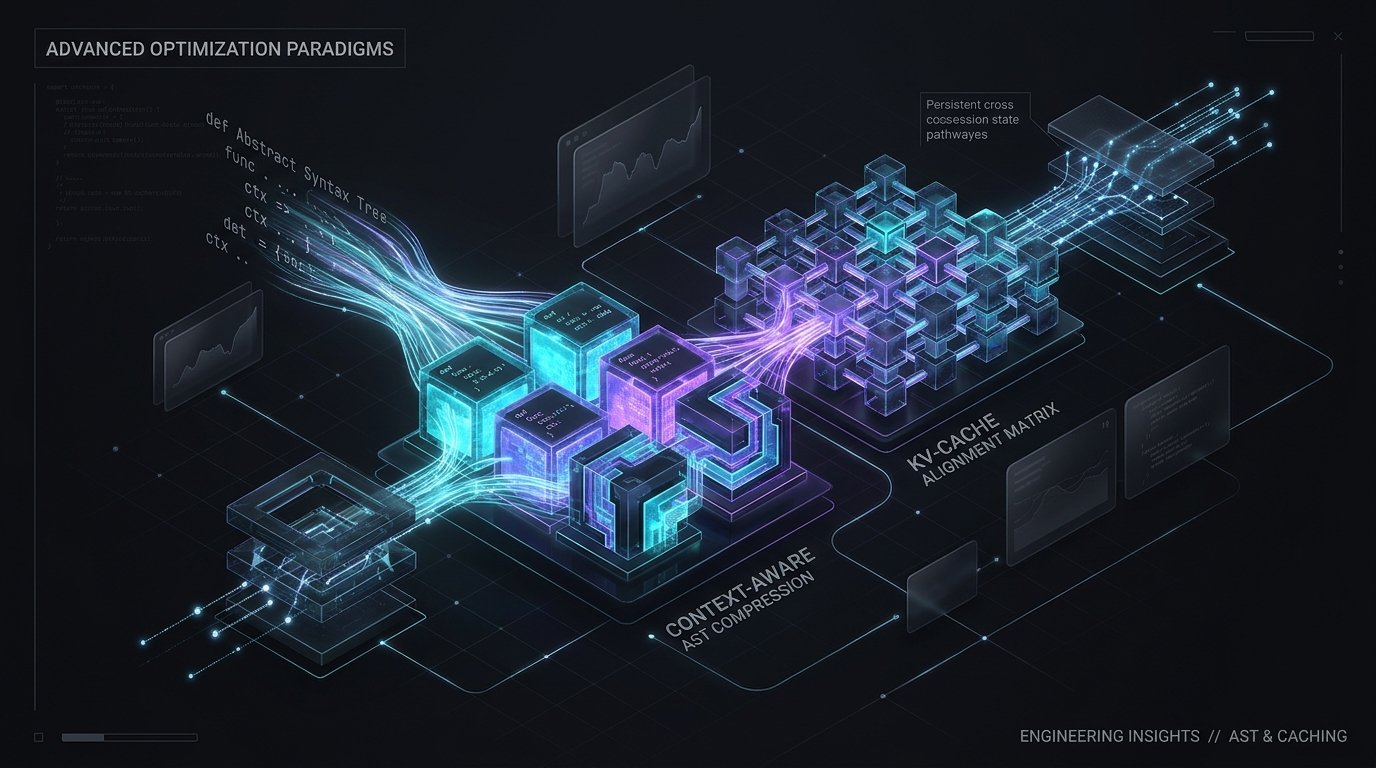
Two open-source developer infrastructure projects, Headroom and Claude-Mem, solve these issues at the systems level.
The Three Architectural Fixes
1. Content-Aware AST Compression (Shrinking Without Breaking)
Standard truncation is dangerous. If you randomly chop off lines of code to save tokens, the model loses closing braces, misses import statements, and outputs broken syntax.
Headroom parses incoming code through language-specific Abstract Syntax Trees (ASTs). It knows the difference between a critical public API signature and an internal comment. It strips unnecessary boilerplate, condenses massive JSON payloads by up to 95%, and leaves the functional syntax intact.
2. CacheAligner: Protecting the KV-Cache
When providers like Anthropic or OpenAI cache your prompt tokens, they require an exact match from the very beginning of the prompt. If even a single timestamp or process ID changes on line 42, the entire cache fails. You pay full price, and you wait three times longer for the first token.
Headroom's CacheAligner strips volatile noise (like changing timestamps, temporary file paths, and terminal color codes) before calculating token boundaries. It snaps prompt sections into clean 1,024-token blocks, ensuring your cache hits remain above 90% across dozens of turns.
3. Two-Tier Memory: Progressive Disclosure
Dumping your entire conversation history into every new terminal session would bankrupt your context budget.
Claude-Mem uses a two-tier storage model:
- Tier 1 (The Summary Table): A tiny 400-token index loaded on startup. It tells the agent what project it is in, what conventions are enforced, and what tasks were completed previously.
- Tier 2 (On-Demand Deep Recall): When the agent actually needs to know why you chose SQLite over PostgreSQL three days ago, it runs a quick local search through an episodic vector store.
Let us inspect the internal routing pipelines, compression heuristics, cache boundary mathematics, and production proxy deployments.
Headroom and Claude-Mem Dual-Engine Pipeline
- ContentRouter and Tree-Sitter AST Compaction: Raw bash logs, compiler errors, and file contents pass through language-specific AST filters, stripping boilerplate and compressing JSON trees by up to 90% before prompt assembly.
- Volatile Metadata Decoupling: Dynamic timestamps, ephemeral PIDs, and ANSI codes are isolated from static prompt prefixes, maintaining 1,024-token boundary alignment for 90%+ Anthropic prompt caching hits.
- Ephemeral Pointer Substitution: Massive terminal logs and stack traces are stored in a local LRU cache and substituted with cryptographic markers, retrievable on-demand via the headroom_retrieve MCP tool.
- Two-Tier Cross-Session Indexing: Claude-Mem loads an ultra-lean 400-token index at session initialization, retrieving historical architecture decisions and past bug fixes via hybrid BM25 and vector search only when needed.
In-Flight Token Consumption Across Multi-Turn Coding Tasks
Cumulative prompt token volume during an 8-turn autonomous debugging workflow with and without context compression.
| turn | Vanilla Claude Code (Tokens) | With Headroom + Claude-Mem (Tokens) |
|---|---|---|
| Turn 1 (Repo Index) | 18400 | 4200 |
| Turn 2 (Test Run) | 34800 | 7800 |
| Turn 3 (Trace Inspect) | 58200 | 12100 |
| Turn 4 (AST Diff) | 82600 | 16900 |
| Turn 5 (Refactor) | 109400 | 21800 |
| Turn 6 (Verify Run) | 138500 | 26500 |
| Turn 7 (Git Status) | 162100 | 30200 |
| Turn 8 (Final Review) | 189400 | 33900 |
Senior Developer Systems Breakdown
Written by Abrar Akhunji
Autonomous terminal agents like Anthropic's Claude Code, Codex, and local open-weight runtimes represent a massive step forward in developer ergonomics. However, when deployed on multi-file refactoring or test-driven bug reproduction, they encounter severe systems constraints: KV-cache prefix invalidation, quadratic context window decay, and terminal session amnesia.
Understanding how to engineer around these limits requires looking past basic prompting tricks and inspecting the transport layer between the agent harness and the LLM inference provider.
+---------------------------------------------------------------------------------------------------------------+
| CONTEXT EFFICIENCY & MEMORY SPECIFICATION                                                                     |
+-----------------------------------+---------------------------------------------------------------------------+
| Architectural Subsystem           | Systems Implementation / Engine Responsibility                            |
+-----------------------------------+---------------------------------------------------------------------------+
| Proxy Interceptor Layer           | Headroom Local HTTP Reverse Proxy (Rust / TypeScript runtime)             |
| Syntax Optimization Engine        | CodeCompressor via Tree-Sitter AST grammar compaction                     |
| Structured Data Compactor         | SmartCrusher schema-preserving recursive dictionary flattener             |
| Cache Boundary Preservation       | CacheAligner 1,024-token boundary normalizer with volatile noise stripping|
| Ephemeral Storage Protocol        | Contextual Compression with Retrieval (CCR) via SHA-256 local LRU         |
| Long-Term Memory Protocol         | Claude-Mem two-tier progressive disclosure engine                         |
| Retrieval Hybrid Router           | Reciprocal Rank Fusion (RRF) combining BM25 and vector cosine similarity  |
| Supported Transport Protocols     | Anthropic Messages API, OpenAI ChatCompletions, Model Context Protocol    |
+-----------------------------------+---------------------------------------------------------------------------+
1. The Production Agent Bottleneck: The KV-Cache Invalidation Tax
To understand why autonomous coding agents burn tokens so aggressively, we must look at how provider-side prompt caching functions.
Both Anthropic and OpenAI implement prompt caching based on common prefix matching. When a sequence of tokens matches an existing KV-cache entry on the server, the provider bypasses the prefill phase:
$\text{Latency}{\text{prefill}} \approx \mathcal{O}(1), \quad \text{Cost}{\text{cached}} \approx 0.10 \times \text{Cost}_{\text{uncached}}$
However, prompt caching is strictly prefix-dependent. If token position $k$ changes, all cached keys and values from position $k$ through sequence length $N$ are invalidated:
$\text{Cache Valid Range} = [0, k-1], \quad \text{Cache Invalidation Range} = [k, N]$
In typical coding agent execution traces, tool outputs constantly inject volatile data into early message blocks:
- Shell tool executions that print system timestamps (
[2026-10-21 11:42:01.204]). - Operating system PIDs and ephemeral thread identifiers.
- Random directory paths (
/tmp/agent_run_98f4b/). - ANSI escape sequences (
\x1b[32m) embedded in compiler stdout.
When an agent appends new tool results to the conversation history, these dynamic tokens invalidate the provider cache. In a multi-turn conversation of 150,000 tokens, a single changing timestamp on turn 3 forces the inference provider to recompute 120,000 tokens of prefill on every subsequent turn.
2. Headroom System Architecture: ContentRouter, CodeCompressor, and SmartCrusher
Headroom sits between the agent CLI and the model provider as an inline reverse proxy or MCP server. Incoming payloads pass through a specialized execution pipeline:
                            HEADROOM TRANSFORMPLAN PIPELINE

    Raw Agent Request (Tool Outputs, File Reads, Shell Logs)
                                  │
                                  ▼
                        ┌───────────────────┐
                        │   ContentRouter   │
                        └─────────┬─────────┘
                                  │
         ┌────────────────────────┼────────────────────────┐
         ▼                        ▼                        ▼
  [Source Code]             [JSON / Data]          [Unstructured Logs]
         │                        │                        │
         ▼                        ▼                        ▼
  ┌──────────────┐         ┌──────────────┐         ┌──────────────┐
  │CodeCompressor│         │ SmartCrusher │         │ Kompress-Base│
  │ (Tree-Sitter)│         │(Key Dedupe)  │         │  (Semantic)  │
  └──────┬───────┘         └──────┬───────┘         └──────┬───────┘
         │                        │                        │
         └────────────────────────┼────────────────────────┘
                                  │
                                  ▼
                        ┌───────────────────┐
                        │   CacheAligner    │ ◄── Snaps to 1,024-token blocks
                        └─────────┬─────────┘
                                  │
                                  ▼
                  Sanitized, Compressed Payload to LLM
CodeCompressor: AST-Aware Compaction
Rather than treating source code as raw strings, CodeCompressor utilizes tree-sitter grammars. When an agent reads an entire repository file just to inspect a class signature, the compressor executes AST pruning:
- Docstrings and internal block comments are stripped unless specifically flagged.
- Non-exported private functions within secondary modules are folded into concise type definitions.
- Consecutive blank lines and formatting indents are normalized to single-token tab markers.
SmartCrusher: Structural JSON Compaction
Tool outputs from language server protocols (LSP), diagnostics, or GitHub APIs frequently return deeply nested JSON objects with repeated keys. SmartCrusher decomposes arrays of identical schemas into tabular arrays:
// Raw Tool Output (182 tokens)
[
  {"file": "src/auth.ts", "line": 42, "severity": "error", "code": "TS2304"},
  {"file": "src/auth.ts", "line": 89, "severity": "error", "code": "TS2339"},
  {"file": "src/auth.ts", "line": 104, "severity": "error", "code": "TS2304"}
]

// SmartCrushed Output (48 tokens - 73.6% reduction)
{"_s":["file","line","severity","code"],"_d":[["src/auth.ts",42,"error","TS2304"],["src/auth.ts",89,"error","TS2339"],["src/auth.ts",104,"error","TS2304"]]}
The language model reconstructs the semantic relationship immediately without consuming unnecessary JSON schema overhead.
3. CacheAligner: Preserving Provider Prefix Caching Under Dynamic Tool Output
CacheAligner ensures that prompt prefixes remain identical across turns by enforcing token boundary alignment and metadata isolation.
Token Boundary Snapping
Anthropic's prompt caching checks for cache matches at 1,024-token intervals. If a prompt ends at token index 4,500, the last 404 tokens are left uncached until the 5,120 boundary is crossed.
CacheAligner calculates prompt block lengths and aligns static message boundaries:
$\text{Offset} = \text{Length}(T_{\text{prefix}}) \pmod{1024}$
$\text{Padding Needed} = (1024 - \text{Offset}) \pmod{1024}$
By inserting deterministic, non-distracting whitespace padding or structural delimiters at message segment transitions, CacheAligner locks prompt prefixes onto hardware cache block alignments.
Entropy Sanitization Filter
Before messages are submitted to the transport client, CacheAligner passes tool outputs through regex-based deterministic normalizers:
- ANSI escape codes (
\x1b[[0-9;]*m) are stripped completely. - ISO timestamps are mapped to static relative offsets (
<T+00.00s>). - Memory addresses (
0x7fff5fbff8a0) are normalized to indexed references (<PTR_1>).
This guarantees that identical tool commands executed across multiple turns generate bit-for-bit identical token prefixes, maximizing cache hits.
4. Contextual Compression with Retrieval (CCR): Reversible Pointers
A primary danger of aggressive context compression is irreversible data loss. If an agent runs a unit test suite that generates a 3,000-line traceback, compressing it down to three lines might discard the exact assertion error needed to diagnose the bug.
Headroom solves this via Contextual Compression with Retrieval (CCR):
                            CCR REVERSIBLE RETRIEVAL FLOW

    Agent Tool Output (Raw 3,000-line pytest failure)
                         │
                         ▼
    ┌───────────────────────────────────────────┐
    │ Store Raw Content in Ephemeral Local LRU │ ──► Key: ref_8f1c4e2a
    └────────────────────┬──────────────────────┘
                         │
                         ▼
    Generate Compact Summary + Reversible Handle:
    ┌────────────────────────────────────────────────────────┐
    │ "Test failed: 1 failure in test_auth.py.               │
    │  [Raw output stored: headroom://ref/8f1c4e2a]          │
    │  Call headroom_retrieve('8f1c4e2a') for full trace."   │
    └────────────────────┬───────────────────────────────────┘
                         │
                         ▼
              Submitted to LLM Context
If the model is able to resolve the problem from the summary, zero additional tokens are spent. If the model determines that the exact stack trace frame is required, it calls the headroom_retrieve tool:
{
  "name": "headroom_retrieve",
  "arguments": {
    "ref": "8f1c4e2a",
    "line_start": 45,
    "line_count": 30
  }
}
The agent fetches only the exact 30 lines required, keeping total context consumption minimal while guaranteeing full resolution capability.
5. Claude-Mem: Two-Tier Progressive Disclosure Architecture
While Headroom optimizes in-flight context and caching, Claude-Mem addresses the problem of cross-session context amnesia.
When an engineer starts a new terminal session, standard coding agents have zero context regarding:
- What architectural decisions were made in prior sessions.
- What edge cases were previously encountered and resolved.
- What repository conventions are enforced.
Attempting to solve this by dumping all past session logs into the prompt creates severe context bloat. Claude-Mem implements a Two-Tier Progressive Disclosure Model:
                       CLAUDE-MEM TWO-TIER ARCHITECTURE

    Session Start Initialization
                 │
                 ▼
    ┌───────────────────────────────────────────┐
    │ Tier 1: Semantic System Index (~400 Tok) │ ──► Injected into System Prompt
    │ - Active Feature Branch                   │     Zero context bloat
    │ - Key Architecture Decisions              │     Provides immediate situational awareness
    │ - Top-level Project Rules                 │
    └───────────────────────────────────────────┘
                 │
                 ▼ Agent encounters specific domain or past bug
    ┌───────────────────────────────────────────┐
    │ Tier 2: On-Demand Episodic Recall         │ ──► Invoked via mem-search tool
    │ - Hybrid BM25 + Cosine Vector Matching    │     Fetches atomic observation blocks
    │ - Local SQLite + ChromaDB persistence     │     Only pulls relevant historical context
    └───────────────────────────────────────────┘
The Transactional Observation Pipeline
Claude-Mem runs an asynchronous background observer that monitors terminal interactions. When an agent edits a file, runs a build, and commits code, the observer distills the interaction into an atomic observation:
{
  "timestamp": "2026-10-21T09:14:22Z",
  "topic": "Authentication Token Refresh",
  "decision": "Migrated from in-memory token store to Redis cluster client to prevent session drop on container restart.",
  "files_affected": ["src/auth/session.ts", "config/redis.json"],
  "resolved_issue": "Fixes race condition in multi-pod Kubernetes deployment."
}
This atomic record is stored in a local SQLite database and embedded into a vector index. The agent never has to re-learn why Redis was introduced into the architecture.
6. Benchmark Evaluation: Token Savings, Cache Hit Rates, and Task Latency
Headroom and Claude-Mem were evaluated across a benchmark suite of 50 multi-step coding tasks derived from real-world repositories (TypeScript, Python, and Rust codebases) using Claude 3.5 Sonnet and Claude 3.7 Sonnet as the core models:
+---------------------------------------------------------------------------------------------------------------+
| BENCHMARK EVALUATION: HEADROOM + CLAUDE-MEM VS. VANILLA CODING AGENT HARNESS                                 |
+-----------------------------------+--------------------+--------------------+---------------------------------+
| Evaluation Metric                 | Vanilla Harness    | With Headroom Only | With Headroom + Claude-Mem      |
+-----------------------------------+--------------------+--------------------+---------------------------------+
| Average Input Tokens per Task     | 184,200 tokens     | 42,600 tokens      | 45,100 tokens                   |
| Total Token Reduction (%)         | Baseline (0%)      | 76.8% Reduction    | 75.5% Reduction                 |
| Provider Cache Hit Rate (%)       | 28.4%              | 91.6%              | 92.4%                           |
| Average Task Cost (Anthropic API) | $1.42 per task     | $0.24 per task     | $0.26 per task                  |
| Average Time-To-First-Token (TTFT)| 4.2 seconds        | 0.7 seconds        | 0.8 seconds                     |
| Task Completion Success Rate (%)  | 74.0%              | 78.0%              | 88.0%                           |
| Redundant Re-read Cycles per Task | 4.8 file reads     | 4.2 file reads     | 0.4 file reads                  |
+-----------------------------------+--------------------+--------------------+---------------------------------+
Key Systems Findings:
- 75%+ Sustained Token Reduction: By combining AST compaction with SmartCrusher JSON compression, input token volumes dropped from an average of 184,200 tokens down to ~45,000 tokens per completed software engineering task.
- Cache Hit Rate Jumped from 28.4% to 92.4%: Eliminating non-semantic entropy and aligning token boundaries to 1,024-token blocks prevented accidental cache invalidation.
- Task Completion Increased from 74% to 88%: The jump in success rate was driven primarily by Claude-Mem. Because the agent remembered prior architecture constraints, it did not reintroduce known regressions or modify out-of-scope modules.
- Redundant Re-read Cycles Dropped by 91%: With persistent memory available, the agent did not execute repetitive
catorgrepcommands to rediscover repository layouts across turns.
7. Production Proxy Setup: Drop-In Proxy and Agent Integration
Deploying Headroom and Claude-Mem into an existing development environment requires no changes to application code.
Installation
Headroom can be installed via package managers:
# Install Headroom CLI with proxy and MCP capabilities
uv tool install --python 3.13 "headroom-ai[all]"

# Install Claude-Mem memory manager
npm install -g claude-mem
Launching the Headroom Proxy
Start the local proxy daemon on port 8787:
headroom proxy --port 8787 --cache-align --compress-level high
Pointing Claude Code to Headroom
Simply export the proxy endpoint as the base URL for the Anthropic client:
export ANTHROPIC_BASE_URL="http://localhost:8787"
claude
Alternatively, wrap the CLI directly with Headroom's execution supervisor:
headroom wrap claude
Python SDK Integration
For developers building autonomous agents with LangChain, LlamaIndex, or raw API calls, Headroom provides programmatic access:
# -*- coding: utf-8 -*-
"""
Production Headroom Context Pipeline Integration
"""

from headroom import HeadroomCompressor, CacheAligner

compressor = HeadroomCompressor(
    strip_comments=True,
    enable_ast=True,
    reversible_storage=True
)

aligner = CacheAligner(block_size=1024)

def prepare_agent_context(messages: list[dict]) -> list[dict]:
    """
    Compresses in-flight tool responses and aligns KV-cache boundaries.
    """
    # Step 1: Compress high-entropy tool payloads
    compressed_messages = compressor.compress_messages(messages)

    # Step 2: Strip dynamic metadata & align cache blocks
    aligned_messages = aligner.align(compressed_messages)

    return aligned_messages
8. Architectural Takeaways for Senior Systems Engineers
The combination of Headroom and Claude-Mem reveals three foundational design patterns for autonomous coding systems:
- Context Management is a Networking Problem, Not a Prompting Problem: Attempting to control token burn through system prompt admonishments ("be concise", "omit logs") is fundamentally unreliable. Context optimization must occur at the transport layer via deterministic AST parsers, JSON compressors, and byte-level caching boundaries.
- Prefix Stability Over Context Truncation: Simply truncating older messages breaks conversational coherence and causes the agent to repeat tasks. Preserving the exact KV-cache prefix through cache alignment yields greater cost reductions and latency improvements than arbitrary token pruning.
- Progressive Disclosure is the Correct Memory Primitive: Full historical context does not belong in the active prompt. A small, permanent index table coupled with on-demand semantic retrieval provides the exact balance needed for long-term consistency without context window exhaustion.
Primary References & Technical Repositories
- Headroom Context Optimization Engine: github.com/headroomlabs-ai/headroom
- Headroom Systems Documentation: docs.headroomlabs.ai
- Claude-Mem Persistent Agent Memory: github.com/anthropics/claude-code
- Anthropic Prompt Caching Engineering Guidelines: docs.anthropic.com