Simplified Overview (ELI5)
Written by Abrar Akhunji
Imagine you hire a brilliant software engineer who has a bizarre medical condition: every time they close their laptop at 5:00 PM, their brain completely resets.
To help them survive on the job, you give them a giant cardboard box where they can toss sticky notes before going home. This cardboard box is how Standard Vector RAG (Retrieval-Augmented Generation) works today.
At first, the box works fine. On Day 2, the engineer searches the box for "database password" and finds the right sticky note.
By Day 60, however, the cardboard box is a disaster:
- Outdated Notes Look Identical to New Notes: There are five sticky notes about the payment API. Four of them describe the old broken API from last month, and only one describes today's migration. Because the old notes use the exact same words, the engineer grabs the wrong ones and breaks production.
- Guesses Mix with Facts: Last Tuesday, the engineer wrote a hunch: "Maybe the bug is in Redis?" Three weeks later, they pull that sticky note out of the box and treat their old guess as a 100% verified fact.
- No Big Picture: To understand how the authentication module works, the engineer has to read 45 scattered sticky notes instead of one clean summary page.
Enter Hindsight: A Structured Brain for AI Agents
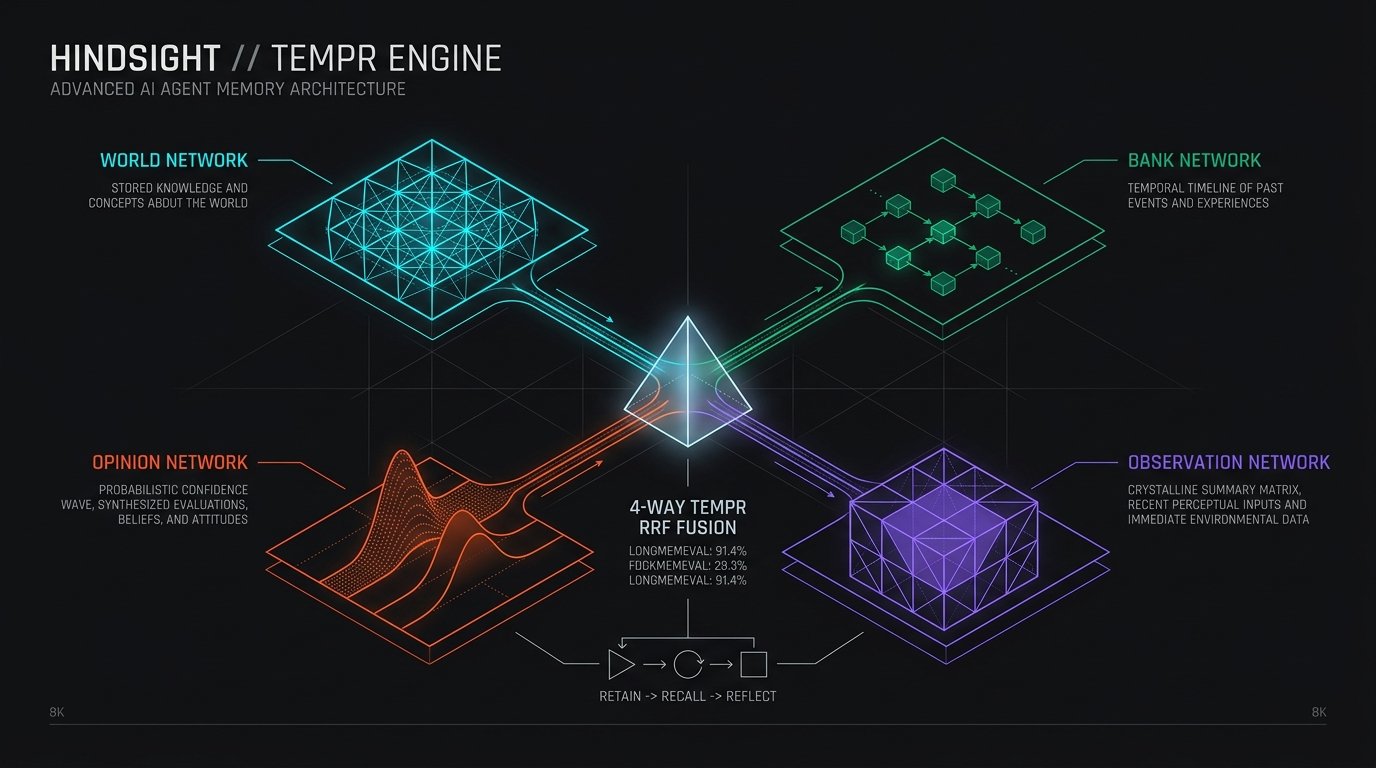
Created by researchers at Vectorize.io, Virginia Tech, and The Washington Post ("Hindsight is 20/20", arXiv:2512.12818), Hindsight replaces the messy cardboard box with Four Specialized Filing Cabinets:
The Hindsight Four-Network Brain:

1. [ WORLD NETWORK ]       ──> Hard, objective facts ("The repo uses PostgreSQL 17")
2. [ BANK NETWORK ]        ──> Personal diary of actions ("I ran pytest at 2pm; 3 tests failed")
3. [ OPINION NETWORK ]     ──> Evolving hunches + confidence % ("85% sure auth leak is in JWT middleware")
4. [ OBSERVATION NETWORK ] ──> Clean entity profiles ("Summary of AuthController.ts architecture")
And instead of just looking for sticky notes that "sound similar," Hindsight uses three brain-like habits:
- Retain: When something happens, it neatly files objective facts, personal actions, and hunches into their separate cabinets with timestamps.
- Recall (via TEMPR): When you ask a question, it searches by meaning, exact code keywords, connected relationships, and time—combining all four using a mathematical ranking tournament.
- Reflect (via CARA): In the background, it pauses to think: "Wait, the test passed after we fixed the connection pool—so my old hunch about Redis was wrong!" It automatically lowers the confidence score on its old hunch and updates its summary sheet.
The result? On LongMemEval (the toughest test for long-term AI memory), Hindsight scores 91.4%, while the old cardboard box (Vector RAG) barely passes half the time!
Let's dive under the hood and inspect the graph schemas, retrieval math, and systems code that make this work.
Hindsight's Three Core Epistemic Operations: Retain, Recall, Reflect
- Structured Epistemic Extraction & Entity Linking: Incoming unstructured text or tool output is parsed into atomic propositions, classified into World, Bank, or Opinion networks, linked to canonical entities in the knowledge graph, and stamped with dual temporal intervals (event time vs. ingestion time).
- 4-Way Parallel Retrieval & Reciprocal Rank Fusion: Queries trigger four simultaneous search streams: Dense Vector Cosine, Sparse BM25 Lexical, Graph Spreading Activation across entity edges, and Temporal Window Filtering. Results are unified via Reciprocal Rank Fusion (RRF) and cross-encoder reranked.
- Evidence-Grounded Belief Synthesis & Consolidation: Triggered asynchronously or on demand, CARA evaluates newly retained experiences against existing Opinion and Observation nodes—resolving contradictions, decaying stale hypotheses, and regenerating clean entity summaries.
- Token-Budgeted Epistemic Prompt Assembly: The agent receives a tightly budgeted, provenance-tagged context payload separating verified World Facts from probabilistic Opinions and synthesized Entity Observations.
Section 3: Inside TEMPR: 4-Way Hybrid Retrieval & Reciprocal Rank Fusion
When an agent invokes recall(query), Hindsight does not rely on a single vector index. Instead, it executes TEMPR (Temporal Entity Memory Priming Retrieval)—a four-pronged parallel search pipeline designed to guarantee high recall across semantic, lexical, relational, and temporal dimensions.
                           ┌─────────────────────────────┐
                           │   Incoming Agent Query q    │
                           └──────────────┬──────────────┘
          ┌───────────────────────┬───────┴───────┬───────────────────────┐
          ▼                       ▼               ▼                       ▼
┌───────────────────┐   ┌───────────────────┐   ┌───────────────────┐   ┌───────────────────┐
│ 1. Dense Semantic │   │ 2. Sparse Lexical │   │ 3. Entity Graph   │   │ 4. Temporal       │
│ HNSW Vector Index │   │ BM25 Inverted Idx │   │ BFS Spreading Act │   │ Interval Parser   │
└─────────┬─────────┘   └─────────┬─────────┘   └─────────┬─────────┘   └─────────┬─────────┘
          │                       │                       │                       │
          └───────────────────────┴───────────┬───────────┴───────────────────────┘
                                              ▼
                               ┌─────────────────────────────┐
                               │ Reciprocal Rank Fusion (RRF)│
                               │  Score(m) = Sum 1/(k + r_i) │
                               └──────────────┬──────────────┘
                                              ▼
                               ┌─────────────────────────────┐
                               │   Cross-Encoder Reranker    │
                               │ + Token Budget Packing      │
                               └─────────────────────────────┘
The Four Parallel Retrieval Streams
- Dense Semantic Vector Search ($R_{\text{vec}}$): Computes cosine similarity between query embedding $\mathbf{e}_q$ and memory node embeddings $\mathbf{e}_m$ to capture conceptual paraphrases.
- Sparse BM25 Lexical Search ($R_{\text{bm25}}$): Executes exact token matching with inverse document frequency weighting—crucial for matching exact function signatures, SHA hashes, error codes, and environment variable names.
- Entity Graph Spreading Activation ($R_{\text{graph}}$): Extracts named entities $E_q = {e_1, e_2, \dots}$ from the query and performs a bounded breadth-first traversal (typically 2 hops) across co-occurrence and causal edges in the knowledge graph. This surfaces multi-hop dependencies (e.g., querying about
CheckoutServiceautomatically primes memories ofStripeWebhookHandlerif they share an outage edge). - Temporal Window Filtering ($R_{\text{temp}}$): Parses explicit and relative temporal constraints (e.g., "after last Tuesday's deployment") into UTC intervals $[t_a, t_b]$ and applies recency decay weighting.
Mathematical Fusion via RRF
Because raw scores from cosine similarity ($[-1, 1]$), unbounded BM25 logits ($[0, \infty)$), and graph activation weights are incommensurable, TEMPR combines the ranked lists $L = {R_{\text{vec}}, R_{\text{bm25}}, R_{\text{graph}}, R_{\text{temp}}}$ using Reciprocal Rank Fusion (RRF):
$\text{RRF_Score}(m) = \sum_{s \in L} \frac{w_s}{k_{\text{rrf}} + \text{rank}_s(m)}$
where $\text{rank}s(m)$ is the 1-based position of memory node $m$ in retrieval stream $s$, $w_s$ is the stream weight, and $k{\text{rrf}} = 60$ is the smoothing constant that dampens outliers from any single modality.
Finally, the top-$N$ candidates from RRF are passed through a lightweight Cross-Encoder Reranker $\Phi_{\text{cross}}(q, m)$ that computes full bidirectional self-attention between the query and candidate memory before packing the results to fit the caller's exact token budget.
Section 4: CARA & Epistemic Belief Dynamics
While TEMPR solves retrieval, CARA (Coherent Adaptive Reasoning Agents) solves belief maintenance during the Reflect operation.
Every agent instance in Hindsight can be configured with a disposition vector $\mathbf{d} = [\sigma_{\text{skepticism}}, \lambda_{\text{literalism}}, \eta_{\text{plasticity}}]$ that governs how the agent updates its $\mathcal{G}{\text{Opinion}}$ network when new experiences arrive in $\mathcal{G}{\text{Bank}}$.
Given an existing belief node $b$ with prior confidence $c_t \in (0, 1)$ and a set of newly retained evidence nodes $E_{\text{new}}$, CARA evaluates the directional support $s(e, b) \in [-1, +1]$ (where $+1$ is direct confirmation and $-1$ is direct refutation) and updates the belief confidence in log-odds space:
$\text{logit}(c_{t+1}) = \gamma^{\Delta t} \cdot \text{logit}(c_t) + \frac{\eta_{\text{plasticity}}}{1 + \sigma_{\text{skepticism}}} \sum_{e \in E_{\text{new}}} w_{\text{source}}(e) \cdot s(e, b)$
where:
- $\gamma \in (0, 1]$ is the temporal decay factor over elapsed time $\Delta t$, ensuring unverified hunches naturally fade if never reinforced.
- $\sigma_{\text{skepticism}}$ acts as an epistemic inertia damper, preventing a single noisy tool failure from overturning a battle-tested architectural invariant.
- $w_{\text{source}}(e)$ weights verified compiler/test output ($\mathcal{G}_{\text{Bank}}$) higher than conversational speculation.
LongMemEval Multi-Session Benchmark: Accuracy by Memory Architecture (%)
Evaluation across single-session recall, multi-session synthesis, temporal reasoning, and knowledge update tasks (arXiv:2512.12818)
| category | Hindsight (TEMPR + CARA) | Temporal KG (Zep / Graphiti) | Fact-Store Memory (Mem0) | Standard Flat Vector RAG |
|---|---|---|---|---|
| Overall LongMemEval | 91.4 | 71.2 | 68.4 | 52.8 |
| Temporal Reasoning | 89.6 | 74.5 | 58.1 | 39.4 |
| Knowledge Updates | 93.2 | 69.8 | 71 | 44.2 |
| Multi-Hop Synthesis | 88.7 | 67.3 | 64.9 | 51 |
Section 5: Production Implementation: Wiring Hindsight into Local Agents & MCP
One of the primary reasons Hindsight gained rapid traction across /r/LocalLLaMA in September 2026 is its zero-friction deployment model: it runs as a self-hosted Docker container or embedded Python server, exposes an OpenAI/Anthropic-compatible SDK, and ships with a native Model Context Protocol (MCP) server out of the box.
1. Self-Hosting Hindsight & Registering with Claude Code / Cursor via MCP
You can spin up the Hindsight engine locally backed by PostgreSQL (pgvector + age graph) and point it to either a cloud model or a local Ollama / MLX / vLLM endpoint:
# Launch self-hosted Hindsight server on port 8888
docker run -d \
  --name hindsight-memory \
  -p 8888:8888 \
  -e HINDSIGHT_LLM_BASE_URL="http://host.docker.internal:8080/v1" \
  -e HINDSIGHT_LLM_MODEL="Qwen3.8-27B-Instruct" \
  -v ~/.hindsight/data:/var/lib/hindsight \
  ghcr.io/vectorize-io/hindsight:latest
Once running, Hindsight exposes a live MCP server at http://localhost:8888/mcp. Add it directly to your claude_desktop_config.json, .cursor/mcp.json, or Hermes agent config:
{
  "mcpServers": {
    "hindsight-epistemic-memory": {
      "url": "http://localhost:8888/mcp",
      "headers": {
        "Authorization": "Bearer local-dev-secret",
        "X-Bank-Id": "abrar-portfolio-architecture"
      }
    }
  }
}
Your coding agent immediately discovers three native MCP tools—retain, recall, and reflect—allowing it to persist architectural decisions and recall historical bug root causes across sessions automatically.
2. Programmatic Integration via Python SDK (hindsight_agent_loop.py)
For custom multi-agent systems, here is a complete production pattern demonstrating how to separate retain, recall, and reflect inside an autonomous engineering agent:
import os
from hindsight_client import Hindsight

# Connect to local or cloud Hindsight instance
memory = Hindsight(
    base_url=os.getenv("HINDSIGHT_URL", "http://localhost:8888"),
    api_key=os.getenv("HINDSIGHT_API_KEY", "local-dev-secret")
)

BANK_ID = "distributed-inference-gateway"

def log_engineering_session():
    # 1. RETAIN: Ingest both objective system facts and episodic debugging logs
    # Hindsight automatically routes these into World, Bank, and Opinion networks
    memory.retain(
        bank_id=BANK_ID,
        content=(
            "Deployed vLLM 0.9.2 on node-gpu-04 with FP8 KV-cache enabled. "
            "Observed P99 TTFT spike to 1,420ms when concurrent batch size exceeds 64. "
            "Initial hypothesis: PCIe Gen4 peer-to-peer contention during tensor parallel all-reduce."
        ),
        context={"session_id": "debug-2026-09-27-a", "env": "staging"}
    )

    # Later session: new empirical evidence refutes the initial hypothesis
    memory.retain(
        bank_id=BANK_ID,
        content=(
            "Ran nsight-systems profile on node-gpu-04. PCIe bus utilization was only 31%. "
            "Root cause confirmed: Python GIL contention in the custom tokenizer pre-processor thread. "
            "Migrated pre-processor to Rust Tokio worker pool; P99 TTFT dropped to 185ms at batch size 128."
        ),
        context={"session_id": "debug-2026-09-27-b", "env": "staging"}
    )

    # 2. REFLECT: Trigger CARA epistemic consolidation
    # Demotes the refuted PCIe hypothesis in the Opinion network and updates the Observation summary
    reflection = memory.reflect(
        bank_id=BANK_ID,
        query="Synthesize our verified root causes and current architectural bottlenecks for P99 TTFT spikes."
    )
    print(f"[CARA Reflection Synthesis]:\n{reflection.text}\n")

    # 3. RECALL: Execute 4-way TEMPR hybrid search (Vector + BM25 + Graph + Temporal)
    recalled_context = memory.recall(
        bank_id=BANK_ID,
        query="What caused the TTFT latency spike on node-gpu-04 and how was it resolved?",
        max_tokens=1200
    )

    for item in recalled_context.memories:
        print(f"[{item.network.upper()} | score={item.score:.3f}] {item.content}")

if __name__ == "__main__":
    log_engineering_session()
Section 6: Systems Engineering Takeaways & Attribution
The transition from naive Vector RAG to epistemic architectures like Hindsight marks a foundational maturity milestone in agentic systems engineering:
- Memory Is an Epistemic Graph, Not a Vector Bucket: Treating objective domain facts, autobiographical tool traces, and speculative working hypotheses as identical float32 vectors guarantees context poisoning over long horizons. Explicit network segregation ($\mathcal{G}{\text{World}}, \mathcal{G}{\text{Bank}}, \mathcal{G}{\text{Opinion}}, \mathcal{G}{\text{Observation}}$) is mandatory for production reliability.
- Multi-Strategy Retrieval Beats Single-Index Scaling: Neither dense embeddings nor graph traversal alone can handle the diversity of developer queries. TEMPR's 4-way parallel execution fused via Reciprocal Rank Fusion ($k=60$) delivers deterministic recall across both conceptual questions and exact symbol lookups.
- Asynchronous Reflection Prevents Context Bloat: By running CARA's
Reflectsynthesis to compress raw episodic traces into preference-neutral entity observations and decay refuted beliefs, agents maintain constant-time $O(1)$ prompt token overhead even across months of continuous operation.
Primary References & Technical Attribution:
- Foundational Research Paper: Chris Latimer, Nicoló Boschi, et al. (Vectorize.io, Virginia Tech, The Washington Post), "Hindsight is 20/20: Building Agent Memory that Retains, Recalls, and Reflects", arXiv preprint (
arXiv:2512.12818). - Open-Source Repository & MCP Server: Vectorize.io Engineering Team, "Hindsight: Agent Memory That Works Like Human Memory", GitHub (
github.com/vectorize-io/hindsight&github.com/vectorize-io/hindsight-cookbook). - Benchmarking Standard: Xiaowu Wu et al., "LongMemEval: Benchmarking Chat Assistants on Long-Term Interactive Memory", ICLR / arXiv benchmark suite.
- Community Orchestration Patterns: Local agentic engineering discussions on Reddit
/r/LocalLLaMA("Hermes + Qwen 3.8-27B + Hindsight MCP: Local Autonomous Coding Stack", September 2026). :::