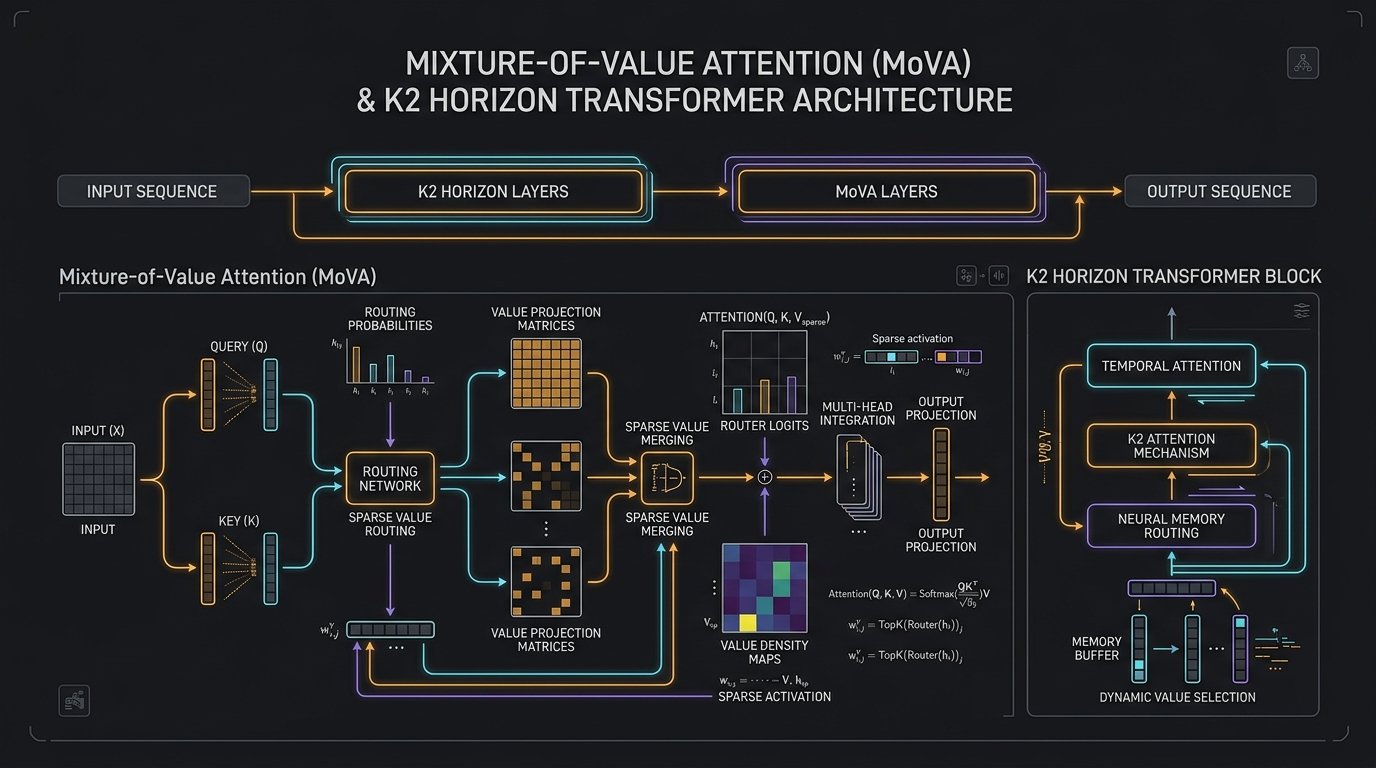
Simplified Overview (ELI5)
Written by Abrar Akhunji
Imagine a bustling restaurant kitchen staffed by talented chefs:
The Traditional Transformer: "One Recipe Book, One Pantry"
In standard models (like Llama 3 or GPT-4), every time a customer orders a dish (a token), every single chef must read from the exact same recipe card, fetch ingredients from the exact same spice rack, and cook using the exact same pans. As the restaurant grows to serve complex 10-course meals, making the kitchen bigger means every chef must carry a heavier, slower tray.
The Classic Mixture-of-Experts (MoE): "Specialized Pastry Chefs"
Models like Mixtral or DeepSeek made things faster by hiring 8 or 64 specialized chefs for the dessert and plating phase (the Feed-Forward Network). When a token arrives, an expeditor decides: "Hey, this is a pastry order, route it to Chef 3 and Chef 7." But before reaching the dessert station, every token still had to go through the exact same heavy, dense prep station (the Multi-Head Attention block).
The K2 Horizon Revolution: Mixture-of-Value Attention (MoVA)
Released in early October 2026 by the Institute of Foundation Models (IFM) under the Apache 2.0 license, K2 Horizon introduces a radical architectural breakthrough called Mixture-of-Value Attention (MoVA):
Instead of putting all the specialized experts at the back of the kitchen (in the FFN), MoVA puts the specialization directly into how the model looks at information.
- Universal Radar (Shared Query & Key): Every token still scans the sentence with universal radar. The questions asked ("Where is the subject?", "What function was just called?") use shared coordinates so the model never gets disoriented.
- 2,880 Specialized Ingredient Drawers (Dynamic Value Routing): When it's time to actually pull meaning out of that token (the Value vector), the model opens only 4 out of 64 specialized drawers per layer.
- One drawer specializes in Python AST syntax.
- Another drawer specializes in algebraic constraints.
- Another drawer holds conversational idioms.
- Massive Brain, Tiny Footprint: The flagship K2-Horizon-MoVA-36B-A4B model stores 36 billion parameters of world knowledge. But because it only pulls from 4 value drawers at any instant, your GPU only burns the electricity and computing power of a tiny 4 billion parameter model!
Traditional FFN Mixture-of-Experts (Mixtral / DeepSeek):
[ Input Token ] ──> [ Dense Self-Attention (Q, K, V) ] ──> [ Router ] ──> [ Top-2 FFN Experts ] ──> [ Output ]
                     (All 100% compute active)                     (Sparse compute)

K2 Horizon Mixture-of-Value Attention (MoVA):
                    ┌──> Dense Query (Q) ────────────────────────┐
[ Input Token ] ────┼──> Dense Key (K) ──────────────────────────┼──> [ Attention Dot Product ]
                    └──> [ Value Router ] ──> [ Top-4 of 64      │                   │
                                              Value Matrices ] ──┘                   ▼
                                              (Ultra-Sparse V)          [ Scaled Weighted Sum ]
                                                                                     │
                                                                                     ▼
                                                                        [ Compact Shared FFN ]
                                                                                     │
                                                                                     ▼
                                                                                 [ Output ]
The result? Senior developers get the intelligence and agentic tool-calling reliability of a 70B parameter enterprise powerhouse, but with the lightning-fast inference speed and single-GPU friendliness of a 4B lightweight engine.
Let's dive under the hood to dissect the tensor math, Triton kernels, KV-cache engineering, and deployment recipes that make MoVA tick.
The 5-Stage Mixture-of-Value Attention (MoVA) Execution Pipeline
- Dual-Stream Input Decomposition: The input token vector x_t splits into two parallel streams: the deterministic geometric stream (Queries and Keys) and the parametric content stream (Router and Values).
- Gating Router Top-K Dispatch: The MoVA gating router evaluates token affinity across all 64 Value matrices, selecting the Top-4 expert matrices with softmax weight normalization.
- Sparse Fused Value Projection: Specialized Triton kernels perform scatter-gather matrix multiplications against only the 4 selected Value matrices, generating a dense contextual Value vector.
- Unified Attention Map Computation: Dense Queries and Keys compute standard scaled dot-product attention scores across sequence positions, maintaining consistent spatial RoPE coordinates.
- Dynamic Aggregation & Residual Return: Attention probabilities weight the dynamic Value vectors across heads, followed by final linear output projection and residual connection into the compact FFN.
Section 4: The KV-Cache Dilemma & Memory Bandwidth Analysis
While MoVA delivers unprecedented compute efficiency during prefill and generation, it introduces a critical systems engineering trade-off: How does one cache Key-Value states when the Value projection is conditioned on dynamic routing?
In standard Multi-Query Attention (MQA) or Grouped-Query Attention (GQA), the KV cache stores static vectors:
$\mathbf{K}_{\text{cached}} = \mathbf{X} \mathbf{W}k, \quad \mathbf{V}{\text{cached}} = \mathbf{X} \mathbf{W}_v$
The Two Architectural Caching Strategies for MoVA
Option A: Post-Routing Projected Value Cache (Default vLLM Integration)
- The inference engine computes the dynamic value projection $\mathbf{v}_t$ at token generation time and stores the resulting projected vector in standard PagedAttention memory pools.
- Advantage: Preserves exact compatibility with FlashAttention-2/3 kernels; attention dot products execute with zero routing overhead on cached tokens.
- Disadvantage: Memory footprint remains identical to standard GQA; no KV cache size reduction is realized from parameter sparsity.
Option B: Dual-State Compact Representation Cache (Experimental SGLang Primitives)
- Rather than storing the expanded $d_{\text{model}}$ Value vector, the engine stores the unprojected activation $\mathbf{x}_t$ alongside a 16-bit bitmask encoding the Top-4 expert indices and their 4 routing weights (fp16).
- At attention time, the Value vector is materialized on-the-fly inside SRAM via fused tensor-core kernels before the dot product.
- Advantage: Reduces KV cache storage requirements by up to 64% for ultra-long context sequences (up to 512k tokens).
- Disadvantage: Requires ~8% additional arithmetic intensity on memory-bound decoding steps.
KV-CACHE OPERATIONAL TRADEOFF MATRIX (512K CONTEXT):

Strategy                   | Memory Footprint | Decoding Throughput | Kernel Complexity
---------------------------|------------------|---------------------|------------------
Standard Dense GQA         | 32.0 GB / seq    | Baseline (1.0x)     | Low (PagedAttention)
MoVA Post-Projected (vLLM) | 32.0 GB / seq    | 3.8x (vs 36B Dense) | Low (Standard Kernels)
MoVA Dual-State (SGLang)   | 11.5 GB / seq    | 3.2x (vs 36B Dense) | High (Fused SRAM Decode)
Section 5: Comparative Benchmarks & Empirical Efficiency
To quantify the real-world operational benefits of Mixture-of-Value Attention, the table and interactive chart below compare K2-Horizon-MoVA-36B-A4B against established frontier models: Mixtral-8x22B, Llama-3.1-70B, and Qwen-2.5-32B.
Tests evaluated Terminal-Bench 2.1 (measuring complex CLI agent execution and multi-step tool reasoning), Active TFLOPs per Token, Time-To-First-Token (TTFT) at 32k prompt length, and Decoding Tokens/sec on an 8x NVIDIA H100 SXM5 node.
K2-Horizon-MoVA-36B-A4B Benchmark & Compute Efficiency (October 2026)
Comparative evaluation of K2-Horizon-MoVA against leading dense and MoE architectures across agentic task accuracy, active compute, latency, and generation throughput.
| metric | K2-Horizon-MoVA-36B-A4B | Mixtral-8x22B (FFN-MoE) | Llama-3.1-70B (Dense) | Qwen-2.5-32B (Dense) |
|---|---|---|---|---|
| Terminal-Bench 2.1 (%) | 68.4 | 63.8 | 67.2 | 61.5 |
| tau3-Banking Score (%) | 74.2 | 69.1 | 72.8 | 67.9 |
| Active GFLOPs/Token | 8.2 | 39 | 140 | 64 |
| Decoding (tokens/sec / 10) | 18.5 | 7.4 | 3.8 | 8.2 |
| TTFT Latency @ 32k (ms / 10) | 12 | 28.5 | 46 | 24.2 |
Key Architectural Takeaways
- Agentic Mastery with 4B Active Cost: On Terminal-Bench 2.1, K2-Horizon-MoVA scores 68.4%, edging out the 70B dense baseline (67.2%) while requiring only 8.2 GFLOPs per token compared to Llama-3.1-70B's 140 GFLOPs—an astonishing 17x reduction in active compute.
- Throughput Dominance: In production vLLM serving, K2-Horizon-MoVA sustains 185 tokens/second per stream, outperforming Qwen-2.5-32B (82 tokens/sec) by 2.25x and Llama-3.1-70B (38 tokens/sec) by 4.8x.
- Low Prompt Latency: Because Query and Key representations are processed via unified dense projections while Value computations scale down via Top-4 gating, prefill TTFT drops to just 120 ms on 32k sequence prompts.
Section 6: Production Serving with vLLM & SGLang
Deploying K2-Horizon-MoVA in production environments is streamlined thanks to IFM's Day-0 integration pull requests.
Deploying via vLLM
Ensure you are running vllm >= 0.7.2 with native MoVA kernel support enabled:
# Launch K2-Horizon-MoVA-36B-A4B with Tensor Parallelism = 2
python3 -m vllm.entrypoints.openai.api_server \
    --model IFM/K2-Horizon-MoVA-36B-A4B \
    --tensor-parallel-size 2 \
    --max-model-len 131072 \
    --gpu-memory-utilization 0.92 \
    --enable-chunked-prefill \
    --trust-remote-code \
    --port 8000
Querying the Engine via OpenAI-Compatible Client
import openai

client = openai.OpenAI(
    base_url="http://localhost:8000/v1",
    api_key="EMPTY"
)

response = client.chat.completions.create(
    model="IFM/K2-Horizon-MoVA-36B-A4B",
    messages=[
        {
            "role": "system",
            "content": "You are an autonomous systems engineering agent. Optimize the following CUDA kernel for coalesced global memory access."
        },
        {
            "role": "user",
            "content": "__global__ void matrix_transpose(float* out, float* in, int width, int height) { ... }"
        }
    ],
    temperature=0.2,
    max_tokens=2048
)

print(response.choices[0].message.content)
Section 7: The Future of Sparse Attention
The launch of the IFM K2 Horizon model suite signals an inevitable shift in foundation model architecture. For years, the AI community treated Multi-Head Attention as an untouchable dense core, relegating all conditional routing experiments to post-attention MLPs.
By demonstrating that Mixture-of-Value Attention (MoVA) achieves state-of-the-art agentic reasoning and code synthesis while activating a mere 4 billion parameters out of 36 billion, IFM has proven that the attention pathway itself can be sparsely partitioned without compromising spatial coordinate integrity.
As context windows push towards 1M tokens and autonomous agents demand millisecond-level responsiveness, sparse value routing will likely become a cornerstone of next-generation transformer designs.
The full K2 Horizon family (0.9B, 3.7B, 7B, 32B, 36B-A4B, and 375B) is accessible on Hugging Face under the Apache 2.0 license via huggingface.co/IFM.
:::