
Simplified Overview (ELI5)
Written by Abrar Akhunji
Have you ever tried to work on a huge project, but your brain just couldn't keep track of all the moving pieces? AI has the exact same problem. When you give it too much information, it forgets things.
On July 16, 2026, Moonshot AI announced Kimi K3, a massive new AI brain that is trying to solve this problem once and for all. It is incredibly powerful and has a perfect memory for enormous amounts of text—what developers call a 1 million token context window. You can literally drop entire books and codebases into it, and it won't lose track of a single detail.
How Big is K3?
To understand how smart Kimi K3 is, you need to look at its size. It has 2.8 trillion parameters. In simple terms, think of parameters as the AI's brain cells. This makes it one of the largest open AI models in the world.
But it doesn't use all its brain cells at once. It uses a clever trick: imagine a giant office building with 896 specialized experts inside. If you ask a question about cooking, only the 16 best chefs wake up to answer. This saves a huge amount of energy while keeping the AI incredibly smart!
Senior Developer Systems Breakdown
Written by Abrar Akhunji
The frontier of open-weight models just shifted dramatically. On July 16, 2026, Moonshot AI launched Kimi K3, a 2.8-trillion-parameter multimodal behemoth engineered for long-horizon coding and end-to-end knowledge work.
While the full weights are scheduled to drop on July 27, 2026, the model is already accessible via the Kimi API and web platform. The technical architecture behind this model introduces some serious structural innovations over its predecessor, K2, resulting in a 2.5× increase in scaling efficiency.
Architectural Breakthroughs
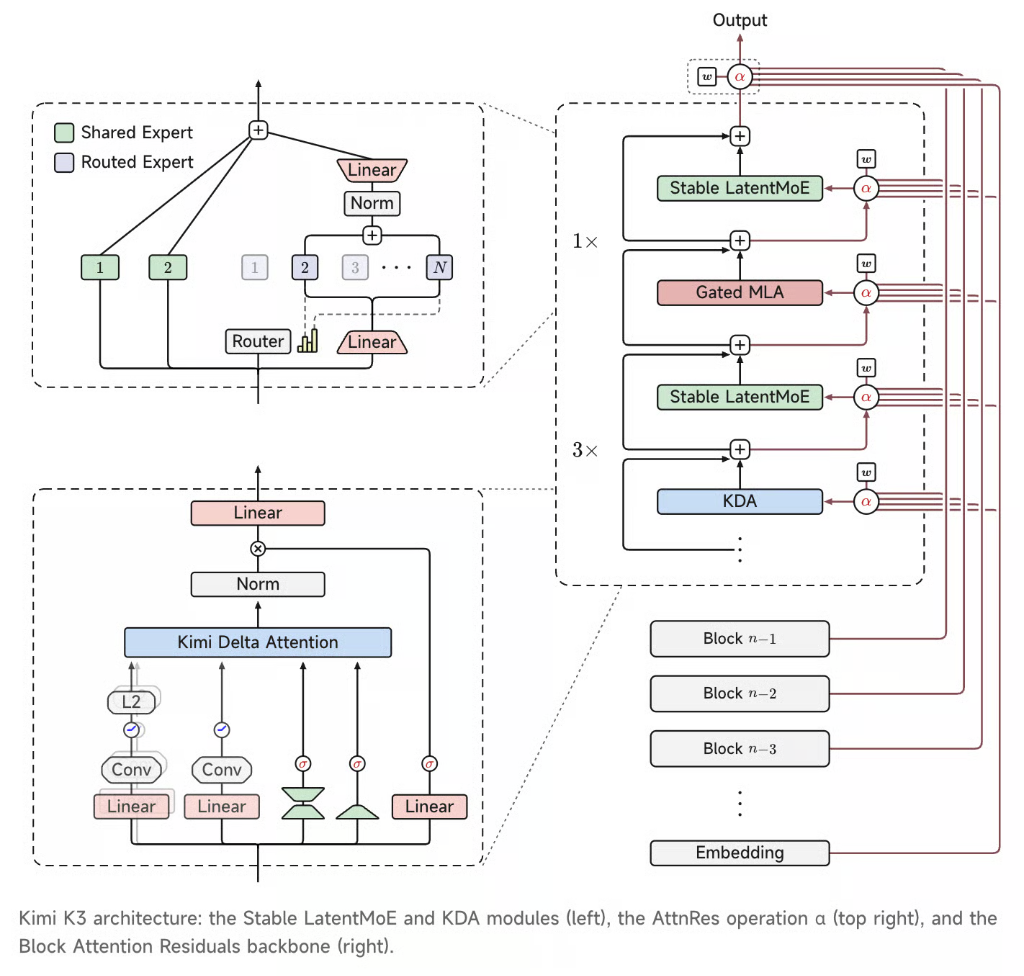
Kimi K3 manages its massive parameter count using a Stable LatentMoE framework. It consists of 896 total experts, activating just 16 per token to balance cutting-edge capability with efficient compute.
But the real magic lies in its attention mechanism:
- Kimi Delta Attention (KDA): KDA is a hybrid linear attention mechanism that extends Gated DeltaNet. By incorporating a finer-grained, channel-wise gating mechanism, it drastically reduces reliance on traditional $O(T^2)$ softmax attention. The result? KV cache usage is slashed by up to 75%, and decoding throughput is significantly boosted.
- Attention Residuals (AttnRes): Acting as a drop-in replacement for standard residual connections, AttnRes selectively retrieves representations across model depth. This provides smoother information flow across K3's deeper layers and longer sequences, delivering approximately 25% higher training efficiency.
These innovations allow Kimi K3 to flawlessly manage its 1-million-token context window while natively supporting vision and "always-on" reasoning (thinking mode).
Let's break down how Moonshot AI is packaging this intelligence into a cohesive ecosystem.
The Kimi Ecosystem
- Kimi K3 API: The foundational 2.8T parameter model. Priced aggressively for developers: $3.00/1M fresh input tokens, $0.30/1M cached input tokens, and $15.00/1M output tokens.
- Kimi Work: An AI desktop agent that operates locally to automate workflows, manage files, and execute multi-agent tasks (coordinating up to 300 agents in parallel).
- Kimi Code: An AI-powered coding agent available as a CLI and IDE extension, engineered to handle multi-file architectural changes, debugging, and project analysis.
Simplified Overview (ELI5)
Coding, Gaming, and Breaking Records
Kimi K3 isn't just good at answering trivia; it's a builder. It is incredibly skilled at writing code.
During a recent showcase, developers demonstrated Kimi K3's game generation abilities. The AI was able to procedurally generate a fully playable, open-world 3D game right in the web browser using technologies like WebGPU. It wrote the code, built the 3D environments, and created the game logic entirely on its own!
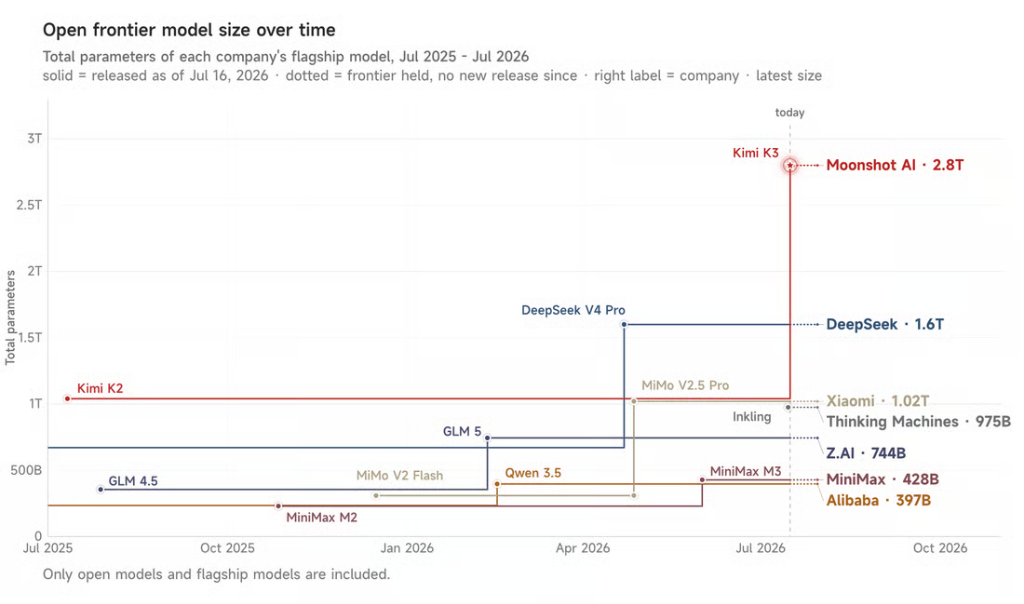
When tested against other top-tier AI models, Kimi K3 proved it belongs in the big leagues. It's competing directly with the absolute best AI models on the market, like Claude Fable 5 and GPT-5.6 Sol, especially when it comes to complex tasks and programming.
Test Your Knowledge!
Let's see if you remember some of the cool tech behind Kimi K3. Click the cards below!
Senior Developer Systems Breakdown
Benchmark Dominance & Market Positioning
Kimi K3 was built to tackle complex, agentic workflows, and the benchmark data reflects this focus. As of mid-July 2026, it is ranked 4th on the Artificial Analysis Intelligence Index, trailing only Claude Fable 5 and two configurations of GPT-5.6 Sol.
Let's look at the numbers:
- GPQA (Diamond): 93.5% (The highest open-weight score published to date).
- Terminal-Bench 2.1: 88.3%
- BrowseComp: 91.2% (for long-context information retrieval).
- FrontierSWE: 81.2% dominance in advanced software engineering.
The model's native multimodal reasoning has also been heavily highlighted through game generation demos. Kimi K3 can procedurally generate playable 3D environments (utilizing Three.js and WebGPU), highlighting its ability to orchestrate complex scene logic and rendering pipelines autonomously.
While Claude Fable 5 may still hold the edge in multi-day autonomous logic, Kimi K3's combination of massive scale, KDA-driven context efficiency, and open-weight status makes it an incredibly disruptive force in the open-source community.
Final Checks
Before you spin up a Kimi Code instance, verify your understanding of the new architecture. Expand the flashcards below.
Simplified Overview (ELI5)
The AI landscape is moving at breakneck speed. With models like Kimi K3 pushing the boundaries of memory and coding, we are getting closer to a world where AI doesn't just assist us, but actively builds the future alongside us.
Senior Developer Systems Breakdown
The release of Kimi K3's weights on July 27 will be a watershed moment for the open-source community. By democratizing access to a 2.8T parameter model with 1M context capabilities, Moonshot AI is setting the stage for a new generation of local agentic applications. The race for frontier intelligence has never been more open.