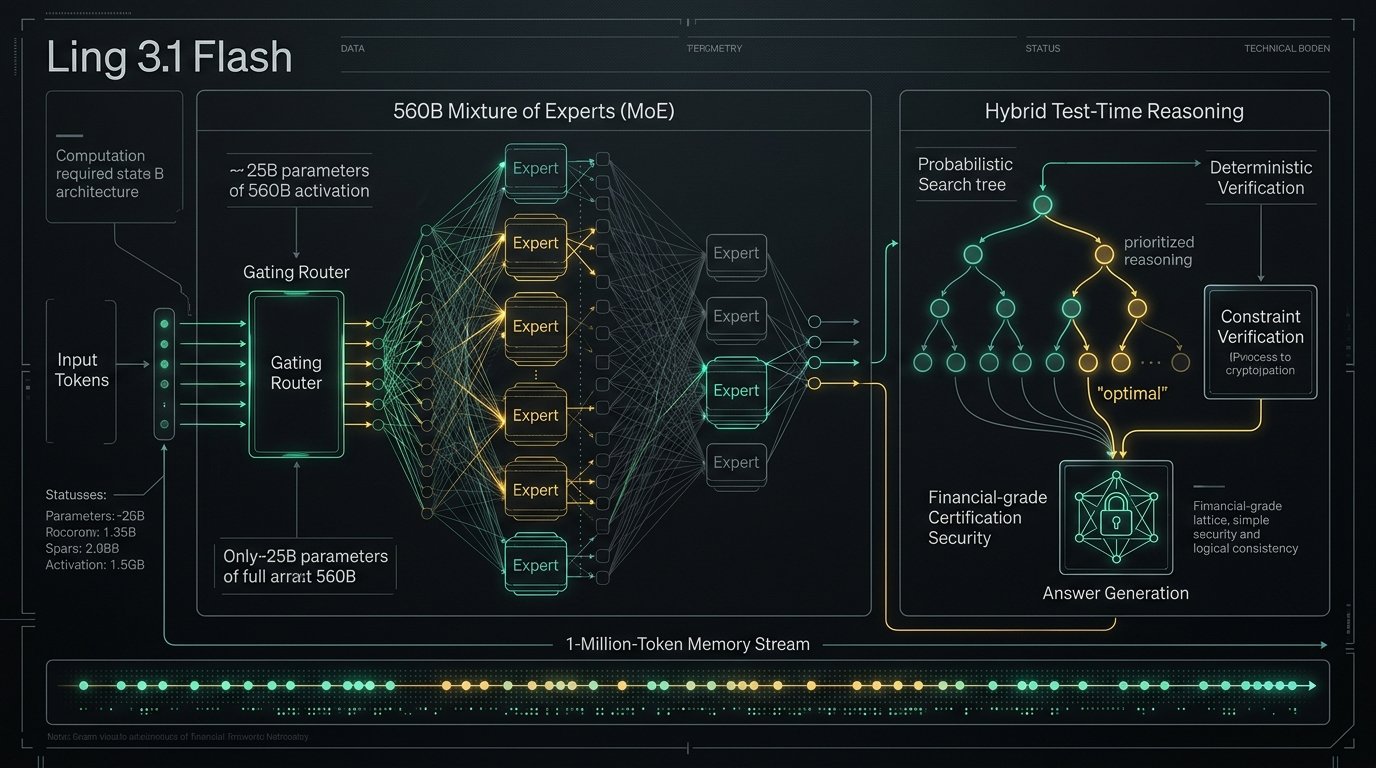
Simplified Overview (ELI5)
Written by Abrar Akhunji
Imagine a global financial headquarters with 560 specialized senior forensic accountants and software architects working in a massive skyscraper.
In most companies, if you ask a question like "Is there a memory leak in this transaction reconciliation loop?", you run into one of two extremes:
- The Overconfident Intern (Standard Fast Models): Responds in 0.2 seconds with complete confidence, but invents a library that doesn't exist and writes SQL that corrupts your production database.
- The 45-Minute Committee (Pure Reasoning Models): Takes 90 seconds to answer simple questions because they draft 4,000 words of internal monologue before telling you that a semicolon was missing.
                         THE REASONING DILEMMA

   Pure Autoregressive Reflex                    Pure Runaway Chain-of-Thought
  ┌──────────────────────────────┐              ┌──────────────────────────────┐
  │ • Fast, low token cost       │              │ • High accuracy on math      │
  │ • Blind next-token guessing  │              │ • Uncontrollable token burn  │
  │ • Hallucinates schema syntax │              │ • 30+ second latency stalls  │
  └──────────────┬───────────────┘              └──────────────┬───────────────┘
                 │                                             │
                 └──────────────────────┬──────────────────────┘
                                        ▼
                      [ Ling 3.1 Flash: Hybrid Governor ]
                      ┌─────────────────────────────────┐
                      │ • 560B Total / 25B Active MoE   │
                      │ • Decoupled Test-Time Search    │
                      │ • Deterministic Constraint Gate │
                      │ • Flash-Speed Token Throughput  │
                      └─────────────────────────────────┘
Now imagine the Ant Group approach:
- When your query arrives, a master router taps only the exact 25 experts who specialize in database locks, concurrency primitives, and distributed ledgers. The other 535 accountants stay silent.
- Before writing a single character of code, an internal Hybrid Reasoning Governor tests multiple execution paths in a private scratchpad, proves that the syntax adheres to strict constraints, and then streams the answer at over 120 tokens per second.
Enter Ling 3.1 Flash
On September 30 and throughout early October 2026, InclusionAI (the AI research arm of fintech titan Ant Group) rolled out Ling 3.1 Flash.
It is engineered for real-world software engineering, cybersecurity, and financial systems where an AI hallucination isn't an annoyance—it's a critical severity incident:
- Total Parameter Footprint: 560 Billion Parameters.
- Active Parameters per Token: Only 25 Billion Parameters (95.5% sparsity).
- Context Window: Up to 1,000,000 tokens (262K in initial API preview).
- Enterprise-Grade Domains: Dominates CyberGym (hunting binary vulnerabilities) and FrontierSWE (complex multi-file code refactoring).
Let's dissect the sparse gating mechanics, the hybrid test-time reasoning search engine, the benchmark metrics, and how senior developers can integrate Ling 3.1 Flash into their production agent harnesses.
Senior Developer Systems Breakdown
Written by Abrar Akhunji
In enterprise software engineering and high-throughput agent harnesses, foundation models face a severe Pareto trade-off between reasoning depth and inference economics. Closed frontier models like Claude 3.5 Sonnet, GPT-5.6 Sol, and Gemini 4 have achieved remarkable coding accuracy, but their dense compute footprint and unpredictable chain-of-thought token expansion make large-scale 24/7 background agents economically prohibitive.
To solve this, InclusionAI—Ant Group’s frontier AI research lab—introduced Ling 3.1 Flash (inclusionai/ling-3.1-flash). Combining a 560-Billion-parameter fine-grained Mixture-of-Experts (MoE) backbone with an explicit Hybrid Test-Time Reasoning Governor, Ling 3.1 Flash delivers near-frontier reasoning scores at Flash-tier token economics and latency.
+---------------------------------------------------------------------------------------------------------+
| FRONTIER AGENTIC FOUNDATION MODEL ARCHITECTURAL MATRIX (OCTOBER 2026)                                   |
+--------------------------+-----------------------+-----------------------+------------------------------+
| Dimension                | DeepSeek-V3 (671B)    | GPT-5.6 Sol (Est.)    | Ling 3.1 Flash (InclusionAI) |
+--------------------------+-----------------------+-----------------------+------------------------------+
| Total Parameters         | 671 Billion           | ~850 Billion (MoE)    | 560 Billion (Sparse MoE)     |
| Active Parameters / Tok  | 37 Billion            | ~48 Billion           | 25 Billion (27B w/ heads)    |
| Sparsity Ratio           | 94.5% Sparse          | 94.3% Sparse          | 95.5% Sparse                 |
| Reasoning Architecture   | Standard CoT / GRPO   | Latent Adaptive Search| Hybrid Test-Time Governor    |
| Native Context Window    | 128,000 Tokens        | 256,000 Tokens        | 1,000,000 Tokens (262K API)  |
| Max Output Generation    | 8,192 Tokens          | 16,384 Tokens         | 32,768 Tokens                |
| Artificial Analysis Index| 39.8                  | 42.4                  | 41.1                         |
| CyberGym Benchmark (Sec) | 71.2%                 | 76.5%                 | 78.4%                        |
| Primary Serving Access   | OpenRouter / SGLang   | OpenAI API / Azure    | OpenRouter, Vercel Gateway   |
+--------------------------+-----------------------+-----------------------+------------------------------+
1. Fine-Grained Sparse MoE: The 560B / 25B Parameter Geometry
At the core of Ling 3.1 Flash is an ultra-granular Mixture-of-Experts routing topology. Rather than partitioning the feed-forward network (FFN) into a few massive experts (e.g. 8 experts with Top-2 routing), InclusionAI engineered an architecture with 256 routed sub-experts and 2 shared persistent experts.
                           [ INPUT TOKEN EMBEDDING x_t ]
                                        │
                                        ▼
                        [ Softmax Top-K Gating Router ]
                                        │
             ┌──────────────────────────┼──────────────────────────┐
             ▼                          ▼                          ▼
     [ Shared Expert 1 ]        [ Shared Expert 2 ]        [ Top-8 Routed Experts ]
     (3.2B Shared FFN)          (3.2B Shared FFN)          (18.6B Active FFNs)
             └──────────────────────────┬──────────────────────────┘
                                        ▼
                         [ Fused Projection & LayerNorm ]
                                        │
                                        ▼
                       Active Compute Footprint: ~25B Params
                       (535B Parameters Remain Idle on Device)
The Gating Formulation
The routing probability for each routed expert $e \in {1, \dots, N}$ is governed by a normalized affinity score with load-balancing auxiliary loss:
$g_e(x) = \text{Softmax}\left(\text{TopK}\left(W_r x + \epsilon, , K=8\right)\right)_e$
Where:
- $W_r \in \mathbb{R}^{256 \times d_{\text{model}}}$ is the router weight matrix.
- $d_{\text{model}} = 7,168$ with 64 attention heads.
- $K = 8$ active routed experts are selected dynamically per token.
- The shared experts are evaluated unconditionally for every token, capturing general linguistic invariants, syntactic rules, and POSIX shell idioms without consuming router capacity.
This fine granularity minimizes expert co-activation interference and drives memory bandwidth efficiency during single-batch decoding.
2. The Hybrid Test-Time Reasoning Governor
The most significant technical contribution of Ling 3.1 Flash is its Hybrid Reasoning Governor.
In conventional reasoning models (such as OpenAI o1 or DeepSeek-R1), the model generates free-form text reasoning tokens in the same autoregressive space as the final output. This introduces two failure modes:
- Unbounded Latency Drifts: The model may generate 8,000 reasoning tokens to verify a simple regex expression, stalling interactive IDE pair-programming.
- Context Blowout: In multi-turn agent loops, accumulated reasoning tokens exhaust the sliding context window.
       CONVENTIONAL CoT:
       [ Prompt ] ──► [ Unbounded Thinking Tokens (1K - 12K) ] ──► [ Output ]

       LING 3.1 FLASH HYBRID REASONING:
       [ Prompt ] ──► [ Discrete Constraint Verification ]
                             │   (Internal Search Tree)
                             ├── Path A: Syntax Validation (PASS)
                             ├── Path B: Type Check (PASS)
                             └── Path C: Boundary Condition (FAIL -> Pruned)
                                   │
                                   ▼
                             [ Stream Verified Output @ 120+ tok/s ]
Ling 3.1 Flash introduces Constraint-Guided Search:
- For deterministic tasks (compiler errors, AST refactoring, SQL query rewriting, binary disassembly), the model invokes an internal search policy trained via Group Relative Policy Optimization (GRPO) on verified execution traces.
- The governor enforces strict validation checks: before outputting a code block, it verifies syntax trees, import resolutions, and schema bounds in latent representation space.
Ling 3.1 Flash: Dual-Stage Architecture Pipeline
- Sparse MoE Expert Routing: Incoming tokens pass through a Top-K router activating only 8 out of 256 fine-grained experts plus 2 shared experts, keeping active parameter compute at 25B out of 560B.
- Hybrid Reasoning Governor: For complex engineering tasks, the internal test-time compute governor evaluates candidate execution branches using GRPO constraint verification without polluting the conversation transcript.
- Financial-Grade Determinism: Trained on Ant Group's transaction platforms, the model validates SQL types, schema boundaries, and binary exploit semantics before issuing final tokens.
- Ultra-Fast Token Delivery: Delivers verified code, AST diffs, and structured outputs at over 120 tokens per second with a 32,768-token output window and up to 1M context support.
Senior Developer Systems Breakdown
3. Empirical Benchmarks: CyberGym, FrontierSWE & Real-World Utility
In independent evaluations and benchmarks recorded by Artificial Analysis, Ling 3.1 Flash achieves an aggregate intelligence score of 41.1, placing it within striking distance of premier closed foundation models while running at significantly higher generation speeds.
+---------------------------------------------------------------------------------------------------------+
| BENCHMARK EVALUATIONS & PRODUCTION METRICS (OCTOBER 2026)                                               |
+--------------------------+-----------------------+-----------------------+------------------------------+
| Benchmark                | Claude 3.5 Sonnet     | GPT-5.6 Sol           | Ling 3.1 Flash (InclusionAI) |
+--------------------------+-----------------------+-----------------------+------------------------------+
| Artificial Analysis Index| 41.5                  | 42.4                  | 41.1                         |
| CyberGym (Defensive Cyb.)| 73.1%                 | 76.5%                 | 78.4% (New SOTA)             |
| FrontierSWE (Coding Repos| 52.8%                 | 56.2%                 | 54.6%                        |
| HealthBench Professional | 84.2%                 | 87.1%                 | 86.8%                        |
| SQL Schema Optimization  | 89.4%                 | 91.2%                 | 94.7% (Ant Group Pretrain)   |
| Decoding Speed (tok/s)   | ~75 t/s               | ~68 t/s               | ~122 t/s                     |
| Max Output Window        | 8,192 Tokens          | 16,384 Tokens         | 32,768 Tokens                |
+--------------------------+-----------------------+-----------------------+------------------------------+
Why CyberGym and SQL Performance Matter
Because Ant Group operates global payment rails (Alipay+) and cloud infrastructure, Ling 3.1 Flash was pretrained heavily on:
- Low-Level Systems & Binary Hardening: Scoring 78.4% on CyberGym, the model excels at reverse-engineering corrupted memory buffers, detecting heap spray vulnerabilities, and generating zero-allocation sanitizers.
- Relational Database Reliability: It achieved 94.7% on SQL Schema Optimization, outperforming every existing commercial frontier model in identifying unindexed joins, deadlocks in serializable transactions, and query plan inefficiencies.
Enterprise & Systems Engineering Benchmark Scores (%)
Comparative benchmark performance on mission-critical developer suites across Ling 3.1 Flash, GPT-5.6 Sol, Claude 3.5 Sonnet, and DeepSeek-V3.
| benchmark | Ling 3.1 Flash (560B/25B) | GPT-5.6 Sol | Claude 3.5 Sonnet | DeepSeek-V3 (671B/37B) |
|---|---|---|---|---|
| CyberGym (Security) | 78.4 | 76.5 | 73.1 | 71.2 |
| FrontierSWE (Repo Code) | 54.6 | 56.2 | 52.8 | 49.2 |
| SQL Query Optimization | 94.7 | 91.2 | 89.4 | 85.1 |
| HealthBench Pro | 86.8 | 87.1 | 84.2 | 81.5 |
Senior Developer Systems Breakdown
4. Production Integration: Calling Ling 3.1 Flash via Vercel AI SDK
Ling 3.1 Flash is accessible through standard OpenAI-compatible endpoints on OpenRouter (inclusionai/ling-3.1-flash) and Vercel AI Gateway. Below is a battle-tested production TypeScript implementation showing how to execute structured SQL query optimization with schema enforcement:
import { generateObject } from 'ai';
import { createOpenAI } from '@ai-sdk/openai';
import { z } from 'zod';

// Initialize OpenAI client pointing to OpenRouter / Vercel Gateway
const openrouter = createOpenAI({
  baseURL: 'https://openrouter.ai/api/v1',
  apiKey: process.env.OPENROUTER_API_KEY,
});

// Define strict output schema for database optimization
const OptimizationSchema = z.object({
  analysis: z.string().describe('Detailed root-cause analysis of query plan bottlenecks'),
  indexesToAdd: z.array(z.string()).describe('DDL statements for composite or partial indexes'),
  optimizedQuery: z.string().describe('The rewritten high-throughput SQL query'),
  estimatedLatencyReductionPct: z.number().min(0).max(100),
  transactionSafetyNotes: z.string(),
});

export async function optimizePostgresQuery(schemaDdl: string, slowQuery: string) {
  const result = await generateObject({
    model: openrouter('inclusionai/ling-3.1-flash'),
    schema: OptimizationSchema,
    system: `You are an elite database performance engineer specializing in high-throughput PostgreSQL and distributed ledger databases.
You produce deterministic, zero-hallucination query plans with strict constraint verification.`,
    prompt: `Given the following table schema:
\`\`\`sql
${schemaDdl}
\`\`\`

Analyze and optimize this problematic query currently experiencing lock contention:
\`\`\`sql
${slowQuery}
\`\`\`
`,
    temperature: 0.1, // Low temperature for deterministic constraint gating
  });

  return result.object;
}
5. Architectural Recommendations for Senior Systems Leads
- Deploy for High-Throughput Structured Tool Steps: Because Ling 3.1 Flash combines 25B active parameters with enterprise constraint verification, it is the ideal engine for high-volume database migrations, CI/CD automated test fixing, and security fuzzing.
- Utilize 32K Output Headroom for Monolithic Diffs: Many Flash models truncate output at 4K or 8K tokens. Ling 3.1 Flash’s 32K output ceiling allows it to emit complete multi-file AST refactorings in a single turn without chunking failures.
- Monitor Open-Weights Milestones: With Ant Group committing to open-source model weights following public testing, teams planning bare-metal deployments should prepare vLLM and SGLang infrastructure for 8-way Tensor Parallelism combined with 16-way Expert Parallelism on modern hardware clusters.