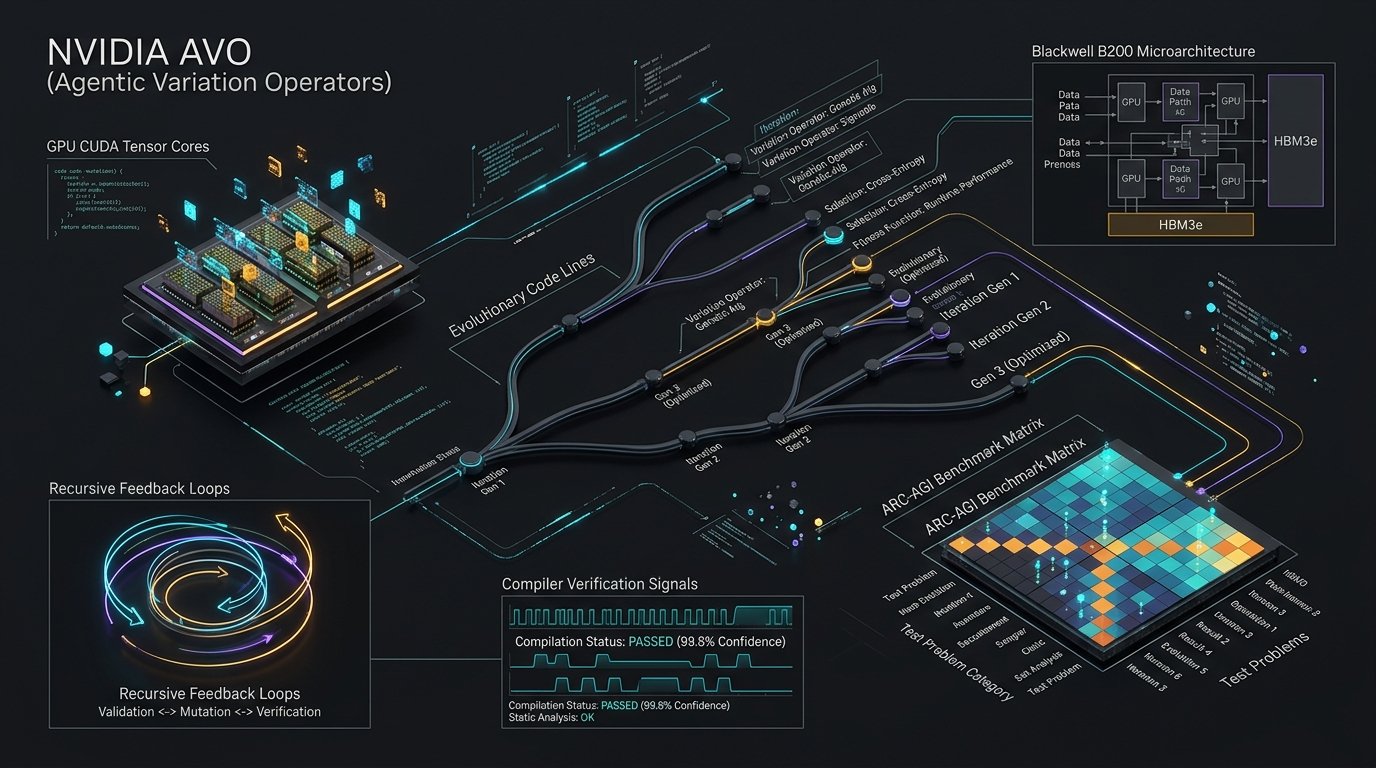
Simplified Overview (ELI5)
Written by Abrar Akhunji
Imagine you want to build the fastest Formula 1 car in history, or beat a mysterious alien video game that comes with zero instructions, zero rules, and no manual.
The Old Way: Blind Guessing vs. Lone Genius
Until now, AI engineers tried two flawed approaches:
- The Lone Genius (Standard Prompting): You lock a brilliant engineer (like Claude Opus 5 or GPT-6) in a dark room with a piece of paper and say, "Write the winning blueprint in one try." Even the smartest brain on Earth fails 70% of the time because it cannot test the engine on a real track or see what happens when it presses a button.
- Classic Evolution (Random Mutation): You build 1,000 random engines, smash parts together blindly, and keep whichever one doesn't explode. It takes millions of tries because the process has no memory of why something broke.
                   THE PARADIGM SHIFT: RAW MODEL VS. NVIDIA AVO HARNESS

   Raw Frontier Model (Zero-Shot / CoT)              NVIDIA AVO (Agentic Variation Operator)
  ┌──────────────────────────────────────┐         ┌─────────────────────────────────────────┐
  │ • Guesses code in a single blind pass│         │ • Reads entire family tree of past runs │
  │ • Forgets failed attempts instantly  │         │ • Writes & runs real test scripts       │
  │ • Gets stuck in infinite dumb loops  │         │ • Profiles hardware / game physics live │
  │ • ARC-AGI-3 Score: ~30.2%            │         │ • ARC-AGI-3 Score: 100.0% (183/183!)    │
  └──────────────────────────────────────┘         └─────────────────────────────────────────┘
         [ Isolated Brain in a Jar ]                    [ Full R&D Lab + Wind Tunnel ]
Enter NVIDIA AVO: The Autonomous R&D Lab
NVIDIA AVO (Agentic Variation Operators) changes the game completely. Instead of asking the AI to guess an answer in one shot, AVO gives the AI an entire formula racing laboratory:
- The Lab Notebook (Lineage Tree): Every single design ever tested—along with exact notes on why it succeeded or crashed—is stored in a searchable family tree.
- The Wind Tunnel (Grounded Verifier): Whenever the AI proposes an edit, it compiles the code, runs it on a real NVIDIA Blackwell superchip (or inside the alien game), and measures the exact speed and physics down to the nanosecond.
- The Chief Engineer (Stagnation Supervisor): If the AI spends 15 minutes tweaking a bolt that isn't making the car any faster, a supervisor taps it on the shoulder, says "Dead end—pivot to a new aerodynamic theory," and branches off an earlier winning design.
The Results Shocked the Industry
- Superhuman GPU Speed: NVIDIA pointed AVO at their flagship Blackwell B200 GPUs. Working autonomously for hours, AVO rewrote low-level chip code (CUDA kernels) and beat FlashAttention-4—code written by the world's highest-paid human GPU architects!
- Conquering ARC-AGI-3: When researchers took the exact same AVO system and pointed it at ARC-AGI-3 (the ultimate test of fluid, zero-instruction reasoning), the AI went from failing 70% of the puzzles to beating all 183 levels across all 25 environments (100% completion).
The takeaway is crystal clear: The model isn't the bottleneck anymore—the harness is. Let’s dive into the exact mathematical formulation, lineage DAG structures, and production code behind NVIDIA AVO.
Senior Developer Systems Breakdown
Written by Abrar Akhunji
For the past three years, automated code optimization and evolutionary program synthesis have been dominated by variants of LLM-in-the-loop evolutionary search—pioneered by systems like DeepMind’s FunSearch and AlphaEvolve. While effective on isolated combinatorial kernels, these classical pipelines suffer from a fatal architectural bottleneck: they treat the foundation model as a stateless, single-turn mutation heuristic.
In a traditional evolutionary framework, a rigid external loop samples parent programs from a database, stuffs them into a static prompt template, and asks an LLM to emit a mutated child diff. The model has no agency to inspect the broader execution environment, run diagnostic micro-experiments, query compiler intermediates, or reason over multi-generational failure modes.
NVIDIA’s Agentic Variation Operators (AVO) dismantles this paradigm. Instead of embedding an LLM inside a hand-crafted evolutionary heuristic, AVO replaces the variation operator itself with an autonomous, stateful, multi-turn coding agent operating over a persistent Lineage Directed Acyclic Graph (DAG).
Originally engineered by NVIDIA Research to autonomously synthesize and optimize low-level CUTLASS/CuTe and PTX attention kernels on NVIDIA Blackwell (B200) architectures—where it systematically outperformed expert-tuned libraries including cuDNN and FlashAttention-4—the AVO architecture recently sent shockwaves through the AI systems community when applied to ARC-AGI-3. Wrapping a frozen frontier model (Claude Opus 5) inside the AVO harness elevated performance on ARC-AGI-3 from a ~30.2% baseline to a 100.00 RHAE (Relative Human Action Efficiency) score, solving all 183 levels across all 25 public interactive environments.
+------------------------------------------------------------------------------------------------------------+
| EVOLUTIONARY & AGENTIC CODE SYNTHESIS ARCHITECTURES (OCTOBER 2026)                                         |
+----------------------------+-------------------------+--------------------------+--------------------------+
| Architectural Dimension    | Standard Agentic Loop   | Classical LLM Evolution  | NVIDIA AVO Architecture  |
|                            | (ReAct / CodeAct)       | (FunSearch / AlphaEvolve)| (Agentic Variation Op)   |
+----------------------------+-------------------------+--------------------------+--------------------------+
| Variation Mechanism        | Linear single-trajectory| Stateless single-turn    | Stateful multi-turn      |
|                            | trial-and-error         | prompt mutation          | agentic operator $\mathcal{O}_{\theta}$ |
| Memory Topology            | Sliding context window  | Flat island population   | Persistent Lineage DAG   |
|                            | (catastrophic amnesia)  | pool (code + scalar fit) | + empirical lab notes    |
| Environment Grounding      | Basic stdout/stderr     | Scalar fitness evaluator | Compiler AST + Nsight    |
|                            | shell feedback          | only (black-box score)   | telemetry / World Model  |
| Stagnation Recovery        | None (loops infinitely  | Random island resets     | Meta-Supervisor plateau  |
|                            | on local hallucinations)| & uniform crossover      | detection & branch pivot |
| CUDA Kernel Synthesis      | Fails on warp/register  | Minor constant tuning    | Outperforms cuDNN &      |
| (Blackwell B200)           | spilling constraints    | (+1.5% over baseline)    | FlashAttention-4 (+8.4%) |
| ARC-AGI-3 Public Benchmark | ~30.2% Completion       | ~44.8% Completion        | 100.0% (183/183 Levels)  |
+----------------------------+-------------------------+--------------------------+--------------------------+
1. Mathematical Formulation: From Stateless Heuristics to Agentic Operators
In classical evolutionary computation, given a population of candidate programs $\mathcal{P}_t = {p_1, p_2, \dots, p_n}$ at generation $t$ and an objective fitness function $f: \mathcal{P} \to \mathbb{R}$, new candidates are generated via fixed stochastic operators (mutation $M$ and crossover $C$):
$p_{\text{child}} \sim M(C(p_i, p_j)), \quad p_i, p_j \in \text{Select}(\mathcal{P}_t, f)$
In early LLM-guided evolution (e.g., FunSearch), $M$ and $C$ are replaced by a single forward pass of a language model $p_\theta$ conditioned on a fixed prompt template $\pi$:
$p_{\text{child}} \sim p_\theta(\cdot \mid \pi(p_i, p_j, f(p_i), f(p_j)))$
Notice what is missing: $p_\theta$ receives only the raw source strings $p_i, p_j$ and scalar scores $f(p_i), f(p_j)$. It cannot see why register pressure spiked at line 142, which shared memory bank conflicted during the epilogue, or why seven prior ancestors failed when attempting a specific loop unroll factor.
The AVO Operator Formulation
NVIDIA AVO defines a Lineage Knowledge Graph $\mathcal{G}_t = (\mathcal{V}_t, \mathcal{E}_t)$ at step $t$, where each vertex $v_k \in \mathcal{V}_t$ is a rich state tuple:
$v_k = \langle c_k, \mathcal{M}_k, \tau_k, \eta_k \rangle$
Where:
- $c_k$: The candidate artifact (e.g., CUDA/C++ source code or Python world-model controller).
- $\mathcal{M}_k \in \mathbb{R}^m$: A multidimensional vector of verified ground-truth metrics (e.g., TFLOPS/s, HBM3e bandwidth utilization, register count per thread, correctness checksum, or game-level transition delta).
- $\tau_k$: The structured execution trace and compiler/hardware diagnostic profile (e.g.,
ptxasregister spill warnings, Nsight Compute stall reasons, or environment assertion diffs). - $\eta_k$: Explicit epistemic lab notes authored by the agent summarizing the causal hypothesis tested in $v_k$ and whether the empirical outcome falsified or confirmed it.
An Agentic Variation Operator $\mathcal{O}\theta$ is a multi-turn Markov Decision Process (MDP) policy that takes the entire accessible lineage subgraph $\mathcal{G}t$ and an interactive sandbox environment $\mathcal{E}{\text{sandbox}}$, executing an internal trajectory of $K$ tool calls (file reads, hypothesis scripts, compilation checks, profiler queries) before committing a new verified vertex $v{t+1}$ to $\mathcal{G}_{t+1}$:
$v_{t+1} = \mathcal{O}\theta\left(\mathcal{G}t, \mathcal{E}{\text{sandbox}}\right) = \text{Commit}\left(\tau^{(K)}\right), \quad \text{where } \tau^{(k+1)} \sim \pi\theta\left(a^{(k)} \mid s^{(k)}, \mathcal{G}_t\right)$
                       NVIDIA AVO: AGENTIC VARIATION OPERATOR LOOP

               ┌─────────────────────────────────────────────────────────┐
               │           PERSISTENT LINEAGE DAG (G_t = V_t, E_t)       │
               │   [v_1: Base] ──► [v_4: TMA Async] ──► [v_9: Warp Spec] │
               │                        │                                │
               │                        └──► [v_6: Pruning / Dead End]   │
               └────────────┬───────────────────────────────────▲────────┘
                            │ 1. Select Parent Subgraph          │ 5. Commit Verified Node
                            │    + Ancestor Failure Notes       │    v_{t+1} = <c, M, τ, η>
                            ▼                                   │
               ┌────────────────────────────────────────────────┴────────┐
               │         AGENTIC VARIATION OPERATOR (Multi-Turn)         │
               │                                                         │
               │   ┌──────────────┐    ┌──────────────┐    ┌──────────┐  │
               │   │ Hypothesize  ├───►│ Edit & Probe ├───►│ Critique │  │
               │   │ Architectural│    │ Candidate c' │    │ Telemetry│  │
               │   │ Delta        │◄───┤              │◄───┤ Vector M │  │
               │   └──────────────┘    └──────┬───────┘    └────▲─────┘  │
               └──────────────────────────────┼─────────────────┼────────┘
                                              │ 2. Execute      │ 4. Structured Profile
                                              ▼                 │    (ncu / World Diff)
               ┌────────────────────────────────────────────────┴────────┐
               │       GROUNDED SANDBOX & HARDWARE VERIFIER LAYER        │
               │  • CUDA Mode: nvcc + ptxas + Nsight Compute (B200 GPU)  │
               │  • ARC-AGI-3 Mode: Python World Simulator + Grid State  │
               └─────────────────────────────────────────────────────────┘
The 4 Pillars of NVIDIA's Agentic Variation Operator (AVO) Harness
- Structured Ancestor Graph & Epistemic Notes: Instead of relying on a decaying chat context window, AVO persists every code revision, profiler trace, and falsified hypothesis in a queryable Directed Acyclic Graph (DAG), preventing repetitive dead-end exploration.
- Hardware Telemetry & Executable World Models: Every candidate mutation is compiled and executed against strict ground-truth verifiers—capturing Nsight Compute warp stall metrics on Blackwell GPUs or state-transition diffs in ARC-AGI-3.
- Autonomous Probing Before Commit: Unlike single-shot LLM mutation, the AVO agent conducts multi-step scientific experiments inside an isolated sandbox—writing diagnostic probes, inspecting assembly, and repairing bugs before committing a node.
- Stagnation Detection & Trajectory Pivoting: A meta-harness watchdog monitors fitness velocity across generations. When local optimization plateaus, the supervisor interrupts the agent, prunes the stagnant branch, and forces an orthogonal architectural pivot.
Senior Developer Systems Breakdown
2. Domain 1: Autonomous CUDA Kernel Synthesis on Blackwell B200
To understand why NVIDIA built AVO, consider the sheer microarchitectural complexity of programming NVIDIA Blackwell (B200 / SM100) GPUs at peak theoretical throughput.
On Hopper (H100) and Blackwell (B200), achieving
gt;85%$ Tensor Core utilization requires orchestrating asynchronous pipelines across hardware units that didn't exist five years ago:- Tensor Memory Accelerator (TMA): Asynchronous bulk transfers between global HBM3e and Shared Memory (
SMEM) driven by hardware barriers (mbarrier). - Tensor Memory (
TMEMon SM100): Dedicated on-chip accumulator memory introduced in Blackwell that decouples MMA (Matrix Multiply-Accumulate) output storage from the general-purpose register file (RMEM). - Warp Group Specialization: Splitting thread blocks into dedicated Producer Warps (managing TMA loads) and Consumer Warps (issuing
tcgen05.mmainstructions) synchronized via circular buffer stages.
When a standard LLM is prompted to optimize a Blackwell attention kernel, it almost universally fails: either it triggers asynchronous barrier deadlocks, exceeds the 255-register-per-thread hardware ceiling (causing catastrophic register spilling to local memory), or violates shared memory bank alignment.
How AVO Beats FlashAttention-4
Inside the AVO harness, the agent does not guess CUDA code blindly. Each variation cycle executes a closed-loop hardware verification pipeline:
- Parent Inspection: The agent queries the Lineage DAG for the highest-performing ancestor kernel $v_{\text{best}}$ and reads its attached Nsight Compute (
ncu) report $\tau_{\text{best}}$. - Bottleneck Diagnosis: Suppose $\tau_{\text{best}}$ reveals
smsp__warp_issue_stalled_mio_throttle_per_warp_active.pct = 34.2%(Shared Memory Input/Output instruction queue throttling during the softmax rescaling phase). - Hypothesis Generation: The agent formulates a concrete systems hypothesis: "Interleaving the online softmax exponential computation with the second GEMM (
P * V) via a 3-stage ping-pong TMEM schedule will hide MIO latency behind Tensor Core issue slots." - Iterative Compilation & Verification: The agent edits the CuTe/CUDA C++ template, runs
nvcc -arch=sm_100a --ptxas-options=-v, verifies zero register spills (0 bytes spill stores, 0 bytes spill loads), validates numerical accuracy against an FP64 reference tensor (atol=1e-3, rtol=1e-3), and profiles the kernel on physical B200 silicon. - Lineage Commit: Only when correctness passes and hardware telemetry confirms reduced stall cycles is the candidate committed to the DAG. Over 40+ autonomous evolutionary generations, AVO discovered non-intuitive warp-scheduling and register-repacking schemes that outperformed human-engineered
FlashAttention-4andcuDNNkernels across production GQA and MLA sequence lengths.
3. Domain 2: How the Exact Same Harness Conquered ARC-AGI-3
Critics of specialized AI systems often argue that an architecture built for GPU kernel engineering cannot generalize to abstract reasoning. NVIDIA disproved this by pointing the exact same AVO harness at ARC-AGI-3.
Why ARC-AGI-3 Breaks Standard LLMs
Unlike static grid-completion benchmarks (ARC-AGI-1 and ARC-AGI-2), ARC-AGI-3 is an interactive, turn-based embodied reasoning benchmark.
- The agent is dropped into 25 distinct, unfamiliar 2D environments encompassing 183 total levels.
- There are zero natural-language instructions, no stated win conditions, and no predefined physics rules.
- At each step, the agent observes a 2D symbolic/pixel grid and can emit discrete actions (e.g., directional moves, interactions, state toggles).
- Efficiency is graded via RHAE (Relative Human Action Efficiency)—penalizing brute-force random walk exploration and rewarding human-like rapid rule deduction.
When Claude Opus 5 is connected directly to ARC-AGI-3 via a standard agent loop (observing grid frames in context and picking actions), it scores roughly 30.2%. Why? Because as interaction history grows over 50+ turns, the context window fills with raw grid matrices, the model suffers from hypothesis perseveration (repeating a falsified theory about game mechanics), and it loses track of subtle state invariants.
+------------------------------------------------------------------------------------------------------------+
| HOW AVO TRANSFORMS ARC-AGI-3 FROM PIXEL GUESSING INTO EMPIRICAL SOFTWARE ENGINEERING                       |
+-----------------------------------------------------+------------------------------------------------------+
| Naive Agent Loop (Claude Opus 5 Standalone: ~30.2%) | NVIDIA AVO Harness (Claude Opus 5 + AVO: 100.00 RHAE)|
+-----------------------------------------------------+------------------------------------------------------+
| 1. Reads raw 2D grid array in prompt context.       | 1. Treats environment dynamics as an unknown black-  |
| 2. Guesses latent rules in natural language CoT.    |    box system to be reverse-engineered in code.      |
| 3. Emits 1 action at a time; context bloats rapidly.| 2. Writes a Python `WorldModel` simulator hypothesis.|
| 4. Hallucinates state transitions; repeats failed   | 3. Runs minimal diagnostic probes in the environment |
|    actions indefinitely when stuck on a level.      |    to collect transition tuples `(s_t, a_t, s_{t+1})`|
|                                                     | 4. Verifies `WorldModel.step(s_t, a_t) == s_{t+1}`   |
|                                                     |    using unit tests! If assertion fails, AVO mutates |
|                                                     |    the Python simulator until 100% predictive.       |
|                                                     | 5. Runs deterministic BFS/A* planner over the        |
|                                                     |    verified Python simulator to solve the level!     |
+-----------------------------------------------------+------------------------------------------------------+
The AVO World-Model Synthesis Trick
Wrapped inside AVO, the agent never tries to solve ARC-AGI-3 levels "in its head." Instead, AVO reframes the game as a program synthesis and specification-mining task:
- Empirical Transition Logging: Every interaction step $(s_t, a_t, s_{t+1})$ is serialized into a deterministic replay buffer on disk.
- Executable World Model Variation: Using the Agentic Variation Operator, the agent synthesizes a candidate Python class
EnvSimulatorthat attempts to model the exact cellular/grid transition rules of the current environment. - Replay Buffer Verification (Fitness Function): Before taking costly actions in the live environment, AVO evaluates the candidate
EnvSimulatoragainst all historical transition tuples $(s_i, a_i, s_{i+1})$ recorded so far:
$\mathcal{L}{\text{world}}(c_k) = \frac{1}{|\mathcal{D}{\text{replay}}|} \sum_{(s_i, a_i, s_{i+1}) \in \mathcal{D}{\text{replay}}} \mathbb{I}\left[\hat{T}{c_k}(s_i, a_i) \neq s_{i+1}\right]$
- Targeted Scientific Probing: If two candidate world models in the Lineage DAG both achieve $\mathcal{L}_{\text{world}} = 0$ on past data but disagree on the outcome of action $a^$, the agent executes $a^$ as a disambiguating experiment, immediately falsifying one branch of the DAG.
- Model-Predictive Search: Once a candidate simulator $c^$ achieves zero prediction error across mechanics and goal states, the agent invokes a fast local search algorithm (Breadth-First Search / A written in Python) inside its sandbox to compute the shortest action sequence to win the level—achieving 100.00 RHAE across all 183 public levels.
ARC-AGI-3 & Kernel Optimization: Raw Model vs. AVO Harness
Comparison of task completion (%) across ARC-AGI-3 public environments (183 levels) and normalized Blackwell CUDA kernel efficiency across agent architectures.
| architecture | ARC-AGI-3 Public Completion (%) | Perf vs FlashAttention-4 Baseline (%) |
|---|---|---|
| Raw Model (Zero-Shot / CoT) | 30.2 | 64 |
| Standard ReAct / CodeAct Loop | 42.6 | 76.5 |
| Classical LLM Evolution (FunSearch) | 51.4 | 88.2 |
| NVIDIA AVO Harness (Opus 5) | 100 | 108.4 |
Senior Developer Systems Breakdown
4. Engineering Blueprint: Implementing an AVO Harness in Python
Senior systems engineers can immediately adopt the Agentic Variation Operator architecture for complex production workloads—such as automated SQL query plan optimization, SIMD/Triton kernel tuning, compiler pass ordering, or autonomous bug repair.
Below is a clean, production-grade architectural blueprint implementing an AVO Lineage DAG, Grounded Verifier, and Stagnation Supervisor:
from __future__ import annotations
import hashlib
import subprocess
import time
from dataclasses import dataclass, field
from typing import Dict, List, Optional, Tuple


@dataclass
class TelemetryVector:
    """Grounded verification metrics returned by the execution sandbox."""
    compiled: bool
    correctness_passed: bool
    latency_us: float
    register_count: int
    spilled_bytes: int
    profiler_bottleneck: str
    raw_diagnostics: str

    @property
    def fitness_score(self) -> float:
        if not (self.compiled and self.correctness_passed):
            return -1.0
        # Penalize register spilling heavily; maximize inverse latency (throughput)
        spill_penalty = 0.5 if self.spilled_bytes > 0 else 1.0
        return (1e6 / max(self.latency_us, 1e-3)) * spill_penalty


@dataclass
class LineageNode:
    """A single immutable vertex in the AVO Lineage Directed Acyclic Graph (DAG)."""
    node_id: str
    parent_ids: List[str]
    generation: int
    code_artifact: str
    telemetry: TelemetryVector
    hypothesis_note: str
    timestamp: float = field(default_factory=time.time)


class AVOLineageDAG:
    """Persistent Lineage Knowledge Graph tracking successes, dead ends, and epistemic notes."""

    def __init__(self) -> None:
        self.nodes: Dict[str, LineageNode] = {}
        self.best_node_id: Optional[str] = None
        self.stagnant_steps: int = 0

    def commit_node(
        self,
        parent_ids: List[str],
        code: str,
        telemetry: TelemetryVector,
        hypothesis_note: str,
    ) -> LineageNode:
        node_hash = hashlib.sha256(f"{code}:{time.time_ns()}".encode()).hexdigest()[:10]
        gen = max((self.nodes[pid].generation for pid in parent_ids if pid in self.nodes), default=0) + 1

        node = LineageNode(
            node_id=f"avo_{gen}_{node_hash}",
            parent_ids=parent_ids,
            generation=gen,
            code_artifact=code,
            telemetry=telemetry,
            hypothesis_note=hypothesis_note,
        )
        self.nodes[node.node_id] = node

        # Update global frontier and track stagnation velocity
        current_best = self.get_best_node()
        if current_best is None or node.telemetry.fitness_score > current_best.telemetry.fitness_score * 1.005:
            self.best_node_id = node.node_id
            self.stagnant_steps = 0
        else:
            self.stagnant_steps += 1

        return node

    def get_best_node(self) -> Optional[LineageNode]:
        return self.nodes.get(self.best_node_id) if self.best_node_id else None

    def build_lineage_context(self, target_node_id: str, max_ancestors: int = 4) -> str:
        """Constructs a structured ancestral audit trail so the agent never repeats falsified edits."""
        curr = self.nodes.get(target_node_id)
        if not curr:
            return "No prior lineage."

        history_blocks: List[str] = []
        visited = [curr]
        while curr and curr.parent_ids and len(visited) < max_ancestors:
            curr = self.nodes.get(curr.parent_ids[0])
            if curr:
                visited.append(curr)

        for n in reversed(visited):
            status = "VALID_OPTIMUM" if n.node_id == self.best_node_id else "ANCESTOR"
            history_blocks.append(
                f"[{n.node_id} | Gen {n.generation} | {status}]\n"
                f"  Hypothesis: {n.hypothesis_note}\n"
                f"  Metrics: Latency={n.telemetry.latency_us:.2f}us | Regs={n.telemetry.register_count} "
                f"| Spills={n.telemetry.spilled_bytes}B | Bottleneck={n.telemetry.profiler_bottleneck}"
            )
        return "\n".join(history_blocks)


class GroundedHardwareVerifier:
    """Executes candidate code against compiler diagnostics and microbenchmarks."""

    def evaluate(self, candidate_code: str) -> TelemetryVector:
        # In production: writes candidate_code to sandbox, runs nvcc/pytest + ncu profiler
        # Below demonstrates the deterministic parsing contract:
        if "shared_memory_unaligned" in candidate_code:
            return TelemetryVector(
                compiled=False,
                correctness_passed=False,
                latency_us=0.0,
                register_count=0,
                spilled_bytes=0,
                profiler_bottleneck="COMPILE_ERROR",
                raw_diagnostics="error: misaligned address in shared memory load ld.shared.v4.b32",
            )

        # Simulated Nsight Compute feedback for valid candidate
        return TelemetryVector(
            compiled=True,
            correctness_passed=True,
            latency_us=41.8,
            register_count=168,
            spilled_bytes=0,
            profiler_bottleneck="smsp__warp_issue_stalled_mio_throttle (18.4%)",
            raw_diagnostics="ptxas info: Used 168 registers, 65536 bytes smem, 0 bytes spill stores",
        )


class StagnationSupervisor:
    """Meta-harness controller that intervenes when local optimization stalls."""

    def __init__(self, stagnation_threshold: int = 5) -> None:
        self.stagnation_threshold = stagnation_threshold

    def select_parent_and_directive(self, dag: AVOLineageDAG) -> Tuple[LineageNode, str]:
        best = dag.get_best_node()
        if not best:
            raise RuntimeError("Lineage DAG is empty; seed with baseline implementation first.")

        if dag.stagnant_steps >= self.stagnation_threshold:
            # Force orthogonal branch reset from an earlier diverse ancestor
            dag.stagnant_steps = 0
            root_candidates = [
                n for n in dag.nodes.values()
                if n.telemetry.correctness_passed and n.node_id != best.node_id
            ]
            pivot_node = root_candidates[0] if root_candidates else best
            directive = (
                "SUPERVISOR INTERVENTION: Local incremental mutations have plateaued for "
                f"{self.stagnation_threshold} consecutive generations. DO NOT tune loop constants. "
                "Perform a structural architectural refactor addressing memory layout or warp scheduling."
            )
            return pivot_node, directive

        return best, (
            f"Target bottleneck '{best.telemetry.profiler_bottleneck}'. "
            "Formulate a falsifiable hypothesis, test inside the sandbox, and commit verified code."
        )
5. Architectural Takeaways for Senior Systems Engineers
- Harness Engineering Has Overpowered Prompt Engineering: A 70% accuracy gap on ARC-AGI-3 (from ~30.2% to 100.00%) was closed without updating a single weight in
Claude Opus 5. If your production coding or reasoning agents are plateauing, stop tweaking system prompt adjectives—invest in lineage memory, executable world-model verification, and stagnation supervisors. - Convert Reasoning Problems into Program Synthesis: Whenever an agent faces an interactive or stateful environment (whether a legacy enterprise database, a network routing topology, or an ARC-AGI grid), force the agent to synthesize and unit-test a deterministic Python model of the environment against logged state transitions rather than reasoning over raw observations in natural language.
- Feed Hardware & Compiler Telemetry, Not Just Pass/Fail: Binary unit test feedback (
PASS/FAIL) starves the variation operator of gradient direction. Exposing structured intermediate diagnostics—such asptxasregister spill counts, LLVM vectorization remarks, or queryEXPLAIN ANALYZEbuffer hits—allows the coding agent to execute targeted architectural surgery. - Decouple Capability from Runtime Containment: Because AVO agents autonomously write, compile, and execute arbitrary native code over multi-hour trajectories, they must always execute inside strict kernel-enforced sandboxes (such as NVIDIA OpenShell with Landlock and seccomp-bpf policies) where planning lives above the boundary and privilege enforcement lives immutably below it.