Simplified Overview (ELI5)
Written by Abrar Akhunji
If you have ever used an autonomous coding agent like Claude Code or Cursor, you know they burn through API credits at an alarming rate. When an agent spends 40 steps fixing a bug, it calls a massive, expensive frontier model for every single action—including trivial tasks like checking if a file exists, running git status, or formatting a JSON array.
Using a $15/million token model to check if a closing bracket is missing is the software equivalent of hiring an aerospace engineer to tighten a screw with a wrench.
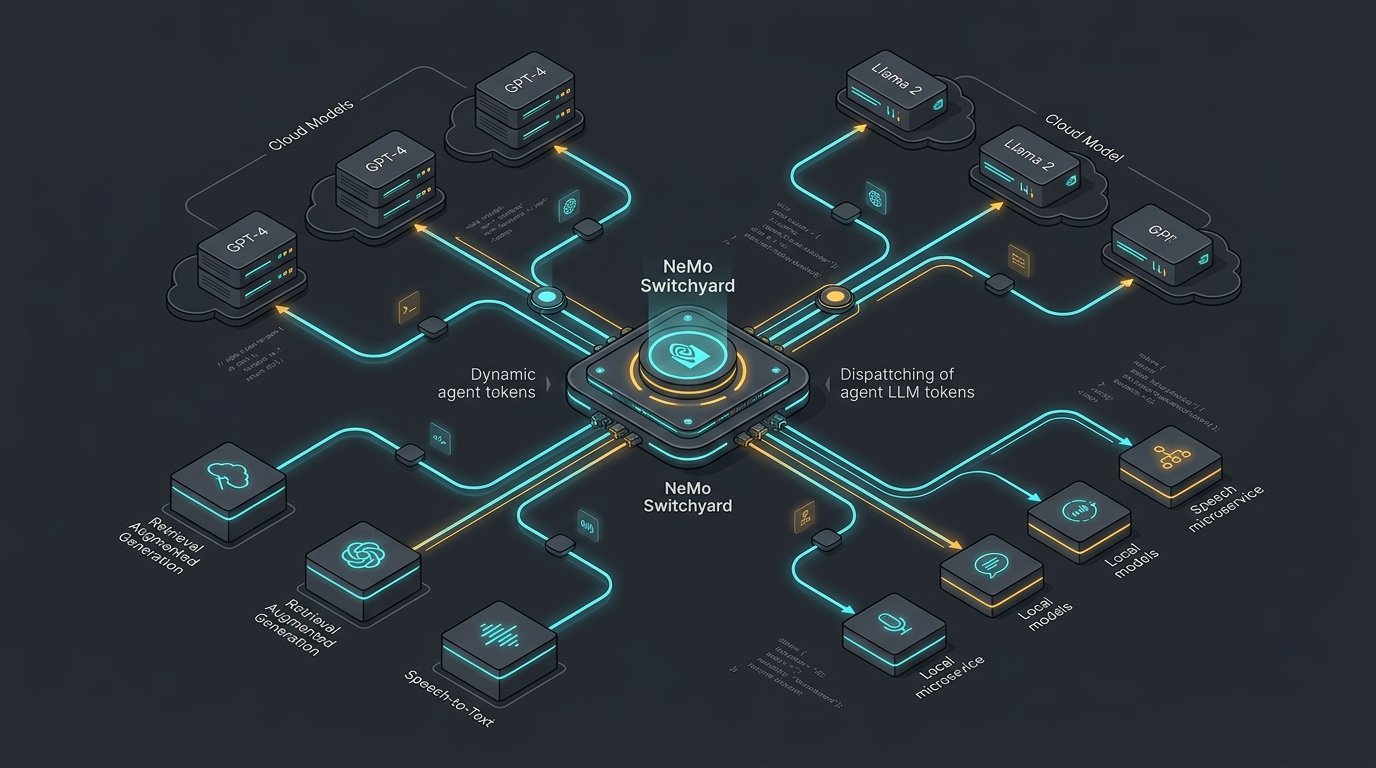
On August 14, 2026, NVIDIA released an open-source tool called NeMo Switchyard. Written entirely in ultra-fast Rust, Switchyard acts as an intelligent traffic cop between your AI agents and your models.
Instead of sending every request to the most expensive model in the cloud, Switchyard inspects what the agent is doing at each step. If the agent is just running a simple bash tool or parsing syntax, it routes the request to a lightning-fast local model running on your GPU. When the agent reaches a complex architectural problem, Switchyard instantly routes it to Claude Opus or GPT-5.
The result? Up to 74% lower token bills with virtually zero drop in problem-solving ability. Here is how NVIDIA built it and why it changes the unit economics of AI software development.
Senior Developer Systems Breakdown
Written by Abrar Akhunji
Frontier AI agents have hit a brutal economic wall: the multi-turn inference cost curve. In production autonomous workflows (such as SWE-bench sweeps, autonomous repo migrations, and continuous test repair), agents average 30 to 80 model invocations per pull request.
Historically, engineering teams "pinned" the entire agent lifecycle to a single frontier endpoint—e.g., claude-3-7-sonnet, claude-opus-4-8, or gpt-5-codex. This created massive capital waste. Roughly 65% of agent turns consist of mechanical tool execution: parsing AST diffs, verifying file manifests, extracting grep output, and echoing shell outputs.
On August 14, 2026, NVIDIA open-sourced Switchyard under the NeMo umbrella: a high-throughput, async Rust proxy server (switchyard-server) and embedded crate (switchyard-libsy). Switchyard introduces wire-level cross-protocol translation (Anthropic Messages $\leftrightarrow$ OpenAI Chat $\leftrightarrow$ OpenAI Responses) combined with dynamic, stage-aware dispatching across heterogeneous backends (NVIDIA NIM, local vLLM, Ollama, Anthropic, and OpenAI).
In LangChain and agentic SWE benchmarks, Switchyard achieved up to a 74% reduction in inference expenditure with less than a 1.2% delta in task resolution rate. What follows is an architectural breakdown of Switchyard’s Rust runtime, its 5 core routing heuristics, and practical deployment configurations for production agent harnesses.
The Unit Economics Problem: The Frontier Model Trap
To understand why Switchyard exists, we must analyze the distribution of token consumption across multi-turn agent lifecycles.
In a standard agent execution loop, an agent alternates between three distinct cognitive states:
- Strategic Planning & Root Cause Analysis: High entropy reasoning requiring deep contextual synthesis, broad codebase understanding, and complex hypothesis formation.
- Deterministic Tool Invocation & Schema Formatting: Low entropy mechanical execution (e.g., emitting structured JSON tool calls for
read_file,list_dir,run_tests). - Observation Parsing & State Reflection: Intermediate filtering of tool stdout/stderr to confirm expected behavior.
Accounts for ~20% of turns but demands top-tier reasoning capabilities (Frontier Claude / GPT-5).
Accounts for ~55% of turns. Perfectly solvable by 8B–27B open-weight models (Nemotron 3.5, Qwen 3.8 27B).
Accounts for ~25% of turns. Requires fast speculative execution with promotion on failure.
When an agent is statically pinned to a $15.00 / M output token model, States 2 and 3 generate massive deadweight economic loss. Switchyard decouples the client agent from the upstream inference provider, transforming model invocation into an optimized, dynamically routed compute graph.
How Switchyard Works: The Core Architecture
Switchyard is architected as an asynchronous Tokio service running in user-space between the agent client (e.g., Claude Code, OpenCode Desktop, Aider, custom agent loops) and downstream inference providers.
Switchyard's 4-Phase Dynamic Routing Pipeline
- Zero-Copy Ingestion & Normalization: The client agent dispatches an HTTP request. Switchyard's async Hyper/Tokio front-end ingests the payload (whether formatted as Anthropic Messages, OpenAI Chat, or OpenAI Responses) and normalizes it into a unified internal IR without unnecessary allocations.
- Feature Extraction & State Analysis: The routing engine extracts key execution heuristics: current conversation depth, presence of prior tool failures in context, system prompt complexity, and token budget constraints.
- Heuristic Model Selection: The configured routing algorithm (Stage, Escalation, Classifier, or Prefill) selects the target backend: e.g., local vLLM instance running Nemotron 3.5 Lightning for routine tool steps, or Anthropic API for complex reasoning.
- On-The-Fly Schema Translation: Switchyard transpiles the request into the target backend's native schema, forwards the stream, translates SSE events back to the client's expected protocol, and collects Prometheus latency and cost metrics.
Wire-Level Protocol Translation
One of Switchyard's most pragmatic engineering features is its built-in bidirectional protocol transpiler.
Before Switchyard, if an agent was built against Anthropic's Messages API schema (with structured content blocks for tool_use and tool_result), pointing that agent to a local vLLM or Ollama instance required rewriting the client harness or running heavyweight Python middleware with high deserialization latency.
Switchyard performs zero-overhead Rust-native AST transformation between:
- Anthropic Messages API (
/v1/messages) - OpenAI Chat Completions API (
/v1/chat/completions) - OpenAI Responses API (
/v1/responses)
[ Claude Code / Codex Agent ] (Speaks Anthropic Messages API)
              │
              ▼  (HTTP / localhost:8080)
┌─────────────────────────────────────────────────────────┐
│                 NVIDIA NeMo Switchyard                  │
│  ┌─────────────────┐ ┌──────────────┐ ┌──────────────┐  │
│  │ Messages Parser │ │ IR Engine    │ │ Router Rules │  │
│  └─────────────────┘ └──────────────┘ └──────────────┘  │
└────────────────────────────┬────────────────────────────┘
                             │
            ┌────────────────┴────────────────┐
            ▼                                 ▼
   [ Anthropic Claude Opus ]         [ Local vLLM / NIM ]
   (Native Messages Protocol)        (Transpiled OpenAI Chat)
Because this occurs in native compiled Rust with streaming SSE passthrough, the proxy introduces sub-millisecond latency overhead (<0.8ms p99), ensuring zero perceptible lag for interactive terminal agents.
The 5 Routing Algorithms in Switchyard
Switchyard supports 5 distinct routing strategies defined declaratively via TOML:
1. Stage Router (Agent Lifecycle Aware)
The Stage Router monitors the sequence of roles and tool interactions in the message history. When an agent is in the midst of successive tool execution loops (reading files, listing directories, executing grep), Switchyard automatically dispatches to high-throughput local models. When the agent finishes tool execution and transitions back to conversational synthesis or complex file editing, it promotes the turn to the frontier model.
2. Escalation Router (Optimistic Speculative Execution)
The Escalation Router adopts an optimistic concurrency model:
- Every new prompt first targets the fast, cost-effective model (e.g., Nemotron 3.5 Lightning / Qwen 3.8 27B).
- If the model outputs an unparseable tool call, emits an error status, or if subsequent execution triggers a test failure, Switchyard's session state machine automatically re-dispatches the prompt to the frontier fallback model with an enriched error trace.
3. Prefill & Residual Stream Scoring
For environments hosting white-box models on NVIDIA NIM or vLLM, Switchyard can inspect early prefill residual-stream signals to evaluate token perplexity before generating the full sequence. If perplexity on the prompt exceeds a calibrated threshold, the request is immediately diverted to a higher-capacity model.
4. LLM Classifier (Judge Router)
A quantized micro-model (such as a 1.5B or 3B parameter classifier) inspects the prompt's semantic intent in <15ms, tagging it as TRIVIAL, TOOL_EXECUTION, CODE_MODIFICATION, or ARCHITECTURAL_DESIGN, and selecting the appropriate provider bucket.
5. Multi-Arm Bandit & A/B Router
Distributes requests across multiple providers according to configurable traffic splits, logging automated quality metrics (Prometheus) to continuously adjust routing weights.
Benchmark: Cost vs Accuracy in Production Sweeps
NVIDIA evaluated Switchyard across 500 multi-turn software engineering tasks comparing static model pinning against Switchyard's Stage-Aware Hybrid Routing:
Inference Spend vs Task Accuracy Across 500 Agentic Tasks
Comparison between single-model static pinning and Switchyard dynamic hybrid routing.
| strategy | Cost ($ per 1k Tasks) | Task Success Rate (%) |
|---|---|---|
| Claude Opus Pin | 184 | 78.4 |
| GPT-5 Pin | 162 | 76.9 |
| Local 27B Only | 14 | 52.1 |
| Switchyard Hybrid | 48 | 77.8 |
The data reveals a stark reality: Static frontier pinning costs ~3.8x more for an accuracy gain of less than 1%. By offloading repetitive tool interactions and mechanical syntax steps to local infrastructure, teams retain frontier-grade reasoning at a fraction of the operating expenditure.
Hands-On: Configuring Switchyard
Setting up Switchyard takes minutes. You can run it either as a standalone binary (switchyard-server) or as an embedded library (switchyard-libsy).
1. Configuration (switchyard.toml)
[server]
listen_addr = "127.0.0.1:8080"
metrics_addr = "127.0.0.1:9090"
log_level = "info"

[clients.claude_code]
protocol = "anthropic"

[[targets]]
id = "frontier_claude"
provider = "anthropic"
endpoint = "https://api.anthropic.com/v1/messages"
model = "claude-3-7-sonnet-20250219"
api_key_env = "ANTHROPIC_API_KEY"

[[targets]]
id = "local_nemotron"
provider = "openai"
endpoint = "http://127.0.0.1:8000/v1/chat/completions"
model = "nvidia/nemotron-3.5-lightning"
api_key = "none"

[router]
type = "stage"
default_target = "local_nemotron"

[router.rules]
on_tool_call = "local_nemotron"
on_reasoning = "frontier_claude"
on_error_escalate = "frontier_claude"
max_fallback_retries = 2
2. Running the Server
# Install Switchyard via cargo
cargo install --git https://github.com/NVIDIA-NeMo/Switchyard.git switchyard-server

# Launch the proxy
switchyard-server --config switchyard.toml
3. Pointing Your Coding Agent to Switchyard
To route an agent like Claude Code through Switchyard, simply override the base URL:
export ANTHROPIC_BASE_URL="http://127.0.0.1:8080"
claude "Refactor the authentication middleware and write unit tests"
Claude Code communicates with Switchyard thinking it is talking directly to Anthropic. Switchyard inspects each turn, routes mechanical steps to your local GPU cluster, forwards complex reasoning steps to Anthropic, and streams responses back seamlessly.
What Senior Developers Should Take Away
- Stop Pinning Everything to Frontier Models: Single-model agent architectures are an anti-pattern. Real-world agent workflows are heterogeneous and should be backed by heterogeneous inference tiers.
- Protocol Lock-In Is Dead: Tools like Switchyard prove that you don't need to rewrite agent client harnesses to test or adopt alternative open-weight models. Wire-level transpilation allows drop-in model swapping.
- Compute Efficiency is the Next Agent Frontier: As agents evolve from 5-step conversational assistants to 100-step autonomous background workers, routing efficiency and token economics will determine whether an AI feature is commercially viable or financially unsustainable.
Sources & Further Reading: