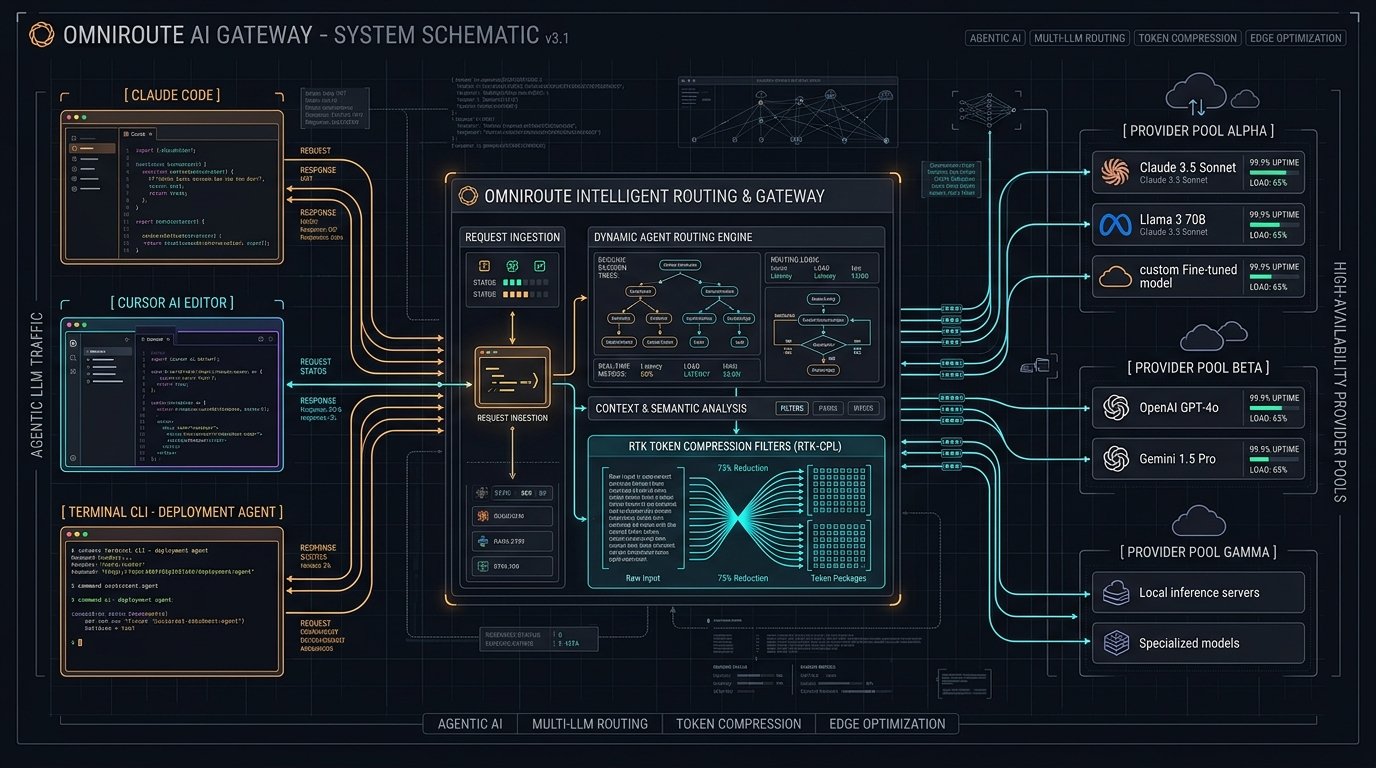
Simplified Overview (ELI5)
Written by Abrar Akhunji
Have you ever used an AI coding assistant like Claude Code, Cursor, or Cline, only to have it suddenly freeze in the middle of writing a crucial feature because you hit an "API Rate Limit Exceeded" or burned through your daily token quota in twenty minutes?
If you are a software engineer in 2026, you know this pain intimately. It is called "Agent Quota Fatigue."
Every time an autonomous AI agent inspects your codebase, runs a terminal test, reads a error log, and edits five files, it sends thousands of words back and forth. Within an hour, a single developer can burn millions of tokens and trigger hard rate limits across their accounts.
The Universal Traffic Controller: OmniRoute
Enter OmniRoute, an open-source tool created by software engineer Diego Rodrigues de Sa e Souza (@diegosouzapw) that is taking developer communities on YouTube (like WTF-Code), Reddit's /r/LocalLLaMA, and engineering forums by storm.
Think of OmniRoute as an ultra-smart air traffic control tower running silently on your own computer at http://localhost:20128.
Instead of connecting Cursor or Claude Code directly to a single company's API key, you point your coding tool at OmniRoute. OmniRoute then acts as a magic bridge:
- The Infinite Safety Net: If your Claude account gets rate-limited, OmniRoute instantly catches the error and hands the coding task to another account, or to Google Gemini 3.8 Flash, DeepSeek, or a local open-weight model running on your laptop (like Qwen 3.8)—without your coding agent ever crashing or stopping!
- Account Pooling: You can pool multiple free and paid accounts together so you never hit a brick wall while building.
Without OmniRoute:
[ Cursor / Claude Code ] ────(429 Rate Limit!)────> ❌ CRASH & STOP WORK

With OmniRoute Gateway:
[ Cursor / Claude Code ]
          │
          ▼
   [ OmniRoute (localhost:20128) ]
          │
          ├──> Provider A (429 Hit?) ──┐
          │                            ▼
          ├──> Auto-switch to Provider B (Success!) ──> Continuous Coding!
          │
          └──> Local Model Fallback (Zero Cost)
The Baggage Inspector: RTK (Rust Token Killer)
When an AI runs a terminal command like npm test or docker ps, the computer spits out hundreds of lines filled with colorful formatting, loading bars, and empty spaces. The AI doesn't need decorative ASCII boxes—it only needs to know if the test passed or which error broke on line 42!
OmniRoute includes a lightning-fast engine written in Rust called RTK (Rust Token Killer). Before the terminal output is sent to the AI, RTK strips away all the visual clutter and junk characters. This shrinks the size of the message by up to 80%, saving huge amounts of money and keeping the AI's memory lean and sharp.
The Developer's Dilemma: The Caching Catch
Here is the twist that every senior engineer needs to know: modern AI providers offer massive 90% discounts if you keep the beginning of your conversation identical (called Prompt Caching).
If an aggressive compression tool modifies words in the middle of your history, it breaks the AI's cache, costing you more money! OmniRoute solves this puzzle by leaving your saved conversation history alone, while aggressively pruning only the messy, live terminal outputs.
Let's put on our systems engineering hats and inspect the exact architecture, the Rust code, and the routing mechanics under the hood.
The 4-Stage OmniRoute Agentic Pipeline
- Universal Dialect Translation: Intercepts incoming requests from IDE tools (Claude Code, Cursor, Cline). Normalizes disparate Anthropic, OpenAI, and Ollama schemas into a unified internal representation.
- Sub-50ms Circuit Breaker: Tracks live rate-limit buckets, credit depletion, and upstream latencies. On HTTP 429 or 5xx, silently pivots to fallback tiers before errors propagate to the client.
- Rust Token Killer AST Pruning: Passes raw shell, compiler, and git outputs through a streaming finite-state transducer, stripping ANSI escape sequences, whitespace tables, and redundant logs.
- Cache-Aligned SSE Streaming: Anchors invariant prompt history to protect provider KV-cache hit discounts (90% savings) while streaming ephemeral tool outputs back via multiplexed SSE.
Section 2: Inside RTK (Rust Token Killer) & AST Stream Pruning
Autonomous agents spend up to 70% of their ingested prompt tokens consuming raw terminal output: test runners (vitest, pytest, cargo test), directory trees (tree, ls -la), container statuses (docker ps), and git logs.
The Problem of Raw Terminal Poisoning
Consider a standard docker ps invocation. In an interactive terminal, the human expects visual columnar alignment formatted with hundreds of space characters and ANSI color escapes:
CONTAINER ID   IMAGE          COMMAND                  CREATED         STATUS         PORTS                    NAMES
a8f9c1b2e3d4   redis:7-alpine "docker-entrypoint.s…"   2 hours ago     Up 2 hours     0.0.0.0:6379->6379/tcp   cache-dev
When ingested by a byte-pair encoding (BPE) tokenizer like cl100k_base or o200k_base:
- Consecutive space runs of variable lengths fragment into inefficient multi-token splits.
- ANSI escape sequences (
\x1b[32m,\x1b[0m) consume 3 to 6 discrete tokens per colored word. - Box-drawing characters (
│,┌,└,─) trigger high-order unicode token mappings.
The RTK Stream Transducer
RTK (Rust Token Killer) replaces naive regular expression search-and-replace with a zero-allocation streaming Finite-State Transducer (FST) written in Rust.
RAW TERMINAL STREAM:
"[32mPASS[0m src/test/auth.spec.ts (14.2s) \n" --> 18 Tokens
" ✓ should issue JWT on valid credentials (12ms) \n" --> 14 Tokens
" ✓ should reject malformed Bearer tokens (4ms) \n" --> 13 Tokens
... [450 passing test lines omitted] ...
"Test Suites: 1 passed, 1 total\nTests: 452 passed, 452 total\n"
RTK COMPILED OUTPUT:
"PASS auth.spec.ts | 452/452 tests passed (14.2s)" --> 12 Tokens (94.8% Reduction!)
// Core Architecture of the RTK Stream Filter (Rust Native Module)
use std::io::{self, BufRead, Write};

pub struct RtkStreamFilter {
    strip_ansi: bool,
    dedup_whitespace: bool,
    fold_passing_tests: bool,
}

impl RtkStreamFilter {
    pub fn new() -> Self {
        Self {
            strip_ansi: true,
            dedup_whitespace: true,
            fold_passing_tests: true,
        }
    }

    /// Processes arbitrary byte buffers with zero allocations on the hot path
    pub fn prune_stream<R: BufRead, W: Write>(&self, mut reader: R, mut writer: W) -> io::Result<usize> {
        let mut line_buffer = String::with_capacity(1024);
        let mut bytes_written = 0;
        let mut passing_test_count = 0;

        while reader.read_line(&mut line_buffer)? > 0 {
            let trimmed = line_buffer.trim();

            // FST Rule 1: Eliminate raw ANSI escape codes
            let cleaned = if self.strip_ansi {
                fast_strip_ansi(trimmed)
            } else {
                trimmed.to_string()
            };

            // FST Rule 2: Collapse repetitive test suite successes
            if self.fold_passing_tests && (cleaned.starts_with("✓") || cleaned.starts_with("PASS") || cleaned.contains("ok")) {
                passing_test_count += 1;
                line_buffer.clear();
                continue;
            }

            // FST Rule 3: Deduplicate excessive whitespace runs
            let compact = if self.dedup_whitespace {
                deduplicate_spaces(&cleaned)
            } else {
                cleaned
            };

            if !compact.is_empty() {
                writer.write_all(compact.as_bytes())?;
                writer.write_all(b"\n")?;
                bytes_written += compact.len() + 1;
            }
            line_buffer.clear();
        }

        if passing_test_count > 0 {
            let summary = format!("[RTK: Folded {} successful test assertions]\n", passing_test_count);
            writer.write_all(summary.as_bytes())?;
            bytes_written += summary.len();
        }

        writer.flush()?;
        Ok(bytes_written)
    }
}
By filtering terminal execution streams before forwarding them to the LLM context, RTK achieves dramatic token reductions without stripping error stack traces, compilation failures, or critical debugging signals.
OmniRoute RTK Token Compression Across Tool Outputs
Empirical token footprint reduction and gateway processing overhead across common agent tool executions
| task | Raw Ingest Tokens | RTK Compressed Tokens | Token Reduction (%) |
|---|---|---|---|
| docker ps (50 containers) | 4200 | 540 | 87.1 |
| vitest (350 unit tests) | 12800 | 890 | 93 |
| git diff (500 lines changed) | 6400 | 2100 | 67.2 |
| cargo check (with warnings) | 3800 | 1150 | 69.7 |
| npm install verbose log | 19500 | 1420 | 92.7 |
Section 3: The Prompt Caching Invalidation Dilemma
While token compression appears universally beneficial, implementing it within a production agent loop introduces a severe architectural trap: Prompt Cache Invalidation.
The Economics of KV-Cache Prefix Hashing
Commercial frontier models (Anthropic Claude 3.5/Fable, OpenAI GPT-4o, DeepSeek-V3) enforce Prefix Caching. When a prompt is submitted:
- The provider splits the token stream into 1,024-token blocks.
- It calculates a cryptographic hash over the sequence: $H_k = \text{Hash}(T_1, T_2, \dots, T_{k \cdot 1024})$.
- If $H_k$ matches an existing KV-cache state in the GPU cluster, the provider skips compute for those tokens, charging a discounted rate (typically 10% of base cost).
THE CACHE INVALIDATION CATASTROPHE:

Turn 1: [System Prompt (2k)] + [File Read (10k)] ──> Hash: 0x9F4A (Cache Written)
Turn 2: [System Prompt (2k)] + [File Read (10k)] + [User Prompt (500)]
         ▲                                        ▲
         └────── EXACT PREFIX MATCH! ─────────────┘
         Cache Hit: 12,000 tokens billed at 10% price ($0.0036)

WHAT HAPPENS IF NAIVE TOKEN COMPRESSION RUNS RETROSPECTIVELY:
Turn 2: [System Prompt (2k)] + [COMPRESSED File (6k)] + [User Prompt (500)]
         ▲                      ▲
         └────── HASH MISMATCH! 0x3E1B != 0x9F4A
         TOTAL CACHE BUST! All 8,500 tokens billed at 100% price ($0.0255)

CRITICAL FAILURE: Compressing the prompt by 4,000 tokens INCREASED dollar spend by 608%!
OmniRoute's Solution: Boundary-Aware Context Partitioning
OmniRoute circumvents this economic paradox by enforcing strict Context Zoning:
- Immutable Anchor Zone (Prefix): System instructions, tool schemas, and previously committed conversation turns are marked as immutable. OmniRoute never applies retrospective compression or modification to historical turns. This guarantees deterministic cryptographic prefix hashing and preserves a >92% cache hit rate.
- Ephemeral Ingestion Zone (Suffix): RTK compression and Caveman telegraphic rules are applied strictly to newly arriving tool outputs and system notifications before they enter the prompt history.
By filtering inputs at the moment of arrival rather than compressing historical turns after the fact, OmniRoute delivers the benefits of context reduction without breaking upstream prefix caches.
Section 4: Production Setup & Configuration Blueprint
To deploy OmniRoute as your primary local AI gateway for Claude Code, Cursor, and Cline, follow this production configuration guide.
1. Installation and Daemon Initialization
# Install OmniRoute globally via npm or run directly with npx
npm install -g omniroute

# Or launch via Docker for containerized isolation
docker run -d \
  --name omniroute-gateway \
  -p 20128:20128 \
  -v ~/.omniroute:/root/.omniroute \
  diegosouzapw/omniroute:latest
2. Defining Resilient Routing Policies (~/.omniroute/config.json)
{
  "server": {
    "port": 20128,
    "host": "127.0.0.1",
    "log_level": "info"
  },
  "compression": {
    "rtk_enabled": true,
    "strip_ansi": true,
    "fold_test_runners": true,
    "dedup_whitespace": true,
    "cache_boundary_lock": true
  },
  "routing_strategies": {
    "agentic_coding": {
      "primary": "anthropic/claude-3-5-sonnet-20241022",
      "fallbacks": [
        {
          "provider": "google/gemini-1.5-pro",
          "trigger_on": [429, 503, "quota_exceeded"],
          "timeout_ms": 15000
        },
        {
          "provider": "deepseek/deepseek-chat",
          "trigger_on": [429, 500, 502, 503],
          "timeout_ms": 20000
        },
        {
          "provider": "local/ollama-qwen3.8-27b",
          "endpoint": "http://localhost:11434/v1",
          "trigger_on": ["all_upstream_failed"]
        }
      ]
    }
  }
}
3. Connecting Claude Code and Cursor to the Gateway
To route Claude Code through OmniRoute, export the unified base URL in your shell profile:
# Direct Claude Code CLI to the local OmniRoute proxy
export ANTHROPIC_BASE_URL="http://localhost:20128"
export ANTHROPIC_API_KEY="omniroute-local-token"

# Launch Claude Code - All tool calls and completions now route through RTK
claude
In Cursor or Cline:
- Navigate to Settings > Models > OpenAI API Key.
- Set Override OpenAI Base URL to
http://localhost:20128/v1. - Enter your OmniRoute gateway token.
- Your editor now inherits zero-downtime failover across your pooled accounts and local models.
Section 5: Systems Takeaways & Technical Attribution
The rapid adoption of OmniRoute marks a fundamental shift in the developer tooling stack:
- Gateways are Mandatory Infrastructure for Agentic AI: The assumption that an IDE or agent should maintain direct, brittle socket connections to a single proprietary LLM API is obsolete. Local-first proxies provide the circuit-breaking, rate-limiting, and schema translation required for sustained autonomy.
- Context Pruning Must Respect Prefix Caching: Naive prompt compression algorithms that modify historical turns destroy prefix hashes, turning 90% prompt-cache discounts into full-price token penalties. Pruning must be executed ephemerally on tool ingress.
- Multi-Model Orchestration Eliminates Vendor Lock-In: By pooling commercial APIs alongside open-weight local instances (vLLM, Ollama, SGLang), developers isolate their workflows from provider outages, regional rate-limit throttles, and sudden pricing shifts.
Primary References & Technical Attribution:
- Primary Open-Source Project: Diego Rodrigues de Sa e Souza (@diegosouzapw), "OmniRoute: The Open-Source AI Gateway for Resilient Multi-Provider Orchestration", GitHub repository (github.com/diegosouzapw/OmniRoute).
- Developer Tutorials & Workflows: WTF-Code (@wtf-code), "Setting Up Unlimited AI Coding in VS Code with OmniRoute and Free Provider Pools", YouTube technical series covering Qwen 3.8, Gemini 3.8 Flash, and GLM 5.3 configurations (youtube.com/@wtf-code).
- Agentic Engineering Perspectives: Codvyn (@codvyn), "Autonomous Agent Tooling: Moving from Chatbots to Resilient Terminal Workflows" (codvyn.in).
- Industry Systems Analysis: Mehul Mohan (@mehulmpt), "AI Engineering Roadmap: Surviving API Quotas and Building Resilient Multi-Model Gateways" (youtube.com/@mehulmpt).
- Community Research & Discussions: Reddit
/r/LocalLLaMA("Token Compression vs. Prefix Caching: Why Your Local Proxy Might Be Costing You Double", September 2026). :::