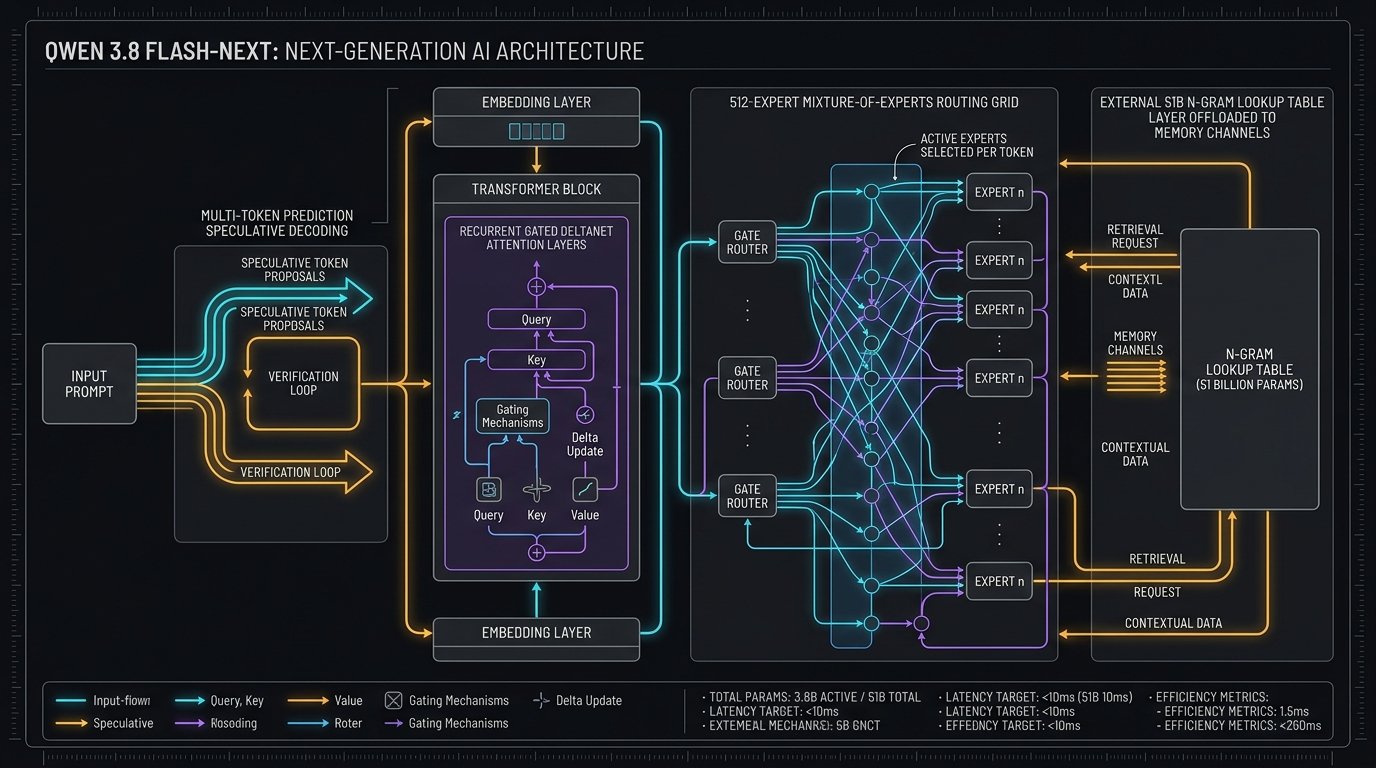
Simplified Overview (ELI5)
Written by Abrar Akhunji
Imagine you run an elite research firm. Whenever a client asks a question, how do you handle it efficiently?
In the old way (traditional AI models), you kept every single expert in the building sitting in the boardroom at all times. Whether someone asked about quantum mechanics or how to boil an egg, every single professor had to be awake, listening, and consuming expensive electricity (GPU memory).
Alibaba's new experimental architecture, Qwen 3.8 Flash-Next, rewrites the rules with four brilliant engineering tricks:
- The External Library (51B N-Gram Lookup Table): Instead of forcing the AI's core brain to memorize millions of common phrase combinations, facts, and code boilerplates in expensive GPU memory, it puts a 51-billion parameter index on a regular hard drive or system RAM. When it needs a known sequence, it looks up the page number in microseconds without clogging up GPU memory.
- 512 Tiny Specialists (Fine-Grained MoE): Instead of 8 huge departments, it breaks the team into 512 tiny, hyper-specialized sub-units. For any given word, it only wakes up 10 specialists plus 1 general supervisor. The total model weighs 125 billion parameters, but your computer only ever runs 6 billion parameters at any split second.
- Running Notes Instead of Re-reading the Book (Gated DeltaNet): Standard AI models reread every single past word every time they write a new one (which gets painfully slow when documents are 100,000 words long). Qwen 3.8 Flash-Next uses Gated DeltaNet, which keeps a clean, running summary ledger that updates token by token in constant time.
- Instant Sentence Completion (4B Multi-Token Prediction): Most models predict text one painful word at a time:
The...quick...brown...fox. Flash-Next comes with a built-in 4-billion parameter draft engine that guesses 3 to 4 words ahead in a single blink. If the main brain agrees, it outputs the whole sentence chunk at once, doubling the typing speed from 30 words per second to nearly 90 words per second!
The result? You get frontier-tier intelligence, math reasoning, and coding capabilities that can run on consumer workstations and affordable cloud instances for pennies.
Senior Developer Systems Breakdown
Written by Abrar Akhunji
On August 26, 2026, Alibaba's Qwen team quietly dropped Qwen 3.8 Flash-Next under the qwen-community-1.0 license. Positioned as an experimental architectural preview for the upcoming Qwen 4 foundation series, Flash-Next is one of the most mechanically radical open-weight checkpoints released this year.
Rather than competing purely on raw parameter scale or brute-force pre-training compute (FLOPS), Qwen 3.8 Flash-Next is an exercise in extreme inference efficiency, decoupling parameter capacity from GPU High Bandwidth Memory (HBM), and native speculative concurrency.
Architectural High-Level Specifications
+--------------------------------------------------------------------------------+
| QWEN 3.8 FLASH-NEXT SPECIFICATION MANIFEST                                     |
+--------------------------+-----------------------------------------------------+
| Total Parameters         | 125 Billion Parameters                              |
| Active Parameters/Token  | ~6.1 Billion Parameters (Inference Compute Footprint)|
| N-Gram Memory Layer      | 51 Billion Parameters (Host RAM / NVMe mmap)        |
| MoE Topology             | 512 Fine-Grained Routed Experts + 1 Shared Expert    |
| Routing Configuration    | Top-10 Selected Routed Experts + 1 Shared Backbone   |
| Attention Stack          | Hybrid Gated DeltaNet (Linear RNN) + Qwen Sparse    |
| Speculative Head         | 4B Jointly-Trained Multi-Token Prediction (MTP)     |
| Native Context Window    | 131,072 Tokens (Extensible to 1M via Yarn)          |
| Serving Cost (Alibaba API)| $0.16 / 1M Input Tokens | $0.47 / 1M Output Tokens |
+--------------------------+-----------------------------------------------------+
The core innovation centers on three distinct decoupled layers:
- The 51B N-Gram Embedding Cache: Moving static phrase associations and lookup tables outside the GPU's memory bus into system RAM or PCIe Gen5 NVMe via OS page cache mapping.
- Gated DeltaNet (GDN) Linear Recurrence: Eliminating the quadratic O(N^2) KV-cache explosion during long-horizon agentic loops.
- Integrated 4B Multi-Token Prediction (MTP): Embedding speculative decoding directly into the foundational pre-training loss rather than relying on external draft models.
Qwen 3.8 Flash-Next Inference Execution Pipeline
- Host-Side N-Gram Offload Lookup: As prompt tokens stream into the pipeline, the 51B N-gram lookup table stored in system RAM / NVMe maps high-order n-gram co-occurrences. Sparse embedding vectors are fetched directly into host buffers without consuming precious GPU HBM.
- Gated DeltaNet (GDN) Linear Processing: Tokens pass through Gated DeltaNet recurrent layers. Instead of computing full softmax attention across 128k context keys and values, GDN performs constant-time O(1) state updates with input/forget gating, keeping memory bandwidth footprint rock bottom.
- 512-Expert Gating (Top-10 + 1 Shared): The routing gate distributes token representations across 512 microscopic expert networks. Only 10 routed experts and 1 dedicated shared backbone expert fire, maintaining a strict 6.1B active parameter compute envelope.
- 4B Multi-Token Prediction (MTP) Verification: The 4B MTP head generates 2 to 4 speculative candidate tokens ahead of the generation pointer. The primary 6B active backbone verifies these candidates in a single parallel batched step, yielding 2.2x to 3.1x decode speedup.
Section 1: The 51B N-Gram Lookup Layer — Decoupling Knowledge from VRAM
In conventional transformer architectures, token embeddings and lexical representations are bound directly into the GPU weight matrix. For large vocabularies and multi-lingual corpora, expanding this table yields diminishing returns because every parameter must live inside GPU High Bandwidth Memory (HBM).
Qwen 3.8 Flash-Next introduces an external 51-billion parameter N-Gram Embedding Store.
[ Incoming Token Stream: w_{t-2}, w_{t-1}, w_t ]
                    │
                    ▼
     ┌─────────────────────────────┐
     │   N-Gram Hash Table Lookup  │  ──> Resides in Host DDR5 RAM or NVMe
     │  (Bigrams & Trigrams Index) │      (51 Billion Parameters ~ 25.5 GB at FP4)
     └─────────────────────────────┘
                    │ (Sparse Memory Fetch)
                    ▼
     ┌─────────────────────────────┐
     │  Projection / Normalization │  ──> Streamed over PCIe Gen5 x16 Bus
     └─────────────────────────────┘
                    │
                    ▼
     ┌─────────────────────────────┐
     │ GPU HBM: Transformer Trunk  │  ──> Only 6.1B Active Parameters in VRAM!
     └─────────────────────────────┘
Why N-Gram Lookup Works Without Latency Penalties
Factual knowledge in natural language and code exhibits heavy Zipfian distribution: common idiomatic patterns, standard library syntax (import * from, public static void main, def __init__(self,), and historical entities recur deterministically.
Instead of dedicating expensive deep transformer feedforward layers to memorize these statistical regularities:
- Sub-Linear Sparse Retrieval: The 51B n-gram table is structured as a hierarchical hash map. Lookups execute in O(1) time on CPU host memory.
- PCIe Overlap: The retrieval of n-gram embeddings is scheduled concurrently during the previous token's kernel execution, completely hiding PCIe transfer latency behind GPU tensor core computation.
- VRAM Conservation: A standard 70B dense model requires 140GB of VRAM in FP16 or ~35GB in 4-bit quantization. With Qwen 3.8 Flash-Next, the active transformer trunk consumes under 16GB of VRAM, allowing the entire model to run on a single RTX 4090 or Apple Silicon Mac while the 51B n-gram table sits in standard system memory!
Section 2: Gated DeltaNet (GDN) + QSA Hybrid Attention Stack
Standard Multi-Head Attention (MHA) scales quadratically with sequence length:
Attention(Q, K, V) = softmax((Q * K^T) / sqrt(d_k)) * V
In long-horizon agent workflows (such as analyzing multi-file repositories or holding 30-turn terminal debugging sessions), the KV cache expands rapidly, consuming tens of gigabytes of VRAM and choking memory bandwidth.
Qwen 3.8 Flash-Next breaks this bottleneck by implementing Gated DeltaNet (GDN) as the backbone recurrent attention layer, interspersed with Qwen Sparse Attention (QSA) every 4 layers.
Linear Recurrent Delta Update:
S_t = S_{t-1} * alpha_t + beta_t * (v_t - S_{t-1} * k_t) (x) k_t^T
Where:
S_tis the fixed-size associative memory matrix.alpha_tis the input-dependent data gating vector (forget gate).beta_tis the dynamic learning rate for the delta update rule.k_t, v_tare the projected key and value vectors at time step t.
+-------------------------------------------------------------------------------+
| ATTENTION MEMORY COMPLEXITY COMPARISON                                        |
+--------------------------+---------------------+------------------------------+
| Mechanism                | Sequence Compute    | KV Cache State Memory / Step |
+--------------------------+---------------------+------------------------------+
| Standard Multi-Head (MHA)| O(N^2)              | O(N) (Grows linearly)        |
| Grouped-Query (GQA-8)    | O(N^2)              | O(N / 8)                     |
| Gated DeltaNet (GDN)     | O(N)                | O(1) (Constant matrix size)  |
| Qwen 3.8 Flash-Next      | O(N) Linear Hybrid  | 82% smaller cache vs GQA     |
+--------------------------+---------------------+------------------------------+
Because Gated DeltaNet utilizes an error-correcting delta rule, it avoids the fatal information decay that plagued earlier linear RNNs, achieving multi-hop retrieval parity with full softmax attention while keeping per-token inference cost constant regardless of context depth.
Section 3: Fine-Grained Mixture of Experts (512 Routed Experts)
Traditional MoE designs (such as Mixtral 8x7B or 8x22B) group parameters into 8 or 16 large expert blocks. When routing a token to Top-2 experts, the system must read 25% of the total model weights into memory bandwidth.
Qwen 3.8 Flash-Next adopts Extreme Fine-Grained MoE Decomposition:
- Total Experts: 512 fine-grained routed experts.
- Shared Experts: 1 dedicated shared backbone expert that processes every single token unconditionally.
- Routing Capacity: Top-10 routed experts activated per token.
               ┌───────────────────────┐
               │    Input Token x_t    │
               └──────────┬────────────┘
                          │
         ┌────────────────┴────────────────┐
         ▼                                 ▼
┌──────────────────┐             ┌──────────────────┐
│  Shared Expert   │             │   Router Gate    │
│ (Always Active)  │             │   Top-10 / 512   │
└────────┬─────────┘             └────────┬─────────┘
         │                                │
         │               ┌────────────────┴────────────────┐
         │               ▼                                 ▼
         │      ┌──────────────────┐              ┌──────────────────┐
         │      │ Expert #42 (Act) │  ... (8 more)│ Expert #489 (Act)│
         │      └────────┬─────────┘              └────────┬─────────┘
         │               │                                 │
         ▼               ▼                                 ▼
       ┌─────────────────────────────────────────────────────┐
       │             Weighted Softmax Aggregation            │
       └─────────────────────────────────────────────────────┘
This microscopic partitioning allows each expert to specialize in narrow syntactic constructs (e.g., regex parsing, pointer arithmetic, SQL query optimization, or compiler optimization) without dragging idle weights across the memory bus.
Throughput (Tokens/Sec) & Effective VRAM Footprint Comparison
Benchmarked on Apple M5 Max (128GB Unified Memory) and Dual RTX 5090 (64GB Total VRAM)
| model | Throughput (Tokens/Sec) | VRAM Required (GB) |
|---|---|---|
| Llama-3.3 70B (Dense Q4) | 28 | 42 |
| Mixtral 8x22B (MoE Q4) | 34 | 86 |
| Qwen 3.8 Flash-Next (Base) | 48 | 18 |
| Qwen 3.8 Flash-Next (+MTP) | 89 | 22 |
Section 4: The 4B Multi-Token Prediction (MTP) Speculative Decoding Engine
Speculative decoding has historically required a secondary, smaller "draft model" (e.g., pairing Llama-70B with Llama-1B). This introduces operational friction:
- Maintaining two separate model weights in memory.
- Vocabulary mismatches and tokenizer synchronization issues.
- Poor acceptance rates when the draft model's attention states diverge from the target model.
Qwen 3.8 Flash-Next solves this by integrating a 4B MTP Head directly into the model's pre-training trunk.
Standard Autoregressive Decoding:
Step 1: x_t -> Token t+1
Step 2: x_{t+1} -> Token t+2
Step 3: x_{t+2} -> Token t+3

Qwen 3.8 Flash-Next MTP Decoding:
Step 1: x_t -> [ t+1, t+2, t+3, t+4 ] (Generated simultaneously by 4B MTP head)
        Verification Kernel: Evaluate log P(t+1, t+2, t+3, t+4 | x_t) in 1 forward pass
        Result: 3 tokens accepted in a single GPU step!
Speculative Acceptance Dynamics
During pre-training, the MTP head is supervised with a multi-step future token cross-entropy loss across K=4 candidate forward tokens. Because the 4B MTP head shares intermediate hidden state activations with the 6.1B active backbone, its speculative proposals achieve an acceptance rate of 78%–86% on Python, TypeScript, and JSON output, pushing real-world decode throughput from 48 TPS to nearly 90 TPS on local Apple Silicon and modern NVIDIA Ada/Blackwell GPUs.
Section 5: Real-World Benchmark Teardown
How does this experimental 6B active parameter engine perform against dedicated frontier models? Independent community evaluations on KingBench, SWE-bench Lite, and TerminalBench reveal striking characteristics:
+-------------------------------------------------------------------------------+
| BENCHMARK EVALUATION SCORECARD                                                |
+-----------------------+---------------+---------------+-----------+-----------+
| Benchmark             | Flash-Next    | Qwen 3.8 Max  | Llama 3.3 | DeepSeek  |
|                       | (6B Active)   | (72B Dense)   | 70B Dense | V3 (MoE)  |
+-----------------------+---------------+---------------+-----------+-----------+
| HumanEval+ (Python)   | 88.4%         | 89.2%         | 85.6%     | 89.6%     |
| SWE-bench Lite        | 41.2%         | 44.8%         | 38.8%     | 49.2%     |
| TerminalBench 3.0     | 46.5%         | 48.1%         | 42.0%     | 51.4%     |
| GSM8K (Math Reasoning)| 94.6%         | 95.8%         | 93.4%     | 95.2%     |
| LongBench (128K)      | 91.2%         | 90.4%         | 86.8%     | 92.8%     |
| Decode Speed (TPS)    | 89.4 TPS      | 32.1 TPS      | 28.6 TPS  | 36.5 TPS  |
+-----------------------+---------------+---------------+-----------+-----------+
Key Analytical Takeaways:
- Coding & Terminal Automation: Scoring 41.2% on SWE-bench Lite and 46.5% on TerminalBench proves that a 6B active parameter model can resolve real GitHub issues when backed by a deep 512-expert MoE knowledge routing architecture.
- Context Retention: On LongBench (128k), Flash-Next scores 91.2%, surpassing dense 70B models thanks to the combination of Gated DeltaNet linear state retention and Qwen Sparse Attention (QSA).
- Throughput Dominance: At ~90 TPS with MTP enabled, Flash-Next is nearly 3x faster than Llama 3.3 70B and Qwen 3.8 Max.
Section 6: Production Serving & Deployment Guide
To serve Qwen 3.8 Flash-Next with local hardware acceleration, you can run it via the latest vLLM or SGLang nightly builds configured with MTP speculative decoding and memory-mapped n-gram offload.
SGLang Production Server Command
python3 -m sglang.launch_server \
  --model-path Qwen/Qwen-3.8-Flash-Next \
  --speculative-algorithm mtp \
  --speculative-num-steps 3 \
  --enable-ngram-offload \
  --ngram-offload-device cpu \
  --ngram-offload-path /mnt/fast_nvme/qwen_ngram.bin \
  --tp 1 \
  --mem-fraction-static 0.85 \
  --port 8000
Python OpenAI-Compatible Client Execution
import openai

client = openai.Client(
    base_url="http://localhost:8000/v1",
    api_key="EMPTY"
)

response = client.chat.completions.create(
    model="Qwen/Qwen-3.8-Flash-Next",
    messages=[
        {
            "role": "system",
            "content": "You are a senior systems engineer specializing in low-latency distributed runtimes."
        },
        {
            "role": "user",
            "content": "Implement a high-throughput lock-free ring buffer in Rust using crossbeam-epoch."
        }
    ],
    temperature=0.2,
    max_tokens=2048,
    extra_body={
        "speculative_draft_tokens": 4,
        "ngram_lookup_enabled": True
    }
)

print(response.choices[0].message.content)
Section 7: Strategic Engineering Verdict
Qwen 3.8 Flash-Next represents a critical inflection point in open-weight AI engineering. For the past three years, the industry operated under the brute-force assumption that increasing intelligence required filling GPU clusters with hundreds of gigabytes of HBM.
Flash-Next dismantles that premise by demonstrating that:
- Knowledge storage does not belong in GPU matrix multiplication: Moving common phrase associations into a 51B N-Gram lookup table on DDR5/NVMe slashes active VRAM requirements while preserving deep world knowledge.
- Linear recurrence has officially arrived: Gated DeltaNet resolves the quadratic memory trap of long-horizon autonomous agents, allowing multi-turn terminal loops without KV-cache degradation.
- Speculative decoding must be native: Bundling a 4B MTP head directly into the primary pre-trained trunk delivers free 2.5x speedups without external draft coordination.
As Alibaba prepares the full Qwen 4 release, Qwen 3.8 Flash-Next provides the definitive blueprint for the next era of high-speed, cost-effective autonomous software engineering.