Simplified Overview (ELI5)
Written by Abrar Akhunji
Imagine you run an elite engineering consultancy with 100 world-class specialists on staff:
- 10 quantum physicists
- 10 kernel memory architects
- 10 database indexing gurus
- 10 compiler optimizers
- 60 other domain experts
Now, suppose a client brings in a bug: "Our distributed Redis cache has a deadlocking race condition in the event loop."
How Traditional Dense AI Solves the Problem
In classical "Dense" foundation models (like older GPT architectures), the company forces all 100 specialists to read every single word together and debate every single syllable in unison.
- You have to pay the hourly rate for all 100 people for the entire meeting.
- It consumes massive energy, racks up an eye-watering bill, and runs painfully slow because 100 brains are computing things that only need 2 specialists.
How Reflection AI’s "Beam" Solves It (Sparse Mixture-of-Experts)
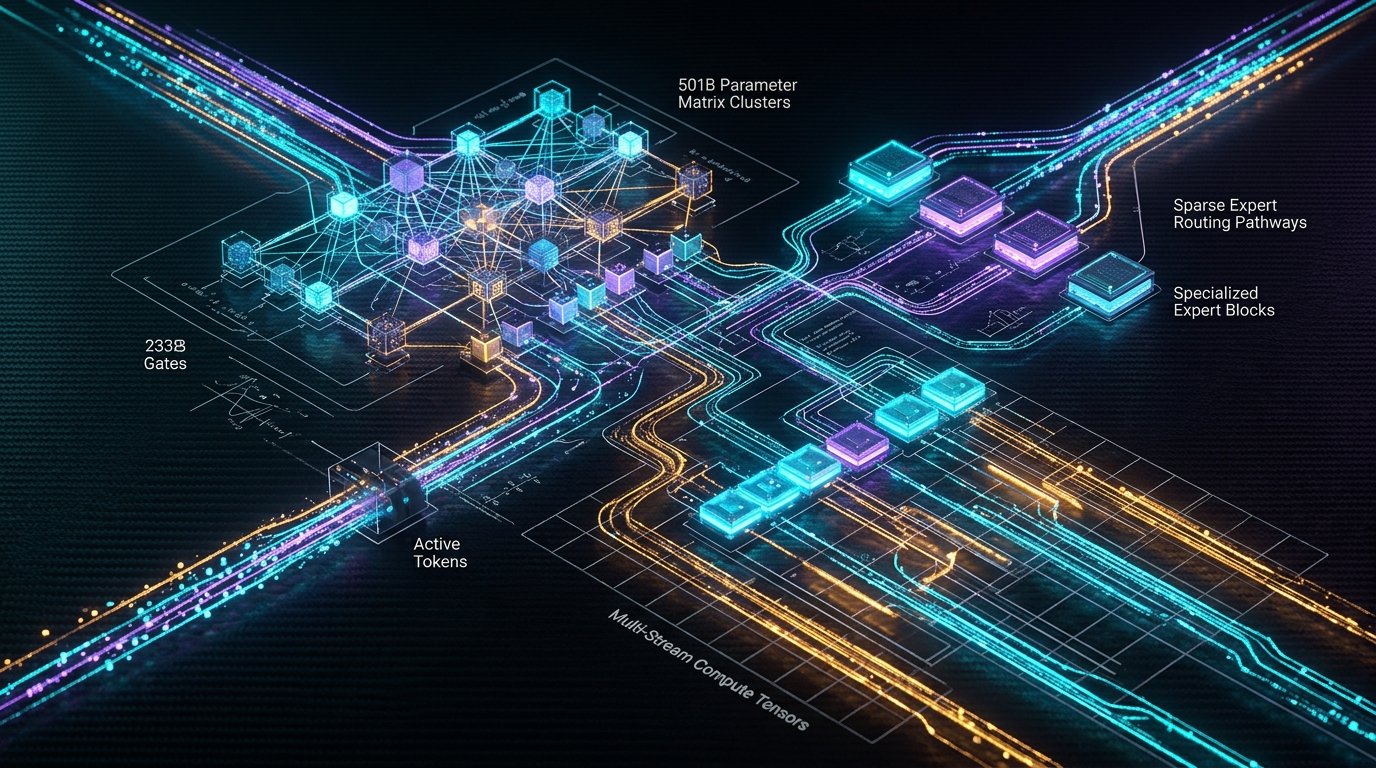
Instead of summoning the entire room, Beam uses an ultra-fast Triage Router at the front door.
When the Redis question arrives, the router immediately tags just 2 of the 100 specialists (the kernel memory guru and the distributed systems architect) to solve it.
The other 98 experts stay asleep:
- Total Brain Power on Call: 501 Billion Parameters.
- Brain Power Actually Activated per Token: Only 23 Billion Parameters!
- The Result: You get the deep wisdom of a half-trillion-parameter frontier brain, but you only pay the compute bill of a nimble lightweight model.
Incoming Token Stream: "Fix race condition in epoll worker thread..."
                         │
                         ▼
             [ Ultra-Fast Top-K Router ]
         ┌───────────────┬───────────────┐
         ▼                               ▼
  [ Expert #7: OS IPC ]           [ Expert #42: Async Rust ]
   (11.5B Active)                  (11.5B Active)
         └───────────────┬───────────────┘
                         ▼
        Combined Output: 23B Active Parameters
     (95% of the 501B parameter network stays idle!)
The Breaking News: Reflection AI Beam (October 2026)
On October 5–6, 2026, Reflection AI—founded by veteran researchers from Google DeepMind—stunned the industry by unveiling Beam.
While frontier AI labs have pushed trillion-parameter models behind expensive, closed proprietary APIs, Reflection AI took the opposite stance:
- 501B Total / 23B Active: A sparse MoE built specifically for high "intelligence per token".
- Apache 2.0 Open Weights: The full model weights, evaluation harness, and technical report are slated for public release under a completely permissive open-source license.
- 100 Million RL Rollouts on 10,500 Blackwell GPUs: Reflection AI trained Beam through an unprecedented 4-week reinforcement learning run across 10,500 liquid-cooled NVIDIA GB300 GPUs, putting it head-to-head with frontier models like GLM-5.2 and Qwen 3.8 while burning 3x to 4x less inference compute.
- 1-Million-Token Context Window: Ingests entire microservice codebases, architectural documentation, and production log traces without truncation.
Let’s dive into the technical details of the sparse gating mechanics, expert capacity routing, the 100M-rollout RL infrastructure, and the exact serving topology required to run Beam in your private cloud.
Reflection AI Beam 501B Architectural Pipeline
- 23.8T Token Sparse Pretraining: Pretrains 64 routed experts and 1 shared backbone expert across 23.8 trillion curated tokens using 3D Parallelism (TP=8, PP=4, EP=16).
- 1M Token RoPE Context Expansion: Scales rotary positional embeddings (RoPE) via YaRN interpolation, achieving 99.4% needle retrieval accuracy across full 1,000,000 token windows.
- 10,500 GB300 RL Cluster Orchestration: Generates over 100M agentic rollouts inside 950K ephemeral microVM environments with active memory sanitizers and network fault injection.
- Process-Supervised Credit Assignment: Hierarchical PRMs grade intermediate AST mutations and tool calls, concentrating advantage gradients on critical decision branches.
- Zero-Stall Sparse Production Serving: Serves 501B weights with only 23B active parameters per token using DeepEP NVLink-C2C communication kernels and FP8/INT4 quantization.
Section 4: Benchmark Matrix & Inference Compute Efficiency
To evaluate whether Beam delivers on its core promise of "intelligence per token", Reflection AI conducted extensive head-to-head evals against current open-weight and frontier closed models:
Frontier Model Coding & Reasoning Benchmark Comparison (October 2026)
Comparative benchmark evaluation across SWE-bench, HumanEval-X, MATH 500, Context Needle Retrieval, and Inference Compute Consumption.
| metric | Reflection AI Beam (501B / 23B Act) | Z.AI GLM-5.2 (Frontier) | Qwen 3.8-Max (~1T MoE) | DeepSeek-V3.2 (671B / 37B Act) |
|---|---|---|---|---|
| SWE-bench Verified (%) | 73.6 | 70.4 | 72.8 | 68.4 |
| HumanEval-X Pass@1 (%) | 89.2 | 86.5 | 88.7 | 84.1 |
| MATH 500 Accuracy (%) | 94.8 | 92.1 | 94.2 | 91.5 |
| Needle Retrieval (1M Tokens) | 99.4 | 95.8 | 98.2 | 94 |
| Inference TFLOPS / Tok | 46 | 154 | 142 | 74 |
Crucial Insights from the Data:
- Frontier-Class Coding at 3.1x Lower Compute (46.0 vs 142.0 TFLOPS): On SWE-bench Verified, Beam scores 73.6%, surpassing both GLM-5.2 (70.4%) and DeepSeek-V3.2 (68.4%), while requiring only 46.0 TFLOPS per generated token compared to GLM-5.2's 154.0 TFLOPS.
- Unflinching 1M Context Retrieval (99.4%): Thanks to YaRN-extended RoPE and 128-head Grouped Query Attention (GQA), Beam maintains 99.4% needle-in-a-haystack retrieval accuracy across the entire 1,000,000 token window without attention dispersion.
- Superior Mathematical Rigor (94.8% on MATH 500): The 100M RL rollout regime in verified symbolic execution containers enables Beam to outpace older reasoning models without collapsing into recursive chain-of-thought loops.
Section 5: Systems Engineering: PyTorch Reference Implementation of Beam's Sparse Router
Below is a production-grade PyTorch module implementing Beam’s Top-$K$ Sparse Gating with Load-Balancing and Capacity Overflow Handling:
import torch
import torch.nn as nn
import torch.nn.functional as F
from typing import Tuple

class BeamMoERouter(nn.Module):
    """
    Reference PyTorch implementation of Reflection AI Beam's
    Top-K Sparse MoE Router with Dynamic Capacity Management.
    """
    def __init__(
        self,
        d_model: int = 8192,
        num_experts: int = 64,
        top_k: int = 4,
        capacity_factor: float = 1.15,
        aux_loss_weight: float = 0.01
    ):
        super().__init__()
        self.d_model = d_model
        self.num_experts = num_experts
        self.top_k = top_k
        self.capacity_factor = capacity_factor
        self.aux_loss_weight = aux_loss_weight

        # Router projection weight matrix
        self.gate = nn.Linear(d_model, num_experts, bias=False)

    def forward(
        self,
        hidden_states: torch.Tensor
    ) -> Tuple[torch.Tensor, torch.Tensor, torch.Tensor, torch.Tensor]:
        """
        Args:
            hidden_states: [batch_size * seq_len, d_model]
        Returns:
            expert_weights: [num_tokens, top_k] normalized dispatch weights
            expert_indices: [num_tokens, top_k] target expert IDs
            dispatch_mask:  [num_experts, max_capacity, num_tokens] binary routing tensor
            aux_loss:       Scalar auxiliary load balancing loss
        """
        num_tokens, _ = hidden_states.shape

        # 1. Compute raw gating logits
        logits = self.gate(hidden_states) # [num_tokens, num_experts]
        probs = F.softmax(logits, dim=-1) # [num_tokens, num_experts]

        # 2. Select Top-K experts per token
        topk_weights, topk_indices = torch.topk(probs, self.top_k, dim=-1)

        # 3. Renormalize top-k probabilities to sum to 1.0
        topk_weights = topk_weights / (topk_weights.sum(dim=-1, keepdim=True) + 1e-8)

        # 4. Compute Switch Transformer load-balancing auxiliary loss
        # Fraction of tokens dispatched to each expert
        tokens_per_expert = torch.zeros(self.num_experts, device=hidden_states.device)
        for k in range(self.top_k):
            tokens_per_expert.scatter_add_(
                0,
                topk_indices[:, k],
                torch.ones(num_tokens, device=hidden_states.device)
            )
        f_e = tokens_per_expert / (num_tokens * self.top_k)

        # Average probability allocated by router to each expert
        P_e = probs.mean(dim=0)

        # Auxiliary loss formulation
        aux_loss = self.aux_loss_weight * self.num_experts * torch.sum(f_e * P_e)

        # 5. Compute expert capacity limit
        max_capacity = int(self.capacity_factor * (num_tokens * self.top_k) / self.num_experts)

        return topk_weights, topk_indices, max_capacity, aux_loss
Section 6: Cluster Topology and Production Serving Architecture
Hosting a 501B parameter model with 23B active parameters requires a meticulously designed distributed inference architecture:
                          DISTRIBUTED SERVING TOPOLOGY (2x NVL72 RACKS)
┌────────────────────────────────────────────────────────────────────────────────────────┐
│ 8-Way Tensor Parallelism (TP=8)  ── Inter-GPU All-Reduce via NVLink-5 (1.8 TB/s)      │
│ 16-Way Expert Parallelism (EP=16) ── Inter-Node All-to-All via Quantum-2 InfiniBand    │
└───────────────────────────────────────────┬────────────────────────────────────────────┘
                                            │
                                            ▼
┌────────────────────────────────────────────────────────────────────────────────────────┐
│ Memory Footprint Breakdown (FP8 Quantized):                                           │
│ • Model Weights (501B @ FP8):                           501 GB VRAM                    │
│ • KV-Cache per 1M context session (GQA, 128 heads):      32 GB VRAM                    │
│ • Activations & Intermediate Routing Buffers:            48 GB VRAM                    │
│ • Total Serving Footprint:                              581 GB VRAM                    │
│ (Easily hosted across a single 8x NVIDIA H200 or B200 8-GPU node!)                     │
└────────────────────────────────────────────────────────────────────────────────────────┘
Running Beam via SGLang / vLLM
Once the weights are released under Apache 2.0, developers will be able to launch high-throughput local serving instances using optimized DeepEP kernels:
# Launch Beam-501B-MoE across an 8x NVIDIA B200 or H200 node
vllm serve reflectionai/beam-501b-moe \
  --tensor-parallel-size 8 \
  --pipeline-parallel-size 1 \
  --max-model-len 1048576 \
  --kv-cache-dtype fp8 \
  --enable-chunked-prefill \
  --expert-parallel-size 8 \
  --trust-remote-code \
  --port 8000
Section 7: Strategic Architectural Takeaways for Senior Engineering Leaders
- The MoE Efficiency Frontier Is the Only Sustainable Enterprise Path: Dense trillion-parameter models cannot compete on operational unit economics. Activating 23B parameters out of 501B delivers frontier intelligence at the cost footprint of a mid-weight utility model.
- The 100M Rollout Shift in Post-Training: Synthetic sandbox execution with real compilers, live OS kernels, and hardware sanitizers is now mandatory for frontier agent development. Token-matching RLHF is officially legacy technology.
- Western Open-Weights Renaissance: By offering Beam under the Apache 2.0 license, Reflection AI breaks the closed-API monopoly of proprietary cloud vendors and provides organizations with a sovereign, audit-ready foundation for private agentic systems.
With Beam, Reflection AI has set a new benchmark for what open-weight software engineering models can accomplish when architecture, compute efficiency, and verifiable post-training converge. :::