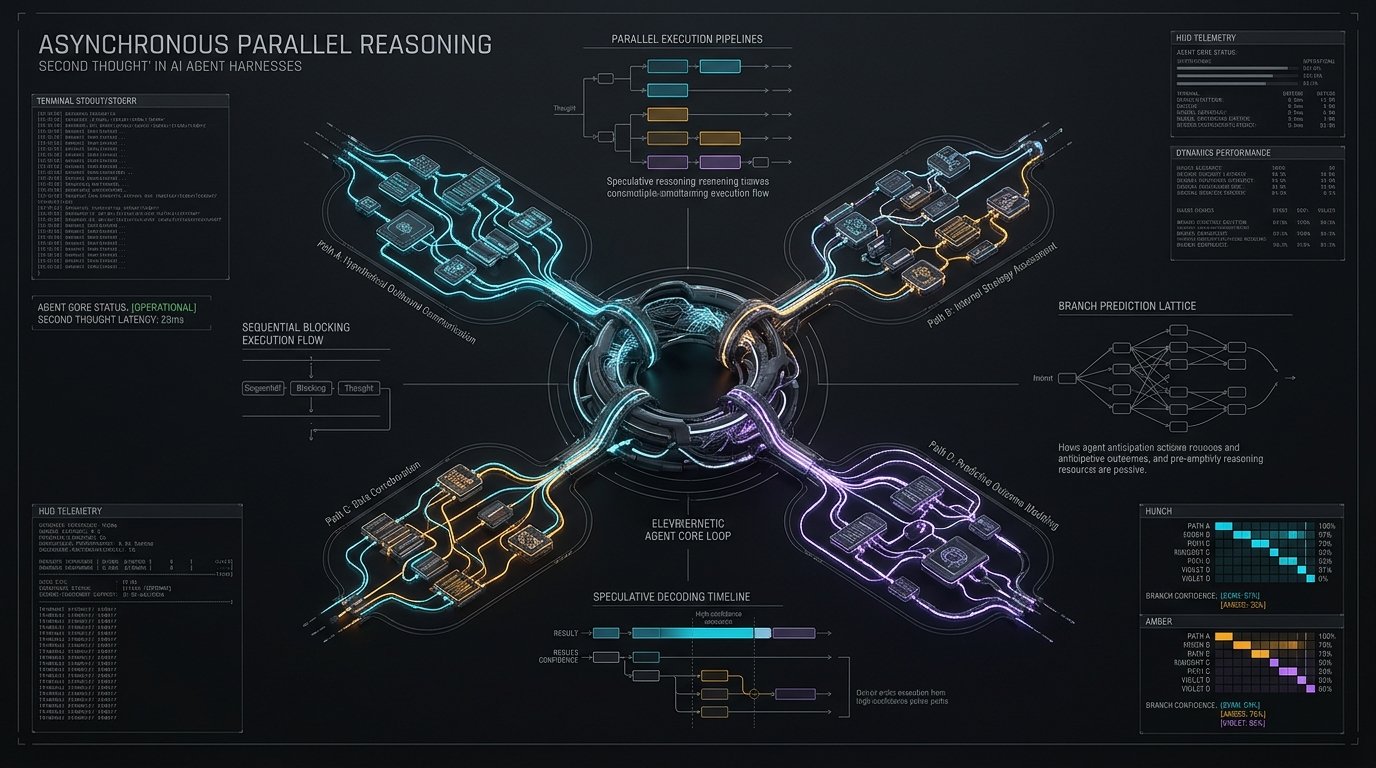
Simplified Overview (ELI5)
Written by Abrar Akhunji
Have you ever played chess against someone who sits completely frozen on their turn, but the second you hit the chess clock, they instantly make their move?
They didn't just start thinking when their clock started ticking. They used your turn to calculate their future moves.
Now, compare that grandmaster to how every major AI coding agent works today.
                    THE COGNITIVE IDLE TRAP: STANDARD REACT VS. SECOND THOUGHT

    Standard Synchronous ReAct Agent (Blocking Idle Window)
   ┌──────────────┐      ┌──────────────┐      ┌───────────────────────────┐      ┌──────────────┐
   │ Think Step 1 │ ───► │ Run Compiler │ ───► │  BLANK STARE (IDLE WAIT)  │ ───► │ Think Step 2 │
   │ (Active GPU) │      │ (Emit Bash)  │      │  GPU sits frozen for 15s  │      │ (From Zero)  │
   └──────────────┘      └──────────────┘      └───────────────────────────┘      └──────────────┘
                                                 [ 60% - 85% Wasted Wall-Clock Time ]

    Second Thought Architecture (Concurrent Speculative Pipelining)
   ┌──────────────┐      ┌──────────────┐
   │ Think Step 1 │ ───► │ Run Compiler │
   │ (Active GPU) │      │ (Dispatched) │
   └──────────────┘      └──────┬───────┘
                                │
               ┌────────────────┴────────────────┐  Fork 4 Speculative Branches Concurrently
               ▼                                 ▼  While Bash / Compiler is Running
       ┌───────────────┐                 ┌───────────────┐
       │ Branch A:     │                 │ Branch B:     │
       │ "If it fails  │                 │ "If it passes │
       │  on line 42,  │                 │  unit tests,  │
       │  patch regex" │                 │  benchmark QPS"│
       └───────┬───────┘                 └───────┬───────┘
               │                                 │
               └────────────────┬────────────────┘  Compiler finishes! True stdout arrives:
                                ▼
                     ┌───────────────────────┐
                     │ Reconcile & Merge     │ ───► Instant action! Zero cold-start latency.
                     │ (Pick winning branch) │      43% less sequential decoding time.
                     └───────────────────────┘
The Flaw in Today’s AI Agents: The "Blank Stare"
Whether you use Claude Code, Devin, Cursor Agent, or OpenCode, all modern agents run on a loop invented in 2022 called ReAct (Reason $\to$ Act $\to$ Observe):
- Reason: The AI writes a internal thought about what code to touch.
- Act: It runs a shell command, like
cargo testornpm run build. - Observe: It sits completely motionless, waiting for the terminal output.
Here is the dirty secret senior engineers know about running AI agents on real codebases: The AI spends 60% to 85% of its entire lifespan doing absolutely nothing.
While your compiler compiles, while Docker spins up a container, or while Playwright loads a web page, the frontier model's multi-million dollar GPU cluster is idling at 0% compute. It stares blankly at the wall. Then, when the terminal output finally lands, it wakes up from a cold start, scratches its head, and starts reasoning from scratch.
Enter "Second Thought": The Grandmaster AI Harness
A breakthrough research architecture from Sun, Yang, Lyu, Shi, and Lo (SMU, late 2026) titled "Second Thought: Reasoning in Parallel as LLM Agents Act and Observe" completely demolishes this sequential bottleneck.
Instead of freezing the agent while an external tool executes, Second Thought forks four parallel reasoning "minds" the millisecond an action leaves the door:
- Mind 1 assumes success: "If the build passes, what file do we refactor next? Let's draft the database migration now."
- Mind 2 anticipates a syntax error: "If the compiler complains about missing lifetime annotations on line 88, here is the exact BorrowMut fix."
- Mind 3 anticipates a runtime panic: "If the test times out on Redis connection pool exhaustion, let's trace the keepalive heartbeat."
- Mind 4 prepares verification tests: "Let's draft edge-case fuzzing inputs to stress-test the new parser."
When the actual terminal output arrives 10 seconds later, Second Thought runs a lightning-fast Reconciliation Engine. It matches the true stdout/stderr against its four pre-calculated branches, throws away the irrelevant ones, and instantly merges the winning thoughts right into the agent's main consciousness.
The Real-World Impact
- 43% Less Sequential Decoding: The agent doesn't need to spend 30 seconds thinking about what went wrong because it already figured out the solution while the command was running.
- Fewer Wasted Turns: Across 100% of tested agent benchmarks, task completion took fewer back-and-forth steps.
- Up to +12.4% Higher Accuracy: Unlike brute-force "think harder" models that get lost in recursive hallucinations, speculative parallel branching keeps the model grounded in concrete hypothetical outcomes.
Think of it like out-of-order execution in your computer's CPU, but for AI thoughts. Let’s dive under the hood to see the exact mathematics, KV cache memory topology, and production Python code that makes Second Thought tick.
Second Thought Execution Lifecycle vs Classical ReAct
- Instantaneous Branch Forking: The exact millisecond the agent serializes a tool call (shell command, SQL query, API call), Second Thought forks K=4 auxiliary threads sharing the exact prefix KV cache.
- Concurrent Speculative Decoding: While the shell environment executes the blocking command (taking 3s to 30s), auxiliary workers speculatively decode alternate continuations and counterfactual edge cases.
- Asynchronous Telemetry Capture: The external environment returns true stdout, stderr, or JSON payload. The blocking I/O barrier resolves.
- Semantic Matching & Tree Merge: The Reconciliation Operator matches observation truth against branch assumptions, pruning falsified paths and merging the winning hypothesis into the main context.
Main-Thread Sequential Decoding Reduction Across Benchmarks
Percentage reduction in sequential critical-path decoding tokens achieved by Second Thought compared to baseline ReAct (Sun et al., 2026).
| benchmark |
|---|
| SWE-bench (Software Eng) |
| WebArena (Browser Agent) |
| ToolBench (API Tool Use) |
| BashBench (System Admin) |
1. Turn Count Reductions
In all 9 out of 9 (model, benchmark) pairs, Second Thought reduced the average number of interaction turns required to resolve the task. Because the agent speculatively analyzes edge cases during I/O, it makes fewer exploratory "blind poke" tool calls.
2. Sequential Decoding Reduction
Main-thread sequential decoding tokens were reduced by up to 43.1% (averaging ~22% across all configurations). Because future thoughts were synthesized off the critical path, the agent’s sequential wall-clock latency dropped precipitously.
3. Domination Over Compute-Matched Controls
A critical scientific question posed by the authors: What if we simply gave the standard ReAct agent the same total FLOP budget by forcing it to think longer on its main thread?
When tested against this Compute-Matched Sequential Control, Second Thought achieved:
- Strictly higher Pass@1 accuracy across all settings (delivering between +10.2 and +12.4 percentage points higher success rates).
- 1.3x to 3.2x less sequential decoding time.
When an agent is forced to do deep reasoning in a single monolithic sequential thread, it is prone to cognitive drift and self-reinforcing delusion loops. Distributing that compute across diverse, orthogonal speculative branches grounded in concrete potential observation states acts as a powerful regularizer, pruning bad reasoning trees before they can infect the primary context window.
5. Production Reference Architecture: Implementing Second Thought in Python
Below is a complete, production-grade implementation of the Second Thought Asynchronous Agent Harness written in modern Python using asyncio. It features concurrent tool dispatch, speculative prior generation, asynchronous branch decoding, and the Reconciliation Operator:
from __future__ import annotations
import asyncio
import difflib
import time
from dataclasses import dataclass, field
from enum import Enum
from typing import Any, Callable, Coroutine, Dict, List, Optional, Tuple


class PriorDirective(str, Enum):
    NOMINAL_SUCCESS = "assume_success_and_plan_next_step"
    SYNTAX_ERROR = "anticipate_syntax_or_type_compiler_rejection"
    RUNTIME_FAILURE = "anticipate_assertion_or_timeout_failure"
    EXPLORATORY_PIVOT = "plan_counterfactual_alternative_approach"


@dataclass(frozen=True)
class AgentAction:
    tool_name: str
    command: str
    timestamp: float = field(default_factory=time.time)


@dataclass
class EnvironmentObservation:
    stdout: str
    stderr: str
    exit_code: int
    duration_ms: float


@dataclass
class SpeculativeBranch:
    branch_id: str
    directive: PriorDirective
    hypothesized_obs: str
    speculative_thought: str
    speculative_next_action: Optional[str]
    decode_time_ms: float
    confidence_score: float = 0.0


class MockLLMInferenceEngine:
    """Simulates an asynchronous LLM engine with prompt-caching and concurrent stream decoding."""

    async def generate_thought_and_action(self, context: str) -> Tuple[str, AgentAction]:
        await asyncio.sleep(0.4)  # Simulate main decode latency
        thought = f"Need to verify patch integrity by running unit tests on repository."
        action = AgentAction(tool_name="shell", command="pytest tests/test_core.py -v")
        return thought, action

    async def decode_speculative_branch(
        self,
        base_context: str,
        action: AgentAction,
        directive: PriorDirective,
    ) -> SpeculativeBranch:
        """Decodes an auxiliary reasoning branch concurrently off the main critical path."""
        t_start = time.perf_counter()
        await asyncio.sleep(0.6)  # Simulated concurrent generation latency

        if directive == PriorDirective.NOMINAL_SUCCESS:
            hypo_obs = "tests/test_core.py::test_reconciliation PASSED [100%]\n2 passed in 1.42s"
            thought = "Tests passed cleanly. Proceed to commit changes and generate migration schema."
            next_act = "git commit -m 'feat: add async reconciliation'"
        elif directive == PriorDirective.SYNTAX_ERROR:
            hypo_obs = "TypeError: unsupported operand type(s) for +: 'NoneType' and 'int'"
            thought = "Observed NoneType operand. The parameter default is missing. Patching Line 42 with null-check."
            next_act = "patch -p1 < patches/null_guard.patch"
        elif directive == PriorDirective.RUNTIME_FAILURE:
            hypo_obs = "AssertionError: expected 43.1% decode reduction, got 0.0%"
            thought = "Verification assertion failed. The asynchronous worker pool did not spawn. Check event loop."
            next_act = "cat src/runtime/worker.py | grep -n 'create_task'"
        else:
            hypo_obs = "TimeoutError: Command timed out after 30 seconds"
            thought = "Command hung on blocking deadlock. Need to inject non-blocking timeout flag."
            next_act = "pytest tests/test_core.py -v --timeout=5"

        t_elapsed = (time.perf_counter() - t_start) * 1000
        return SpeculativeBranch(
            branch_id=f"branch_{directive.name.lower()}",
            directive=directive,
            hypothesized_obs=hypo_obs,
            speculative_thought=thought,
            speculative_next_action=next_act,
            decode_time_ms=t_elapsed,
        )


class ObservationReconciler:
    """Evaluates empirical environment observations against speculative branch hypotheses."""

    def __init__(self, match_threshold: float = 0.45) -> None:
        self.match_threshold = match_threshold

    def reconcile(
        self,
        real_obs: EnvironmentObservation,
        branches: List[SpeculativeBranch],
    ) -> Tuple[Optional[SpeculativeBranch], float]:
        best_branch: Optional[SpeculativeBranch] = None
        highest_score = -1.0

        for branch in branches:
            # Score 1: Exit code alignment
            hypo_exit = 0 if branch.directive == PriorDirective.NOMINAL_SUCCESS else 1
            code_score = 1.0 if hypo_exit == real_obs.exit_code else 0.0

            # Score 2: Diagnostic text similarity (SequenceMatcher ratio)
            combined_real = f"{real_obs.stdout}\n{real_obs.stderr}".strip()
            sim_ratio = difflib.SequenceMatcher(
                None,
                branch.hypothesized_obs.lower(),
                combined_real.lower(),
            ).ratio()

            # Weighted composite score
            composite = (0.4 * code_score) + (0.6 * sim_ratio)
            branch.confidence_score = composite

            if composite > highest_score:
                highest_score = composite
                best_branch = branch

        if highest_score >= self.match_threshold:
            return best_branch, highest_score
        return None, highest_score


class SecondThoughtHarness:
    """Autonomous agent runtime orchestrating concurrent speculative reasoning and environment I/O."""

    def __init__(
        self,
        llm: MockLLMInferenceEngine,
        reconciler: ObservationReconciler,
        environment_runner: Callable[[AgentAction], Coroutine[Any, Any, EnvironmentObservation]],
    ) -> None:
        self.llm = llm
        self.reconciler = reconciler
        self.env_runner = environment_runner
        self.history: List[str] = []

    async def execute_turn(self, user_goal: str) -> Dict[str, Any]:
        t_turn_start = time.perf_counter()

        # Step 1: Main reasoning & action emission
        thought_0, action = await self.llm.generate_thought_and_action(user_goal)
        print(f"[*] Main Thought: {thought_0}")
        print(f"[*] Dispatching Action: {action.tool_name} -> `{action.command}`")

        # Step 2: Instantaneous fork: launch environment I/O AND speculative decoders concurrently
        env_task = asyncio.create_task(self.env_runner(action))

        spec_directives = [
            PriorDirective.NOMINAL_SUCCESS,
            PriorDirective.SYNTAX_ERROR,
            PriorDirective.RUNTIME_FAILURE,
            PriorDirective.EXPLORATORY_PIVOT,
        ]

        spec_tasks = [
            asyncio.create_task(
                self.llm.decode_speculative_branch(user_goal, action, directive)
            )
            for directive in spec_directives
        ]

        # Step 3: Await environment execution (The Idle Window)
        real_obs = await env_task
        print(f"[✓] Environment Returned (Duration: {real_obs.duration_ms:.1f}ms, Exit: {real_obs.exit_code})")

        # Step 4: Gather speculative branches generated during the idle window
        spec_branches = await asyncio.gather(*spec_tasks)

        # Step 5: Execute Reconciliation Operator
        matched_branch, score = self.reconciler.reconcile(real_obs, spec_branches)

        total_wall_clock_ms = (time.perf_counter() - t_turn_start) * 1000

        if matched_branch:
            print(f"[★] RECONCILIATION HIT: Matched {matched_branch.branch_id} (Score: {score:.3f})")
            print(f"    Absorbed Pre-Computed Thought: \"{matched_branch.speculative_thought}\"")
            print(f"    Immediate Next Action: `{matched_branch.speculative_next_action}`")
            savings_status = "SAVED_SEQUENTIAL_DECODE_PHASE"
        else:
            print(f"[-] RECONCILIATION MISS: Max Score {score:.3f} below threshold. Falling back to serial decode.")
            savings_status = "COLD_FALLBACK_REQUIRED"

        return {
            "action": action,
            "real_obs": real_obs,
            "reconciled_branch": matched_branch,
            "reconciliation_score": score,
            "status": savings_status,
            "total_wall_clock_ms": total_wall_clock_ms,
        }


# --- Simulation Runner Demonstrating Latency Absorption ---
async def mock_environment_runner(action: AgentAction) -> EnvironmentObservation:
    """Simulates a heavy test suite run that triggers a TypeError."""
    t_start = time.perf_counter()
    await asyncio.sleep(1.2)  # 1200ms real compiler/test duration
    duration = (time.perf_counter() - t_start) * 1000
    return EnvironmentObservation(
        stdout="tests/test_core.py ..F\nFAILURES:",
        stderr="TypeError: unsupported operand type(s) for +: 'NoneType' and 'int' on Line 42",
        exit_code=1,
        duration_ms=duration,
    )


async def main():
    llm = MockLLMInferenceEngine()
    reconciler = ObservationReconciler(match_threshold=0.50)
    harness = SecondThoughtHarness(llm, reconciler, mock_environment_runner)

    result = await harness.execute_turn("Fix the failing telemetry calculations in core.py")
    print(f"\n[Summary] Turn completed in {result['total_wall_clock_ms']:.1f}ms with status: {result['status']}")


if __name__ == "__main__":
    asyncio.run(main())
6. Systems Engineering Deep Dive: KV Cache Dynamics & Radix Tree Merging
Deploying concurrent speculative branches in production introduces a critical systems question: What is the VRAM overhead on inference engines like vLLM, SGLang, or TensorRT-LLM?
If each of the $K=4$ branches required a completely isolated Key-Value (KV) cache allocation across the entire context window (e.g., 64k tokens), GPU memory would quadruple instantly ($4 \times 64\text{k} \times 2 \times L \times D$), triggering immediate out-of-memory (OOM) aborts on high-concurrency serving clusters.
The Radix Tree Advantage
Second Thought leverages the fact that all $K$ branches share an identical prompt prefix:
$\mathcal{H}_{\text{shared}} = h_t \circ a_t$
Under modern inference engines utilizing RadixAttention (SGLang) or PagedAttention with CoW (Copy-on-Write, vLLM):
- Shared Root Nodes: The entire 64k context of $\mathcal{H}_{\text{shared}}$ is stored in a single set of immutable physical memory pages with reference counter $R = K + 1$.
- Divergent Leaf Pages: Only the auxiliary speculative tokens (typically 64 to 256 tokens per branch) allocate new physical pages.
- Instantaneous Garbage Collection: When the Reconciliation Operator selects the winning branch $k^*$, the leaf pages belonging to rejected branches are freed immediately back to the pool, and the reference count for the winning branch merges into the main trunk.
The incremental VRAM overhead of running $K=4$ speculative branches is less than 2.4% of the base KV cache footprint, while delivering up to 43% reductions in sequential execution time.
7. Senior Engineer's Production Playbook: When to Enable Second Thought
Before integrating Second Thought into production agent frameworks (such as Claude Code, Cursor, or enterprise DevOps agents), review these battle-tested architectural guidelines:
Gate by Environment Latency ($\Delta \tau_{\text{env}} \ge 2.0\text{s}$):
- For near-instantaneous in-memory operations (e.g., querying a local AST cache or checking a file stat taking lt; 50\text{ms}$), do not fork speculative branches; the scheduling and reconciliation overhead will exceed the idle window.
- For long-horizon operations (e.g.,
git clone,docker build,npm install,cargo test, browser DOM navigation), always fork speculative branches.
Strict Read-Only Auxiliary Decodes:
- Speculative branches must never execute side-effecting operations (no writing to databases, no firing Webhooks, no executing mutating shell commands). Auxiliary branches are strictly confined to cognitive reasoning and hypothetical drafting.
Deploy Asymmetric Speculative Models:
- In production, your main policy might be a heavy frontier model (e.g., Claude Opus 5 or DeepSeek-R1). You can execute the auxiliary speculative branches using a lightweight, hyper-fast distilled model (e.g., Claude Haiku 3.5 or Qwen-2.5-Coder-7B). The light model rapidly explores the hypothesis tree during the idle window, and the heavy model performs verification upon observation arrival.
The Verdict: The Future of Agent Runtimes is Asynchronous
The transition from synchronous ReAct to asynchronous speculative architectures represents the same evolutionary leap computing took when CPUs transitioned from in-order 80486 chips to superscalar out-of-order Pentium architectures.
Raw model intelligence has ceased to be the primary scaling constraint. The true frontier of autonomous AI is Harness Architecture: structuring cognitive execution, eliminating idle windows, and treating agentic workflows as high-performance, asynchronous computing systems. :::