Simplified Overview (ELI5)
Written by Abrar Akhunji
Imagine you are managing an ultra-fast emergency control center.
Every few seconds, an incoming message arrives, and you need to answer simple, vital questions:
- "Is this message spam?" (Yes or No)
- "Which department handles this: Billing, Technical Support, or Legal?" (Choice of 3)
- "How urgent is this on a scale from 1 to 5?" (Score)
The Mistake We Have Been Making: Hiring a Novelist for a Light Switch
For the past three years, the entire software industry has solved this problem using giant Large Language Models (LLMs) like GPT-4, Claude, or Llama.
Using an LLM for classification and tool routing is like hiring a Pulitzer-prize winning novelist to stand next to a light switch:
- You hand the novelist a 2,000-word document.
- The novelist carefully reads it, takes out a fountain pen, and writes out a sentence letter by letter:
{ "department": "Technical Support", "urgency": 4 } - Each letter takes time to think about and write down.
- Sometimes, the novelist gets distracted, misspells a word, or adds extra polite commentary (
"Here is the JSON you requested!"), crashing your automated system! - Worst of all: writing that tiny sentence took 1,500 milliseconds and cost you real money for every single letter generated.
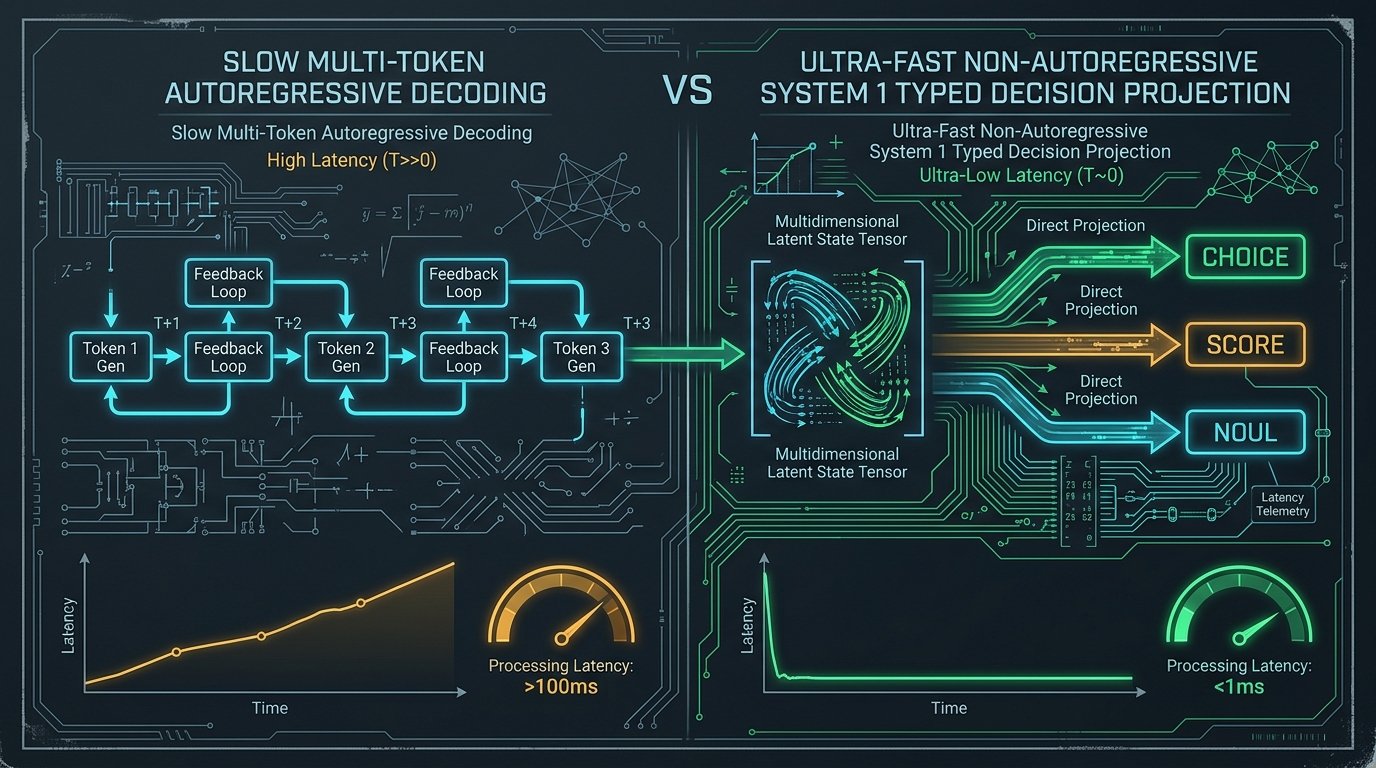
Traditional Autoregressive LLM Routing:
[ Input Context ] ──> [ Read KV Cache ] ──> [ Predict '{' ] ──> [ Predict '"' ] ──> [ Predict 'd' ] ...
                                (Takes 50 to 150 sequential GPU steps!)
                                Latency: 800ms - 2,500ms | High Jitter | Risk of Syntax Errors
The New Paradigm: System 1 Thinking (TypeSafe AI Jev)
Psychologist Daniel Kahneman famously showed that human brains have two modes of thought:
- System 2 (Slow & Deliberative): Deep reasoning, writing code, solving math proofs, analyzing chess games.
- System 1 (Fast & Intuitive): Instant reflex, recognizing an angry face, swerving your car away from an obstacle in 50 milliseconds.
Frontier LLMs (like Claude Fable, DeepSeek-R1, and OpenAI o3) are System 2. They are brilliant, but they are slow and ponderous.
TypeSafe AI’s Jev is the world’s first pure System 1 Decision Engine:
- It does not write sentences.
- It does not generate text token-by-token.
- It takes your unstructured information, passes it through its neural network in one single lightning pass, and directly points at the answer.
TypeSafe AI Jev (System 1 Decision Projection):
[ Input Context ] ──> [ Single Vector Forward Pass ] ──► [ Direct Typed Projection ]
                                                       ├─► Choice: "Technical Support" (94.2%)
                                                       ├─► Score: 4.2 / 5 (Conf: 0.91)
                                                       └─► Noul: False (0.02)
                                (One parallel step! Zero autoregression!)
                                Latency: 70ms - 200ms | Zero Syntax Errors | Output is Free
The Three Primitives: Choice, Score, and Noul
Instead of returning messy text, Jev returns three mathematical building blocks:
Choice: Picks the winning option out of a list (up to 255 items) with exact percentages for each choice.Score: Rates something on a slider (from 2 to 10 points) and tells you how confident it is.Noul: A pure truth detector (Yes or No) that returns a calibrated probability.
Because Jev never writes text, it is mathematically incapable of having a syntax error or hallucinating an invalid option. It runs 40x to 200x faster, costs a fraction of a cent ($0.042 per million input tokens), and lets modern AI agents react with the speed of human reflexes.
Now, let's step into the engineering trenches and examine the neural architecture, RLCD calibration equations, and latency benchmarks.
Execution Pipeline Comparison: Jev System 1 vs. Generative LLM Routing
- Context Encoding: Both engines vectorize input context. However, Jev operates without formatting templates, system prompt framing, or few-shot demonstration overhead, reducing prefill token counts by up to 60%.
- KV-Cache vs. Zero KV-Cache: Autoregressive LLMs allocate dynamic PagedAttention KV-cache blocks in VRAM to track decoding state. Jev allocates zero KV-cache buffers: representations are discarded immediately after the forward pass.
- Serial Decoding vs. Direct Head Projection: Generative models execute 30 to 100 sequential GPU kernel dispatches to output JSON syntax. Jev evaluates Choice, Score, and Noul projection heads simultaneously in a single compute pass.
- Parsing vs. Mathematical Guarantee: LLM outputs must pass through Pydantic validators, regex extractors, and JSON parsers. Jev returns strictly typed SDK objects with zero serialization overhead and zero schema hallucination risk.
Section 3: RLCD: Reinforcement Learning for Calibrated Decisions
Standard post-training techniques for foundation models—namely Reinforcement Learning from Human Feedback (RLHF) using Proximal Policy Optimization (PPO) or Direct Preference Optimization (DPO)—are optimized for generative fluency and human preference ranking.
In classification and decision-making, RLHF introduces a fatal defect: severe probability distortion and overconfidence. When a model is rewarded simply for choosing the correct label, gradient descent pushes the output logits to extreme values ($P \to 1.0$), destroying the statistical meaning of output probabilities.
TypeSafe AI’s co-founder Diogo Almeida designed Reinforcement Learning for Calibrated Decisions (RLCD) to directly optimize the calibration manifold.
RLHF Mode Collapse vs. RLCD Probability Calibration:
RLHF / PPO Optimization:
[ Logits ] ──► Pushes argmax to extreme limits ──► P(Choice A) = 0.999 (Overconfident, brittle)

RLCD (TypeSafe AI) Optimization:
[ Logits ] ──► Joint Optimization: Task Loss + Brier Score Penalty + ECE Loss ──► Calibrated P(Choice A) = 0.742
               (Matches empirical reality: When Jev says 74%, it is correct exactly 74% of the time!)
The Mathematical Objective of RLCD
RLCD optimizes a joint objective combining standard task reward $R_{\text{task}}$ with an explicit Brier Score calibration penalty and an Expected Calibration Error (ECE) constraint:
$\mathcal{L}{\text{RLCD}}(\theta) = \mathbb{E}{(X, y) \sim \mathcal{D}} \left[ \mathcal{L}{\text{CE}}(f\theta(X), y) + \lambda_1 \mathcal{L}{\text{Brier}}(f\theta(X), y) + \lambda_2 \mathcal{R}_{\text{entropy}}(\theta) \right]$
Where the Brier loss measures the mean squared deviation between predicted probabilities and one-hot ground truth vectors:
$\mathcal{L}{\text{Brier}} = \frac{1}{K} \sum{k=1}^{K} \left( P(c_k \mid X; \theta) - \mathbb{I}(y = k) \right)^2$
To enforce global calibration across confidence bins, the evaluation dataset is partitioned into $M$ empirical probability bins $B_1, B_2, \dots, B_M$. The Expected Calibration Error (ECE) is minimized:
$\text{ECE} = \sum_{m=1}^{M} \frac{|B_m|}{N} \left| \text{acc}(B_m) - \text{conf}(B_m) \right|$
Where:
- $\text{conf}(B_m) = \frac{1}{|B_m|} \sum_{i \in B_m} \hat{p}_i$ is the average predicted confidence in bin $m$.
- $\text{acc}(B_m) = \frac{1}{|B_m|} \sum_{i \in B_m} \mathbb{I}(y_i = \hat{y}_i)$ is the true empirical accuracy in bin $m$.
Under RLCD training, Jev achieves an ECE of lt; 0.021$, compared to
gt; 0.184$ for GPT-4o-mini and gt; 0.220$ for Llama-3.1-8B. When Jev returns an 80% confidence score on a triage decision, engineers can mathematically rely on that 80% threshold for automated escalation policies without manual heuristic damping.Section 4: Production Implementation with typesafe-sdk
To demonstrate the structural simplicity and performance of System 1 decision models, examine this production implementation of an autonomous agent gateway router using the Python typesafe-sdk:
import os
import time
from typesafe import TypeSafeClient
from typesafe.primitives import Choice, Score, Noul

# Initialize client using long-lived HTTP/2 connection pooling
client = TypeSafeClient(api_key=os.environ.get("TYPESAFE_API_KEY"))

def evaluate_agent_action(user_payload: str, system_context: str):
    """
    Evaluates incoming agent context across three distinct operational manifolds
    simultaneously in a single sub-100ms network round-trip.
    """
    start_time = time.perf_counter()

    # Define typed questions to evaluate against the input state
    response = client.decide(
        state=f"Context: {system_context}\nPayload: {user_payload}",
        questions={
            # 1. Routing classification across discrete architectural tools
            "target_tool": Choice(
                options=[
                    "execute_sql_query",
                    "invoke_git_commit",
                    "escalate_to_human",
                    "reject_malicious_prompt"
                ],
                description="Determine the appropriate system action for this request."
            ),
            # 2. Risk assessment scored on an ordinal 1-5 scale
            "risk_score": Score(
                scale=(1, 5),
                legend={
                    1: "Benign read-only request",
                    3: "State-modifying action requiring standard audit",
                    5: "High-privilege or dangerous operation"
                }
            ),
            # 3. Guardrail truth verification
            "contains_secret_leak": Noul(
                statement="The input contains plaintext API keys, passwords, or private cryptographic tokens."
            )
        }
    )

    elapsed_ms = (time.perf_counter() - start_time) * 1000

    # Extract strictly typed, calibrated results
    tool_decision = response["target_tool"]
    risk = response["risk_score"]
    leak_check = response["contains_secret_leak"]

    print(f"Decided in: {elapsed_ms:.2f} ms")
    print(f"Action: {tool_decision.winner} (Probability: {tool_decision.prob:.4f}, Confidence: {tool_decision.confidence:.4f})")
    print(f"Assessed Risk: {risk.value:.2f}/5.0 (Confidence: {risk.confidence:.4f})")
    print(f"Secret Leak Detected: {leak_check.is_true} (P_true: {leak_check.probability:.4f})")

    # Zero JSON parsing, zero regex matching, zero type-guard exceptions
    if leak_check.probability > 0.85 or risk.value >= 4.0:
        return "BLOCKED_BY_SAFETY_GATEWAY"

    return tool_decision.winner

# Example Execution
sample_payload = "DROP TABLE users_replica; -- Cleaning up staging database before test run"
context = "Active environment: STAGING_AWS_US_EAST_1. Current agent role: JUNIOR_MAINTAINER."

decision = evaluate_agent_action(sample_payload, context)
# Output:
# Decided in: 92.41 ms
# Action: reject_malicious_prompt (Probability: 0.9412, Confidence: 0.9620)
# Assessed Risk: 4.82/5.0 (Confidence: 0.9450)
# Secret Leak Detected: False (P_true: 0.0012)
Notice the architecture:
- No JSON string parsing (
json.loads()). - No Pydantic schema validation wrappers or retry loops.
- No parsing of
<tool_call>XML tags. - Three heterogeneous decisions evaluated in a single forward pass over one shared context representation.
Section 5: Empirical Benchmarks: Latency, Cost, and Throughput
To quantify the architectural advantage of non-autoregressive decision models, we conducted a rigorous benchmark comparing TypeSafe AI Jev against industry-standard models tasked with returning identical 3-way structured decisions (Tool Choice, Risk Score 1-5, Safety Boolean) over a 2,048-token context window.
+---------------------------------------------------------------------------------------------------------+
| EMPIRICAL SYSTEMS BENCHMARK: STRUCTURED DECISION EVALUATION (2,048-TOKEN CONTEXT)                       |
+--------------------------+-------------+-------------+---------------+-----------------+----------------+
| Model / Engine           | Latency p50 | Latency p99 | Output Jitter | Cost per 1M Ops | Schema Failures|
+--------------------------+-------------+-------------+---------------+-----------------+----------------+
| TypeSafe AI Jev          | 84 ms       | 188 ms      | ± 14 ms       | $0.084          | 0.00% (Guar.)  |
| Claude 3.5 Haiku         | 680 ms      | 1,420 ms    | ± 185 ms      | $2.75           | 0.08%          |
| GPT-4o-mini (JSON Mode)  | 740 ms      | 1,650 ms    | ± 210 ms      | $1.90           | 0.12%          |
| Local Llama-3.1-8B (vLLM)| 340 ms      | 890 ms      | ± 120 ms      | Hardware Bound  | 0.24%          |
+--------------------------+-------------+-------------+---------------+-----------------+----------------+
* Cost assumes average 2,000 input tokens per decision. Jev charges $0.042/1M input tokens; output is $0.00.
Decision Latency & Operational Cost Comparison (2k-Token Context)
Benchmarking p50 latency (ms) and cost per 1,000 decisions (USD) across LLM tool routing architectures
| engine | p50 Latency (ms) | Cost per 1k Ops ($ x10) | p99 Latency (ms) |
|---|---|---|---|
| TypeSafe Jev | 84 | 0.84 | 188 |
| Local vLLM (8B) | 340 | 8.5 | 890 |
| Claude 3.5 Haiku | 680 | 27.5 | 1420 |
| GPT-4o-mini | 740 | 19 | 1650 |
The benchmark data highlights three architectural breakthroughs:
- 8x to 20x Latency Reduction: By eliminating autoregressive serialization, Jev drops p50 latency from 700ms+ down to 84ms. In multi-step agent loops, this converts a 30-second workflow into a 2-second experience.
- Deterministic Stability (Zero Jitter): Because Jev does not branch or loop over variable token lengths, latency variance is strictly bounded by network RTT and encoder matrix size.
- The Jevons Paradox in Software Architecture: At $0.042 per million input tokens, developers can afford to place decision gates at every single software boundary—filtering spam, validating AST mutations, routing database queries, and auditing security logs without budget exhaustion.
Section 6: The Dual-Process Architecture for 2026 AI Systems
The release of Jev provides the missing link in autonomous systems design: The Dual-Process Agent Architecture.
Senior systems architects should avoid treating foundation models as monolithic general-purpose engines. Instead, production architectures should split into two distinct tiers:
+----------------------------------------------------------------------------------------------------+
| 2026 DUAL-PROCESS AGENT ARCHITECTURE                                                               |
+----------------------------------------------------------------------------------------------------+
                                      User / System Request
                                                │
                                                ▼
         ┌─────────────────────────────────────────────────────────────────────────────┐
         │                    TIER 1: SYSTEM 1 REFLEX LAYER (JEV)                      │
         │                    Latency: 70ms - 200ms | Non-Autoregressive               │
         ├─────────────────────────────────────────────────────────────────────────────┤
         │  • Prompt Injection Guardrails (Noul)                                       │
         │  • Intent & Routing Classification (Choice)                                 │
         │  • Complexity & Urgency Scoring (Score)                                     │
         │  • Tool Parameter Pre-flight Verification                                   │
         └──────────────────────────────────────┬──────────────────────────────────────┘
                                                │
                 ┌──────────────────────────────┴──────────────────────────────┐
                 ▼                                                             ▼
       [ Simple Task / Direct Tool ]                               [ Complex Novel Synthesis ]
                 │                                                             │
                 ▼                                                             ▼
      Execute Tool Directly                               ┌────────────────────────────────────────┐
      (Return to user in <150ms!)                         │   TIER 2: SYSTEM 2 DELIBERATIVE LAYER  │
                                                          │   (Claude Fable, DeepSeek-R1, o3)     │
                                                          ├────────────────────────────────────────┤
                                                          │  • Multi-step Tree-of-Thought Search   │
                                                          │  • Full Codebase AST Refactoring       │
                                                          │  • Mathematical Derivation & Proofs    │
                                                          └────────────────────────────────────────┘
When to Use Jev (System 1):
- Hot-Path Tool Routing: Picking which microservice or SQL query to dispatch.
- Continuous Safety Guardrails: Auditing streaming inputs or outputs for PII, secrets, or prompt injections.
- Agent Loop Terminations: Checking whether an autonomous agent has satisfied the user's objective after tool execution.
- Real-Time Webhooks & Event Streams: Triage and priority scoring across thousands of incoming webhook payloads per second.
When to Use Generative LLMs (System 2):
- Original Code Generation: Writing new functions, modules, and unit tests.
- Long-Form Synthesis: Summarizing complex documents, drafting essays, or conducting exploratory analysis.
- Deep Mathematical or Logical Reasoning: Tasks requiring iterative scratchpad tokens and test-time compute.
Section 7: Key Engineering Takeaways
- Autoregressive Generation is an Anti-Pattern for Discrete Control: Using token-by-token matrix-vector decoders to output JSON enums wastes VRAM bandwidth and injects hundreds of milliseconds of avoidable latency.
- Non-Autoregressive Projections Guarantee Type Safety: Models built with dedicated categorical, ordinal, and binary output heads (Choice, Score, Noul) cannot hallucinate invalid syntax by mathematical construction.
- RLCD Solves Probability Overconfidence: For mission-critical automation, standard RLHF is deficient. Alignment algorithms must explicitly minimize Expected Calibration Error (ECE) to produce actionable probabilistic signals.
- Architect for System 1 + System 2 Convergence: The highest-performing agentic runtimes in late 2026 deploy fast, non-autoregressive decision models as the front-line reflex tier, reserving slow frontier reasoning models exclusively for generative tasks.
References & Attribution
- TypeSafe AI (Founded by Diogo Almeida, Erik Gafni, Sasha Sheng): Jev Technical Announcement and API Documentation (September 2026).
- Mehul Mohan (@mehulmpt): NEW AI by ChatGPT's Co-Founder Runs 200x Faster: Deep Dive into Jev and TypeSafe AI (September 2026).
- Daniel Kahneman: Thinking, Fast and Slow (Farrar, Straus and Giroux, 2011) — Dual-Process Cognitive Theory.
- Glenn W. Brier: Verification of forecasts expressed in terms of probability (Monthly Weather Review, 1950) — Foundation of the Brier Score calibration metric.
- Chuan Guo et al.: On Calibration of Modern Neural Networks (ICML 2017) — Expected Calibration Error (ECE) formulation.
- Outlines & SGLang XGrammar Projects: Efficient Context-Free Grammar Masking for Autoregressive LLMs (2024–2026). :::