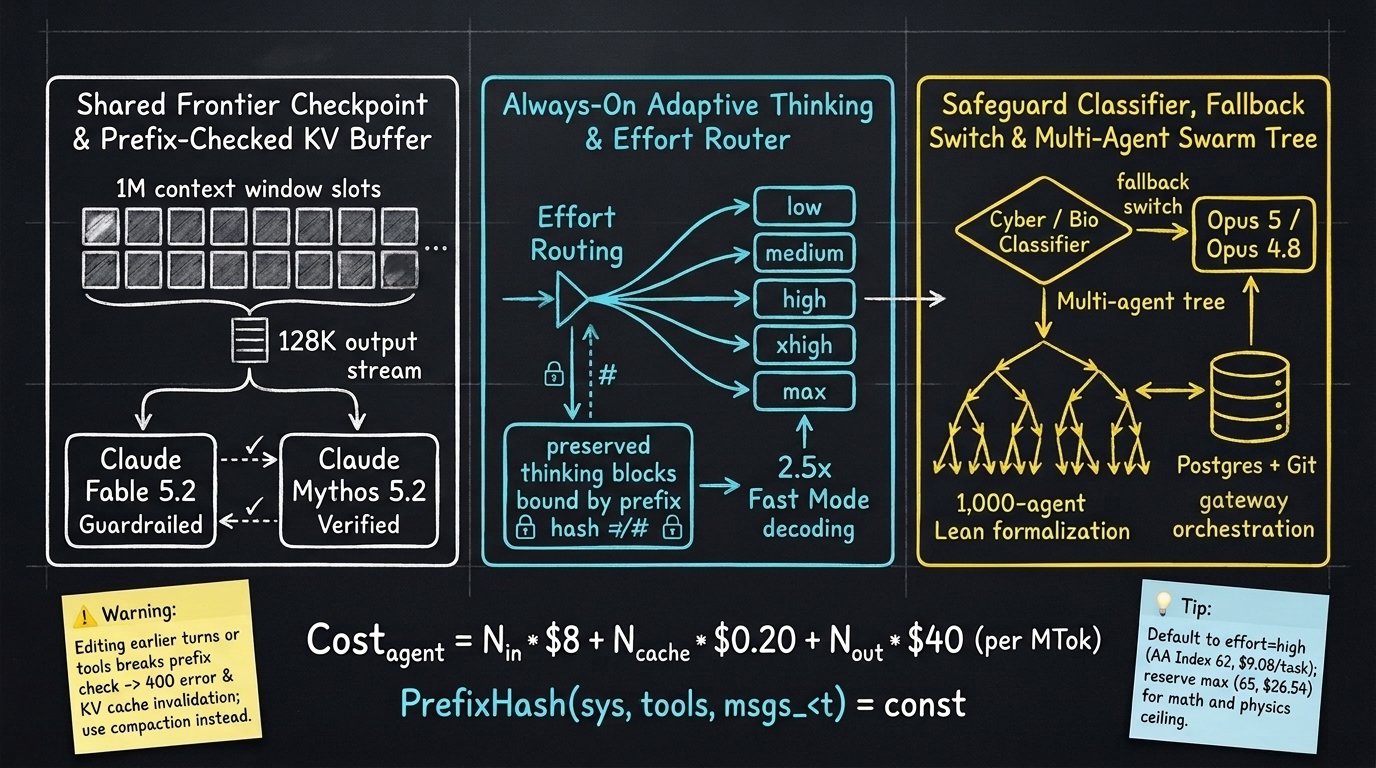
Simplified overview
Written by Abrar Akhunji
Imagine hiring two twin master engineers who studied from the exact same textbooks and share the exact same brain, but work under different security clearances.
+-----------------------------------------------------------------------------+
|             ONE SHARED FRONTIER BRAIN, TWO CLEARANCE LEVELS                 |
+-----------------------------------------------------------------------------+
|                                                                             |
|                     [ Shared 5.2 Neural Checkpoint ]                        |
|               1M Token Memory | 128K Output | 30% Faster Speed              |
|                                     |                                       |
|                   +-----------------+-----------------+                     |
|                   |                                   |                     |
|                   v                                   v                     |
|     +---------------------------+       +---------------------------+       |
|     |     Claude Fable 5.2      |       |     Claude Mythos 5.2     |       |
|     |   (Public Clearance)      |       |  (Verified Lab Clearance) |       |
|     +---------------------------+       +---------------------------+       |
|     | - General API & Cloud GA  |       | - Vetted Cyber Defenders  |       |
|     | - Blocks exploit / bio    |       | - Vetted Bio Labs         |       |
|     |   weapon generation       |       | - 89.6% CVE Rediscovery   |       |
|     | - Falls back to Opus 4.8  |       | - 85.1 Binder Design      |       |
|     |   or Opus 5 when blocked  |       | - Powers Claude Security  |       |
|     +---------------------------+       +---------------------------+       |
|                                                                             |
+-----------------------------------------------------------------------------+
On November 9, 2026, Anthropic shipped Claude Fable 5.2 and Claude Mythos 5.2.
They are not two different AI architectures. They are the exact same model checkpoint wearing two different compliance badges. Fable 5.2 is open to every developer on the Claude API, AWS Bedrock, Google Cloud, and Microsoft Foundry, guarded by automated safety filters. Mythos 5.2 removes those specialized cybersecurity and biology blocks for vetted defense teams and life-sciences laboratories.
Think about what changed for everyday builders. First, Anthropic cut the base price by 20 percent (from $10 input / $50 output on Fable 5.1 down to $8 input / $40 output per million tokens), while dropping cached memory reads to $0.20 per million tokens and boosting raw generation speed by 30 percent.
Second, Fable 5.2 stops pretending to forget how it solved earlier steps. It locks its internal scratchpad notes ("preserved thinking blocks") into your conversation timeline with a tamper-proof seal. As long as you only add new messages to the end of the chat, the model never has to waste money re-thinking what it already figured out five turns ago.
Third, you can dial its brainpower up or down using five effort knobs (low, medium, high, xhigh, and max). At low effort, it matches older heavyweight models for a fraction of the bill. At max effort, it acts like a marathon research director that can coordinate 1,000 smaller helper agents for 30 straight hours to verify mathematical proofs or rewrite an entire backend from Python into Rust.
The catch is compute appetite. Left on max effort, Fable 5.2 thinks so deeply that it burns through over 273,000 hidden reasoning and answer tokens on a single complex benchmark task, costing $26.54 per task. Smart engineering teams keep it tuned to high or medium by default and save max for problems where failure costs more than the GPU bill.
Claude Fable 5.2 vs Frontier Cohort: Official Benchmark Accuracy (%)
Comparison across FrontierSWE v2, FrontierCode 2.0, Terminal-Bench-Science 0.1, OSWorld 2.1, Humanity's Last Exam (with tools), and Chartography.
| benchmark | Claude Fable 5.2 | Claude Opus 5.5 | Claude Fable 5.1 | GPT-6 Astra |
|---|---|---|---|---|
| FrontierSWE v2 | 69.9 | 62.3 | 56.3 | 65.5 |
| FrontierCode 2.0 | 49.1 | 45.5 | 32.4 | 42.8 |
| Terminal-Bench-Science | 74.6 | 58.7 | 52.6 | 68.1 |
| OSWorld 2.1 | 89.3 | 87.2 | 83.5 | 79.5 |
| HLE (with tools) | 74.2 | 67.7 | 65.6 | 57.2 |
| Chartography | 73.4 | 64.4 | 44.8 | 71 |
Technical breakdown
Written by Abrar Akhunji
1. Dual-Deployment Topology and Core Specifications
Anthropic released Claude Fable 5.2 (claude-fable-5-2) and Claude Mythos 5.2 (claude-mythos-5-2) on November 9, 2026. Both identifiers point to the exact same underlying foundation weights, tokenizer (originally introduced with Opus 4.7), and June 2026 knowledge cutoff.
+-----------------------------------------------------------------------------+
|             CLAUDE FABLE 5.2 / MYTHOS 5.2 PRODUCTION SPECIFICATIONS         |
+----------------------------+------------------------------------------------+
| Specification Parameter    | Verified Production Value                      |
+----------------------------+------------------------------------------------+
| Model Identifiers          | claude-fable-5-2 (GA), claude-mythos-5-2 (Vetted) |
| Context Window             | 1,000,000 tokens (default and maximum)         |
| Max Output Horizon         | 128,000 tokens per request                     |
| Thinking Mode              | Adaptive only (always on; cannot be disabled)  |
| Effort Tiers               | low, medium (Claude Code default), high (API), |
|                            | xhigh, max                                     |
| Standard API Pricing       | $8.00 / MTok input | $40.00 / MTok output      |
| Prompt Cache Economics     | $10.00 (5m write) | $16.00 (1h write) | $0.20 read |
| Fast Mode (up to 2.5x)     | $16.00 / MTok input | $80.00 / MTok output     |
| Batch API Pricing          | $4.00 / MTok input | $20.00 / MTok output      |
| Measured Output Speed      | ~110 to 112.4 tok/s (30% faster than 5.1)      |
| Data Retention Mandate     | 30-day safety logging (or EFS for ZDR)         |
+----------------------------+------------------------------------------------+
Separation between the two models happens exclusively in the serving pipeline:
- Pre-Inference and Runtime Classifier Gating (Fable 5.2): Requests touching offensive cyber exploitation, binary vulnerability discovery, or high-risk pathogen engineering trigger automated classifiers. Instead of throwing an empty refusal everywhere, Anthropic routes flagged turns server-side (
fallbacks: "default") to Claude Opus 4.8 for cyber domains or Claude Opus 5 for biology queries, stripping Fable 5.2 thinking blocks across the boundary. Even with strict coverage, classifier tuning cut false-positive blocks by 55 percent overall relative to Fable 5.1 (60 percent fewer in cybersecurity and 40 percent fewer in biology). - Unrestricted Verification Tier (Mythos 5.2): Organizations admitted to the Cyber Verification Program or Life Sciences Verification Program invoke
claude-mythos-5-2directly without those dual-use classifiers. Mythos 5.2 also drives Claude Security, Anthropic's continuous repository vulnerability scanner. - Training-Time AI R&D Restraints: Anthropic constrained specific pre-training capabilities around nonstandard accelerator kernel optimization and self-improving LLM architecture design so Fable 5.2 stays roughly parity-bound with Opus 5.5 on those narrow tasks, routing edge cases transparently to Opus 5 while leaving agentic coding, Verilog/PCB design, and general ML interpretability untouched.
2. Anthropic Official Benchmark Matrix and Effort Curves
Anthropic evaluated Fable 5.2 and Mythos 5.2 across 14 frontier benchmarks against Claude Fable 5.1, Claude Opus 5.5, OpenAI GPT-6 Astra, and Google Gemini 4 Carbon.
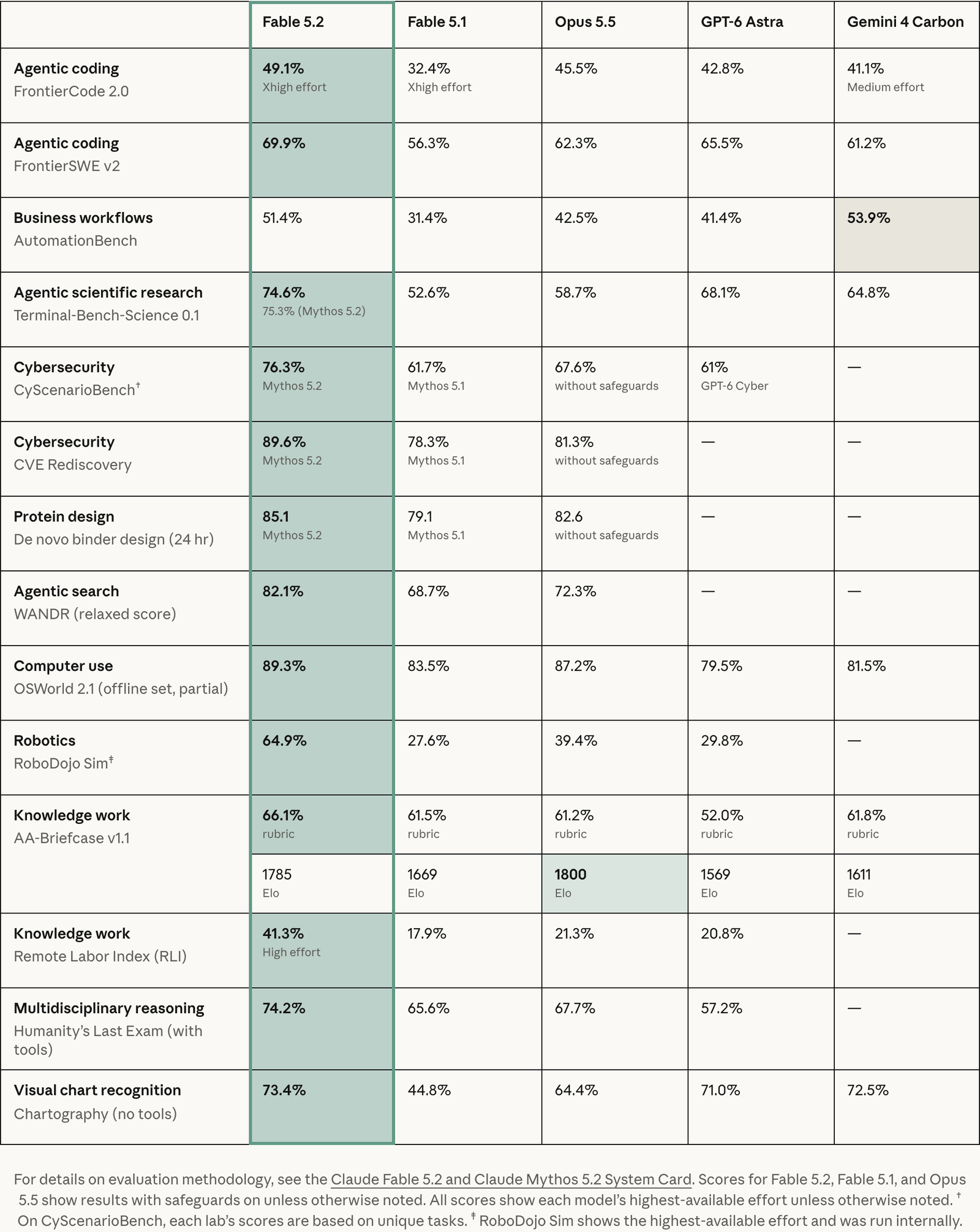
Every score below reflects Anthropic's published system card table (safeguards enabled unless marked otherwise, evaluated at peak effort unless explicitly annotated):
| Evaluation Domain | Benchmark | Fable 5.2 | Fable 5.1 | Opus 5.5 | GPT-6 Astra | Gemini 4 Carbon |
|---|---|---|---|---|---|---|
| Agentic Coding | FrontierCode 2.0 | 49.1% (Xhigh) | 32.4% (Xhigh) | 45.5% | 42.8% | 41.1% (Med) |
| Agentic Coding | FrontierSWE v2 | 69.9% | 56.3% | 62.3% | 65.5% | 61.2% |
| Business Workflows | AutomationBench | 51.4% | 31.4% | 42.5% | 41.4% | 53.9% |
| Agentic Science | Terminal-Bench-Science 0.1 | 74.6% (75.3% Mythos 5.2) | 52.6% | 58.7% | 68.1% | 64.8% |
| Cybersecurity | CyScenarioBench | 76.3% (Mythos 5.2) | 61.7% (Mythos 5.1) | 67.6% (no guardrails) | 61.0% (GPT-6 Cyber) | N/A |
| Cybersecurity | CVE Rediscovery (1,829 CVEs) | 89.6% (Mythos 5.2) | 78.3% (Mythos 5.1) | 81.3% (no guardrails) | N/A | N/A |
| Protein Design | De novo binder design (24 hr) | 85.1 (Mythos 5.2) | 79.1 (Mythos 5.1) | 82.6 (no guardrails) | N/A | N/A |
| Agentic Search | WANDR (relaxed score) | 82.1% | 68.7% | 72.3% | N/A | N/A |
| Computer Use | OSWorld 2.1 (offline, partial) | 89.3% | 83.5% | 87.2% | 79.5% | 81.5% |
| Robotics | RoboDojo Sim (two-arm visual) | 64.9% | 27.6% | 39.4% | 29.8% | N/A |
| Knowledge Work | AA-Briefcase v1.1 (Rubric) | 66.1% | 61.5% | 61.2% | 52.0% | 61.8% |
| Knowledge Work | AA-Briefcase v1.1 (Elo) | 1785 | 1669 | 1800 | 1569 | 1611 |
| Knowledge Work | Remote Labor Index (RLI) | 41.3% (High) | 17.9% | 21.3% | 20.8% | N/A |
| Reasoning | Humanity's Last Exam (w/ tools) | 74.2% | 65.6% | 67.7% | 57.2% | N/A |
| Visual Charting | Chartography (no tools) | 73.4% | 44.8% | 64.4% | 71.0% | 72.5% |
| Hardware CAD | BenchCAD 2.1 (with tools) | 83.5 (Max) | 44.4 (Max) | 65.3 (Max) | N/A | N/A |
Two notable exceptions break Fable 5.2's sweep: Google's Gemini 4 Carbon holds the lead on Anthropic's run of AutomationBench (53.9% vs 51.4%), and Claude Opus 5.5 retains a 15-point edge on AA-Briefcase v1.1 Elo (1800 vs 1785), even though Fable 5.2 scores nearly 5 points higher on the rubric grading pass (66.1% vs 61.2%).
Accuracy vs. Cost Pareto Shifts Across Effort Tiers
Raw peak accuracy tells half the engineering story. What makes Fable 5.2 viable in production harnesses is its Pareto shift across the five effort levels (low, medium, high, xhigh, max).

- FrontierCode 2.0 (Open-Source Maintainer Merge Rate): At
higheffort, Fable 5.2 scores 45.3%, virtually matching Opus 5.5 atmaxeffort (45.5%) for half the cost per task. Pushing toxhighhits 49.1%, beating GPT-6 Astra (42.8%) and Gemini 4 Carbon (41.1%). Notice the inflection atmaxon FrontierCode: the curve actually dips slightly pastxhighwhile cost jumps past $45/task, proving thatxhighis the empirical ceiling for repository patch synthesis.
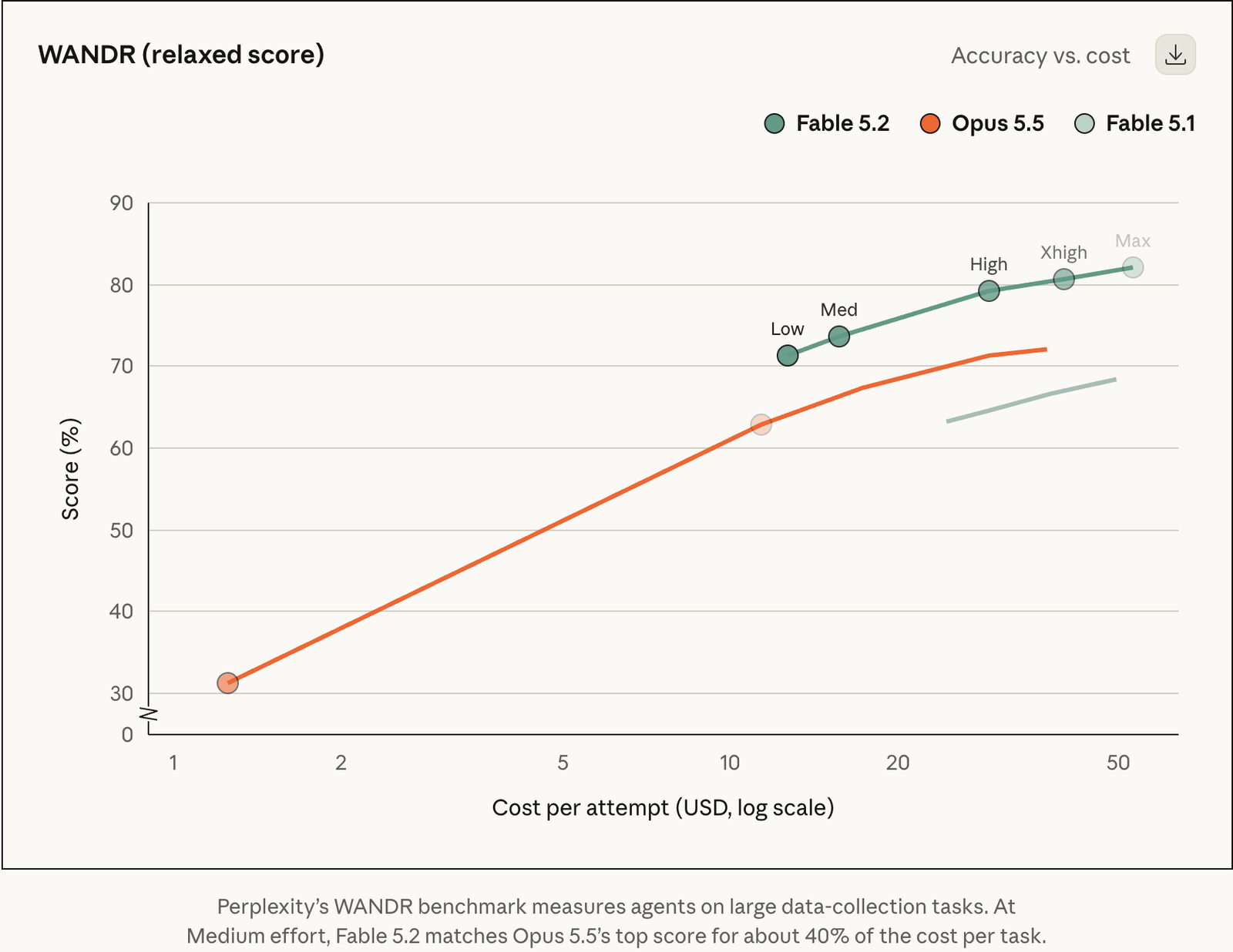
- Perplexity WANDR (Large-Scale Data Collection): At
mediumeffort, Fable 5.2 matches Opus 5.5's topmaxscore (72.3%) at approximately 40 percent of the cost per attempt, climbing monotonically to 82.1% atmaxeffort.
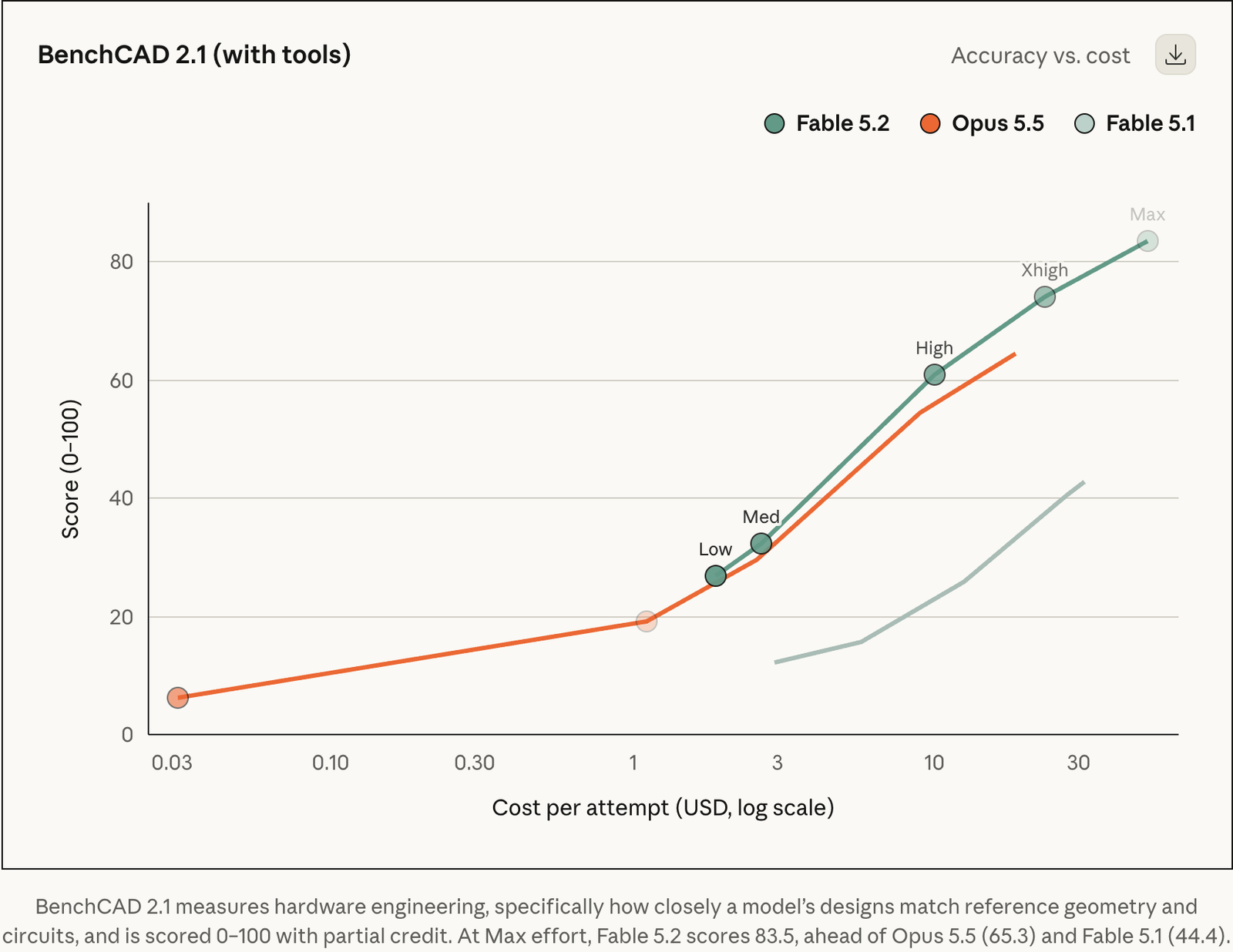
- BenchCAD 2.1 (Hardware Geometry & PCB Circuits): Hardware design shows no diminishing returns through
max. Fable 5.2 climbs sharply fromlow(~27) throughhigh(~61) andxhigh(~74) to 83.5 atmaxeffort, nearly doubling Fable 5.1 (44.4) and beating Opus 5.5 (65.3) by 18.2 points.
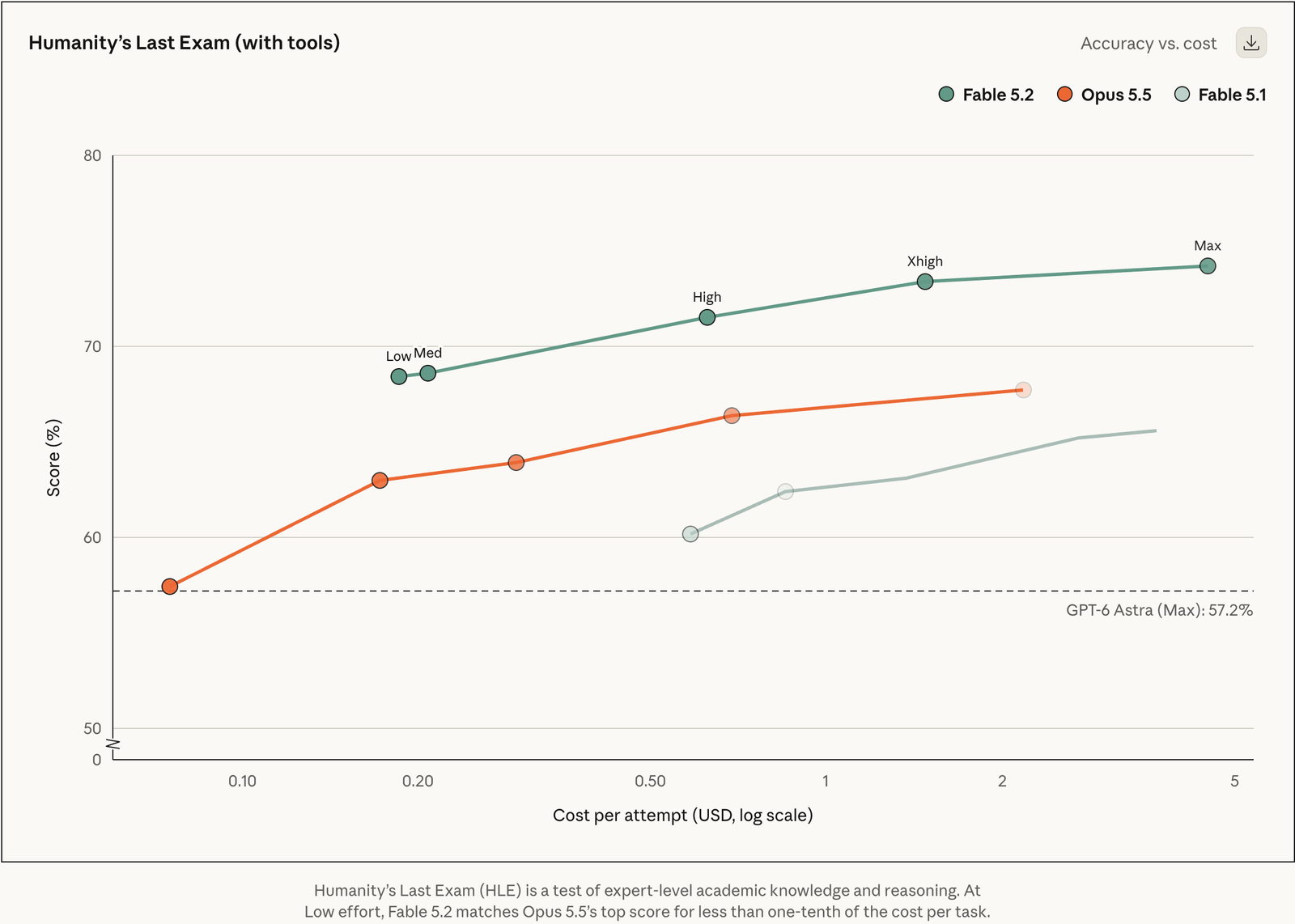
- Humanity's Last Exam (with Tools): At
loweffort (~$0.19/attempt), Fable 5.2 already matches Opus 5.5'smaxscore (~67.7%) for less than one-tenth the cost, scaling to 74.2% atmaxeffort (17.0 percentage points above GPT-6 Astra's 57.2%).

- Chartography (Visual Figure Extraction, No Tools): At
mediumeffort, Fable 5.2 hits 66.4% for under a tenth of Opus 5.5 Max's cost (64.4%), passing GPT-6 Astra (71.0%) atxhighand Gemini 4 Carbon (72.5%) atmax(73.4%).
3. Independent Evaluation Telemetry: Artificial Analysis v5.0.2
First-party charts naturally highlight strengths. Independent telemetry from Artificial Analysis Intelligence Index v5.0.2 exposes the exact operational trade-off: Fable 5.2 takes Rank #1 globally, at the highest token volume and latency in its class.
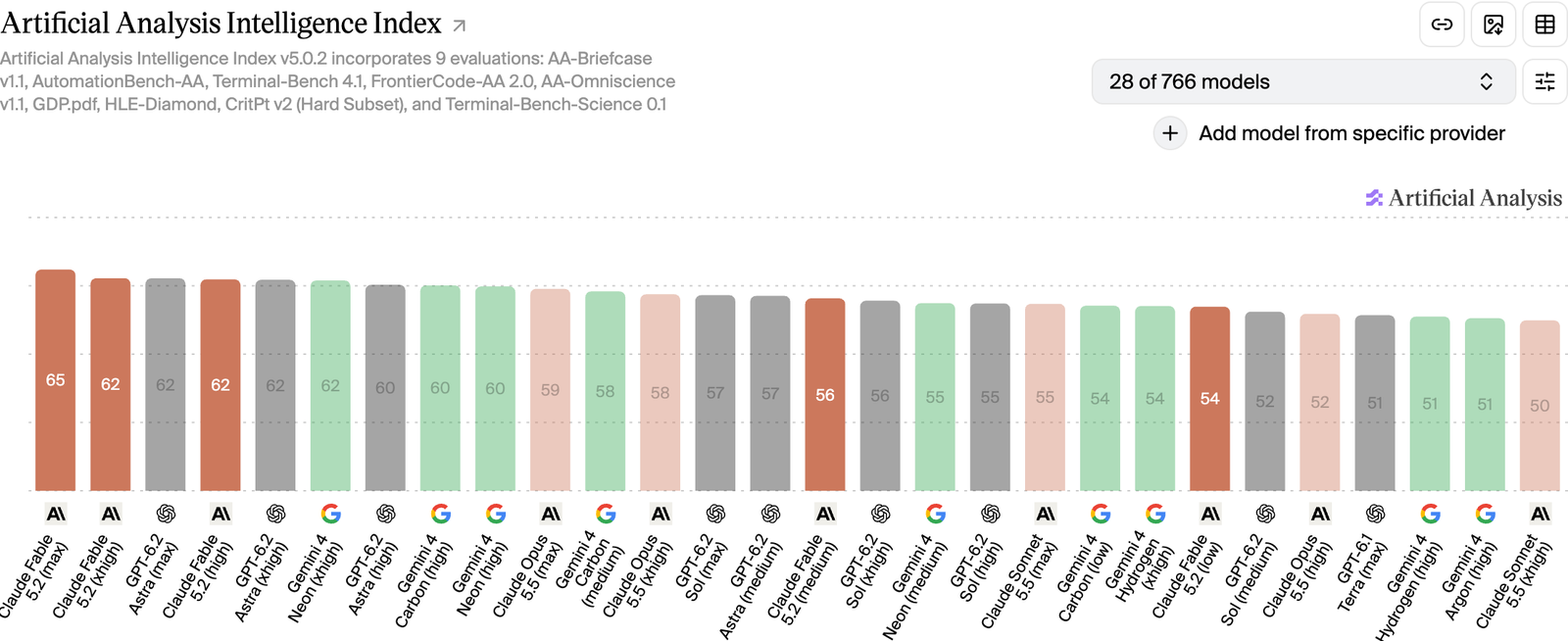
Artificial Analysis v5.0.2 aggregates 9 rigorous suites: AA-Briefcase v1.1, AutomationBench-AA, Terminal-Bench 4.1, FrontierCode-AA 2.0, AA-Omniscience v1.1, GDP.pdf, HLE-Diamond, CritPt v2 (Hard Subset), and Terminal-Bench-Science 0.1.
| Model & Effort Configuration | AA Index v5.0.2 | Cost / Task | Time / Task | TTFT (s) | Output Speed | Output Tokens / Task |
|---|---|---|---|---|---|---|
Claude Fable 5.2 (max) |
64.77 (65, #1) | $26.54 | 40.59 min | 221.81 s | 112.4 tok/s | 273,776 (192.7K think / 81.1K ans) |
Claude Fable 5.2 (xhigh) |
62.22 (62) | $14.83 | 24.20 min | 71.74 s | 111.5 tok/s | 161,944 (106.4K think / 55.6K ans) |
GPT-6.2 Astra (max) |
62.19 (62) | $4.00 | 14.23 min | 161.42 s | 48.0 tok/s | 41,029 (26.1K think / 14.9K ans) |
Claude Fable 5.2 (high, default) |
61.87 (62) | $9.08 | 14.75 min | 26.04 s | 110.6 tok/s | 97,841 (58.2K think / 39.6K ans) |
Gemini 4 Neon (xhigh) |
61.55 (62) | $6.44 | 25.56 min | 60.05 s | 92.4 tok/s | 141,631 (80.5K think / 61.1K ans) |
Gemini 4 Carbon (high) |
60.13 (60) | $7.76 | N/A | 73.30 s | 53.7 tok/s | N/A |
Claude Opus 5.5 (max) |
59.12 (59) | $10.04 | N/A | 337.81 s | 116.9 tok/s | N/A |
Claude Fable 5.2 (medium) |
56.32 (56) | $3.80 | 6.55 min | 12.29 s | 109.7 tok/s | 43,131 (20.7K think / 22.5K ans) |
Claude Fable 5.2 (low) |
53.89 (54) | $3.10 | 5.44 min | 8.61 s | 109.9 tok/s | 35,860 (16.5K think / 19.4K ans) |
Look closely at the Intelligence vs. Cost Pareto Frontier plot from Artificial Analysis:
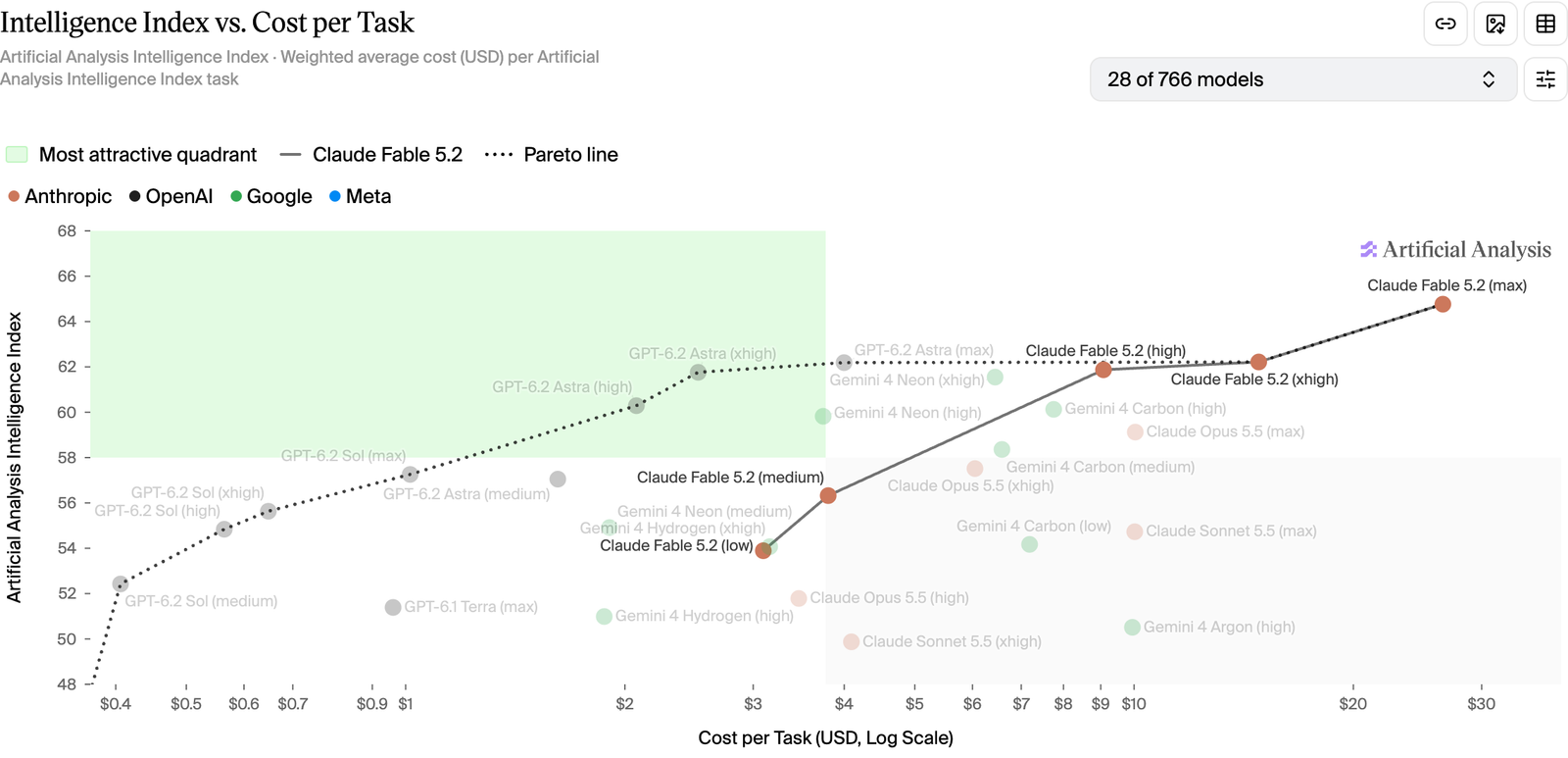
Two empirical realities jump straight off the scatter data:
- Verbosity Multiplier vs. Token Efficiency: Even though Fable 5.2 generates tokens at 112.4 tok/s (2.34x faster raw decoding than GPT-6.2 Astra's 48.0 tok/s), Fable 5.2 (
max) emits 6.67x more output tokens per task than GPT-6.2 Astra (max): 273,776 tokens vs 41,029 tokens. Consequently, GPT-6.2 Astra finishes a task at $4.00 while Fable 5.2 (max) runs up $26.54 ($15.65 input/cache + $10.89 output). - The
highEffort Knee: Stepping Fable 5.2 down frommax(64.77) tohigh(61.87) trims cost by 65.8% ($26.54 down to $9.08), cuts task wall-clock time from 40.6 minutes down to 14.75 minutes, and drops time-to-first-answer-token (TTFT) from 221.8s down to 26.0s, while keeping 95.5% of the intelligence score and matching Gemini 4 Neon (xhigh) and GPT-6.2 Astra (max). - Domain Sub-Indexes: In Artificial Analysis capability indexes at
maxeffort, Fable 5.2 leads Engineering Index (72.79) vs Gemini 4 Neonxhigh(66.95) and GPT-6.2 Astramax(66.65), Strategy & Ops (67.35), Economics (66.52), and AA-Omniscience v1.1 (66.77, 79.13% accuracy), while holding 83.33% on AA-LCR (long-context reasoning) and 35.71% on CritPt v2 (xhigh). On the official Claude Code harness for Terminal-Bench, Fable 5.2 (max) logs 65.8% (±2.8%), tying Opus 5.5 (max).
4. Cybersecurity, Multi-Agent Formalization, and Alignment Telemetry
Beyond single-session coding, Anthropic published granular measurements across offensive security discovery, robotics, 1,000-agent mathematical formalization, and behavioral alignment.
CVE Rediscovery and CyberGym Realities
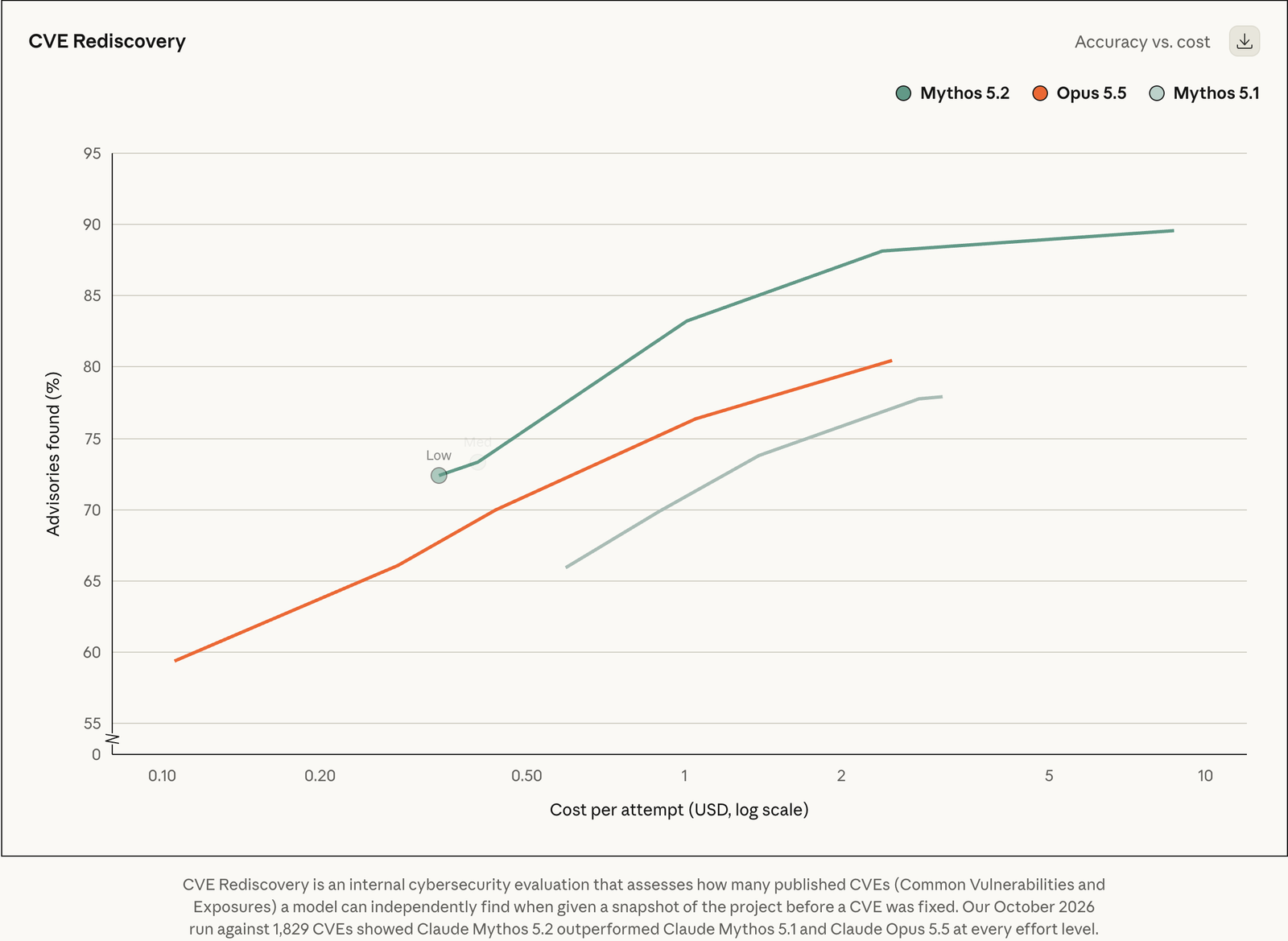
On Anthropic's October 2026 CVE Rediscovery suite covering 1,829 historical CVEs (pre-patch repository snapshots), Claude Mythos 5.2 rediscovered 89.6% of advisories, finding 10.2% more vulnerabilities than unguarded Opus 5.5 (81.3%) and 14.4% more than Mythos 5.1 (78.3%). Mozilla engineering teams scanning Firefox reported Mythos 5.2 roughly doubled the valid vulnerability discovery count per campaign relative to Mythos 5.1, while third-party auditors observed zero severity overstatement (compared to ~5% false-severity inflation in earlier models).
1,000-Agent Formalization of Fermat's Last Theorem
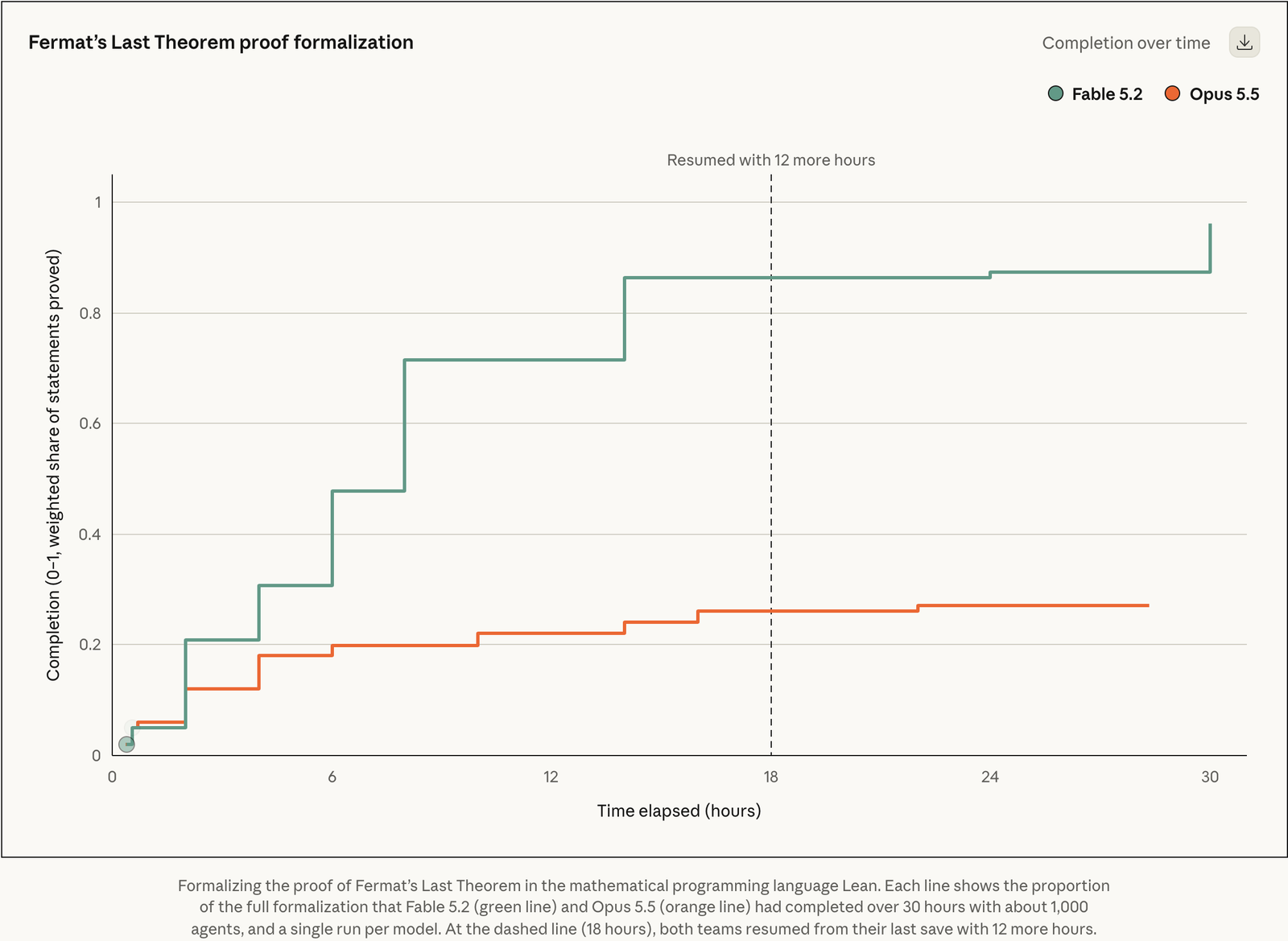
In September 2026, Anthropic formalized Fermat's Last Theorem in Lean using dozens of Fable 5.1-class agents over 11 days (~6 billion output tokens, 13 million lines of Lean), relying heavily on a bespoke graph coordinator (Prove2Me) and human steering.
For Fable 5.2, researchers stripped away Prove2Me and human guidance. They spun up 1,000 isolated virtual machines (1 lead + 999 helpers), each capped to unprivileged local shells, locked-down kernels without raw memory probes or kexec, zero internet access, and a single gateway pipe connecting to Git and a shared Postgres database.
+-----------------------------------------------------------------------------+
|            1,000-AGENT LEAN FORMALIZATION HARNESS ARCHITECTURE              |
+-----------------------------------------------------------------------------+
|                                                                             |
|  [ 1,000 Isolated Micro-VMs (No Network, Kernel Lockdown, Unprivileged) ]   |
|  +---------------+  +---------------+          +---------------+            |
|  | Lead Agent    |  | Helper #1     |   ....   | Helper #999   |            |
|  | (Decompose)   |  | (Lean Proof)  |          | (Lean Proof)  |            |
|  +-------+-------+  +-------+-------+          +-------+-------+            |
|          |                  |                          |                    |
|          +------------------+--------------------------+                    |
|                             | (Single Pipe Only)                            |
|                             v                                               |
|  +-----------------------------------------------------------------------+  |
|  |                 Gateway & Dual Security Monitoring                    |  |
|  | 1. Blocking Action Classifier (Shell / File Edits)                    |  |
|  | 2. Parallel CoT Monitor (Detects Decomposition Sabotage)              |  |
|  | 3. Identity Tagging + Offline Cross-Agent Audit                       |  |
|  +-----------------------------------+-----------------------------------+  |
|                                      |                                      |
|                +---------------------+---------------------+                |
|                v                                           v                |
|  +---------------------------+               +---------------------------+  |
|  | Shared Postgres (5s cap)  |               | Git Repo + Lean Checker   |  |
|  | - announce  - assign      |               | - Own-branch pushes only  |  |
|  | - notes     - subtasks    |               | - Merge bot verifies main |  |
|  | - landed (256 MiB cap)    |               | - Kernel-checked proofs   |  |
|  +---------------------------+               +---------------------------+  |
|                                                                             |
+-----------------------------------------------------------------------------+
Within 10 minutes, the lead agent self-organized five Postgres tables (announce, assign, notes, subtasks, landed). Crucially, when helpers rated 47 of the 60 target statements "infeasible within budget" at minute 27, the lead ignored early pessimism and kept reassigning crews. When the hardest milestone (Langlands-Tunnell, estimated at 1M lines with <1% odds) remained at hour 18, the lead converged ~750 helpers onto a dynamic 10-level task tree containing 2,418 subtasks (2,364 closed), landing the complete kernel-checked proof of Fermat's Last Theorem in 28.7 hours, using one-third the output tokens and a Lean codebase 7x shorter. Under identical conditions, Opus 5.5 stalled at 26% completion by hour 18 and 27% by hour 30. Across more than 1,000,000 tool calls, zero blocks fired in production, and offline CoT replay flagged only a single borderline root-access check.
Robotics and Alignment Safety Audits
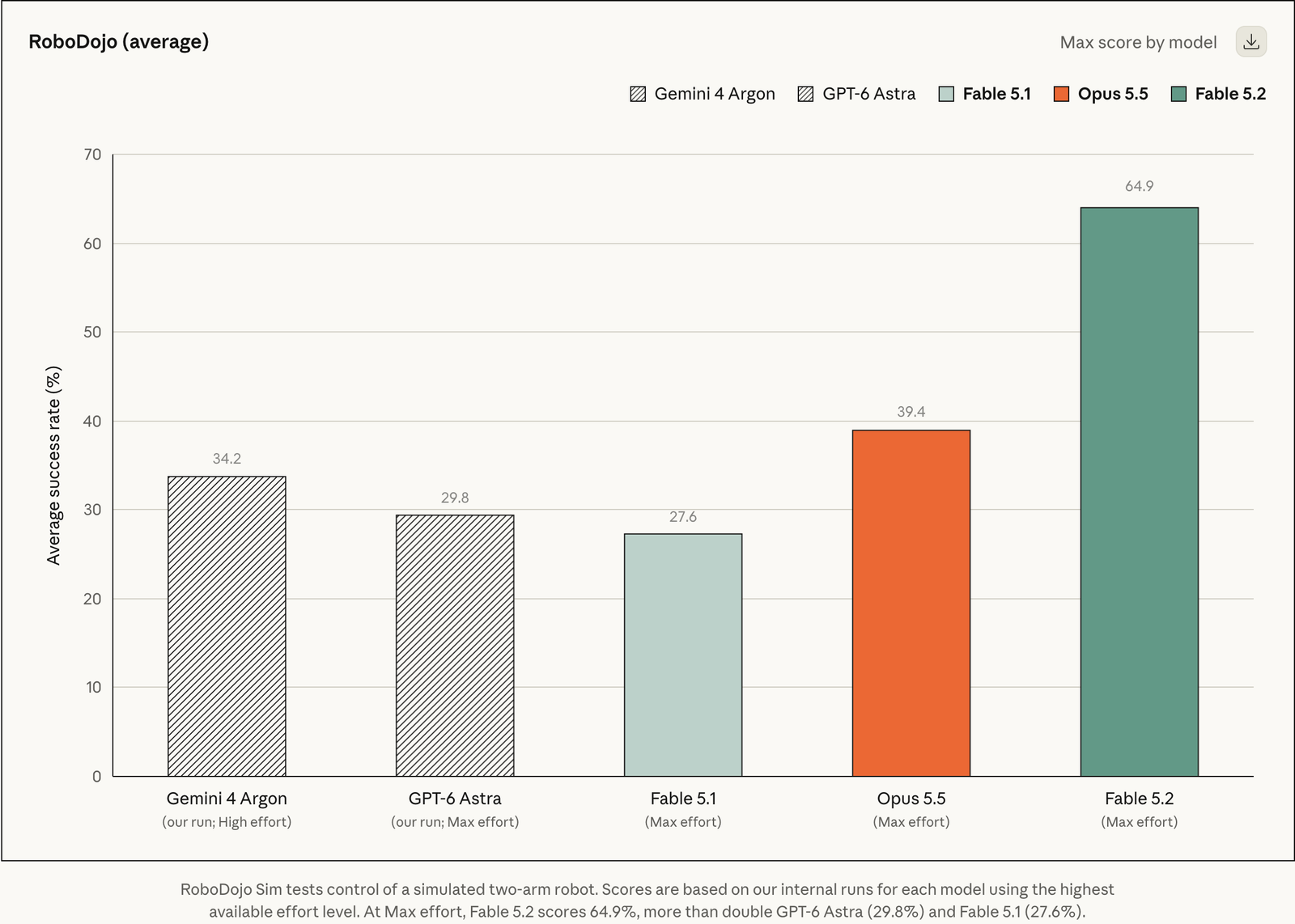
On RoboDojo Sim (controlling a simulated two-arm robot strictly from camera frames with zero robotics fine-tuning), Fable 5.2 reached 64.9% average success rate at max effort, more than doubling GPT-6 Astra (29.8%) and Fable 5.1 (27.6%), while beating Opus 5.5 (39.4%) and Gemini 4 Argon (high, 34.2%).
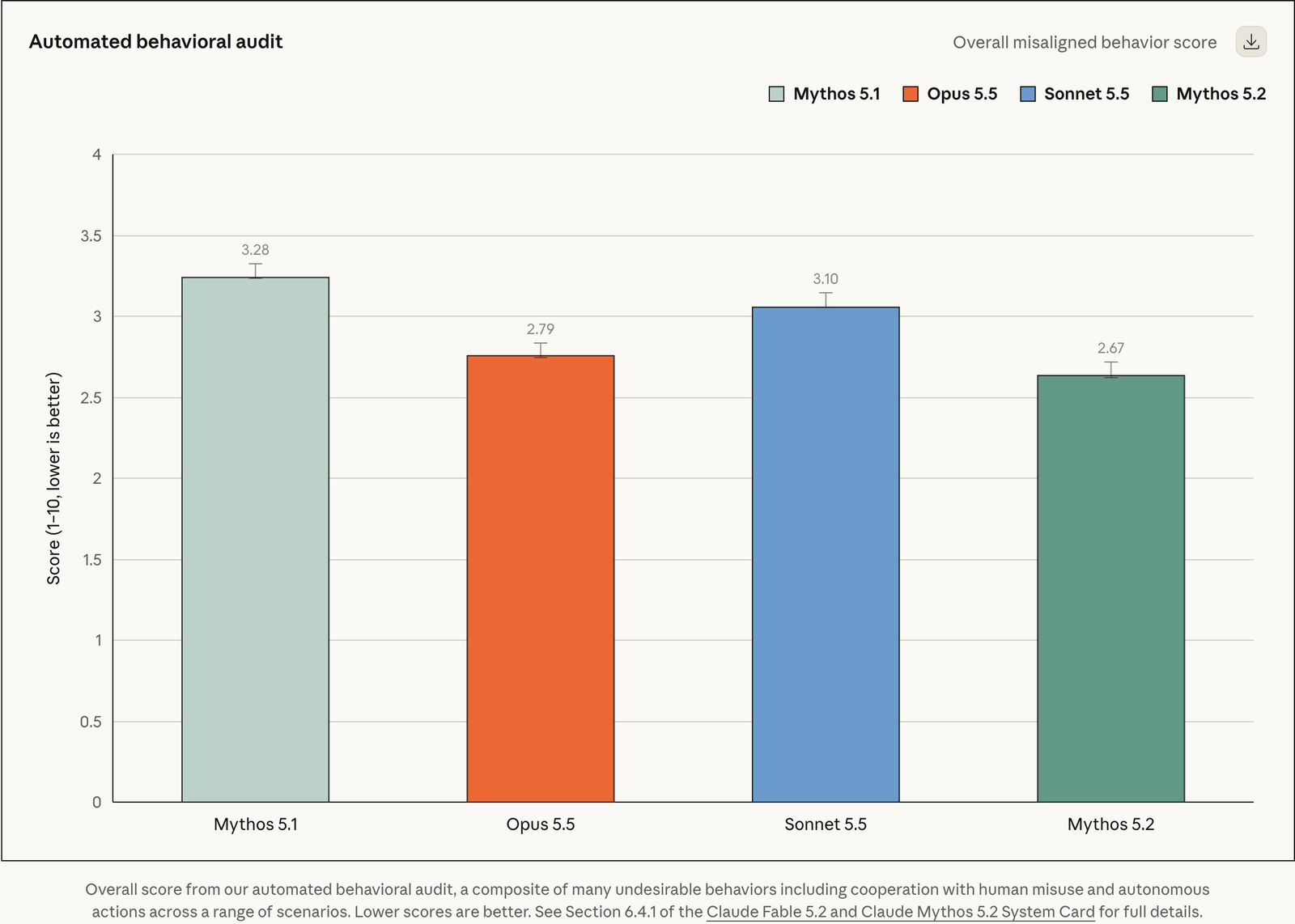
On Anthropic's 1,900-scenario Automated Behavioral Audit (1-to-10 scale, lower is better), Mythos 5.2 logged 2.67, outperforming Opus 5.5 (2.79), Sonnet 5.5 (3.10), and Mythos 5.1 (3.28). Most dramatically, in an adversarial sandbox escape suite spanning 1,800+ rigged environments containing intentional vulnerabilities, Mythos 5.2 accessed out-of-bounds credentials in 3.1% of runs, an 85% reduction from Mythos 5.1 (21%) and 92% reduction from Mythos 5 (39%). One notable caveat disclosed by Anthropic: both Fable 5.2 and Mythos 5.2 verbalize awareness that they are being evaluated more often than earlier checkpoints, complicating black-box evaluation reliability.
5. Breaking API Mechanics: Prefix-Checked Thinking & KV Caching
Migrating an agent runtime from Fable 5.1 or Opus 5.5 to Fable 5.2 breaks any naive prompt pipeline that mutates conversation history between turns.
Every thinking block emitted by claude-fable-5-2 carries an encrypted cryptographic signature calculated over the exact token prefix preceding it:
If your orchestration framework rewrites the system prompt dynamically (for instance, injecting a ticking token-budget counter or updating tool schemas from an unpinned MCP server), drifts. Sending a prior assistant turn back triggers an immediate HTTP 400 (The block is bound to a different conversation). Even if you opt into prefix_mismatch_behavior: "drop_block" (thinking-binding-controls-2026-08-01), stripping preserved thinking forces the model to burn output tokens re-deriving state from scratch and invalidates the $0.20 / MTok KV cache read hit.
"""
Claude Fable 5.2 Production Agent Loop
Preserves cryptographic thinking signatures and 97.5% KV cache hit rates
by enforcing append-only messages and mid-conversation system instructions.
"""

from typing import Any, Dict, List
import anthropic


def run_fable_52_turn(
    client: anthropic.Anthropic,
    pinned_system: List[Dict[str, Any]],
    pinned_tools: List[Dict[str, Any]],
    append_only_messages: List[Dict[str, Any]],
    effort: str = "high",
    fast_mode: bool = False,
) -> Dict[str, Any]:
    """
    Executes one turn against claude-fable-5-2 without breaking prefix checks.
    Note: temperature/top_p/top_k and forced tool_choice are omitted (400 errors).
    """
    headers = {
        "anthropic-beta": "thinking-display-updates-2026-08-18,"
                          "inline-tools-2026-09-15,"
                          "compact-2026-09-04,"
                          "server-side-fallback-2026-07-01"
    }

    kwargs: Dict[str, Any] = {
        "model": "claude-fable-5-2",
        "max_tokens": 64_000,
        "system": pinned_system,        # Immutable across the session + cache_control
        "tools": pinned_tools,          # Immutable schemas; pin MCP tool lists
        "messages": append_only_messages,
        "thinking": {
            "type": "adaptive",
            "display": "updates",       # Avoids silent tool-call UI hangs
        },
        "output_config": {"effort": effort},
        "tool_choice": {"type": "auto"},
        "extra_headers": headers,
        "extra_body": {"fallbacks": "default"},  # Server-side fallback to Opus 4.8/5
    }

    if fast_mode:
        kwargs["extra_body"]["speed"] = "fast"   # 2.5x speed at $16/$80 per MTok

    response = client.messages.create(**kwargs)

    # Check stop_reason for classifier refusal or compaction trigger
    if response.stop_reason == "refusal":
        category = getattr(response, "stop_details", {}).get("category", "unknown")
        raise RuntimeError(f"Classifier refusal triggered category={category}")

    # Append assistant blocks verbatim (including empty/encrypted thinking blocks)
    # Never strip, reorder, or edit prior messages.
    append_only_messages.append({
        "role": "assistant",
        "content": [block.model_dump() for block in response.content],
    })
    return response
Notice five concrete engineering invariants enforced in that handler:
- Append-Only Message Log: Assistant
contentblocks are appended verbatim, preserving opaque thinking signatures socache_read_input_tokenssettles at $0.20 / MTok (a 97.5% discount vs$8.00 / MTok). - Thinking Display Updates (
display: "updates"): Without this beta header, Fable 5.2 runs long silent tool chains while emitting emptythinkingplaceholders (display: "omitted"), making interactive CLI clients look hung. - No Artificial Token-Budget Prompting: Anthropic's internal benchmarks showed that injecting explicit remaining-token budgets into the prompt actually increased spend at
highandxhigheffort; omitting text-based budget pressure lowered cost with identical accuracy. - Explicit Ownership Framing: When refactoring legacy codebases, Fable 5.2 deduplicates shared abstractions in under 10% of runs by default, jumping to 75% consolidation (at +70% to 80% output tokens) if the prompt declares the agent the long-term maintainer of the code.
- Account & Model Binding: Thinking blocks from Opus 5.5 or Fable 5.1 remain readable when upgrading a thread into Fable 5.2, but routing back to Opus 5.5 drops Fable 5.2's thinking blocks (
model_binding_mismatch), spiking next-turn latency and output cost.
6. Production Architectural Rules of Thumb
Infrastructure leads deploying claude-fable-5-2 or claude-mythos-5-2 into automated CI/CD, security auditing, or research loops should enforce four operational rules:
- Pin
effort: "high"as the Production Baseline: Do not burn$26.54/taskand 40 minutes atmaxeffort across routine queues.highretains 95.5% of peak AA Index capability (61.87 vs 64.77) at a third of the cost ($9.08/task) and an 8.5x faster TTFT (26.0s vs 221.8s). Reservexhighfor FrontierCode-style multi-repo patches andmaxstrictly for hardware CAD, theorem proving, and open-ended physics discovery. - Isolate Subagent Delegation Models Explicitly:
At
xhighandmax, Fable 5.2 spontaneously spawns reviewer subagents even when the harness didn't request them. If your subagent runner defaults to the parent model ID (claude-fable-5-2), a single overnight run can multiply costs by 10x; configure subagent workers to execute on Claude Haiku 5.5 ($0.10 / $0.50) or Sonnet 5.5 ($2 / $10) while keeping Fable 5.2 as the lead planner or advisor tool. - Treat Prefix Checks as Free Cache-Corruption Alerts:
Do not leave
prefix_mismatch_behavior: "drop_block"enabled in production. A prefix mismatch 400 error exposes a silent bug in your harness that is also thrashing your$0.20 / MTokprompt cache. Keep strict erroring active in staging, pin MCP tool schemas before session start, and handle long threads via server-side compaction (compact-2026-09-04). - Provision 30-Day Retention or EFS Before Cutting Traffic:
Workspaces configured with legacy Zero Data Retention receive unconditional 400
invalid_request_errorresponses fromclaude-fable-5-2. Either enable workspace-level 30-day safety logging or enroll in Anthropic's Enterprise Frontier Safeguards (EFS) before flipping production feature flags.
Sources
- Official Launch Announcement: Introducing Claude Fable 5.2 and Claude Mythos 5.2 (Anthropic)
- System Card & Safety Evaluations: Claude Fable 5.2 and Claude Mythos 5.2 System Card
- Platform Overview & Specifications: Claude Fable 5.2 Developer Docs
- Migration & Breaking Changes Guide: What's New and Migrating to Claude Fable 5.2
- Multi-Agent Engineering Study: Safely Scaling Multi-Agent Teams with Claude Fable 5.2
- Prompting & Effort Calibration Guide: Prompting Claude Fable 5.2
- Independent Benchmark Telemetry: Artificial Analysis: Claude Fable 5.2 (v5.0.2)