
Simplified overview
Written by Abrar Akhunji
Sending one HTTP POST request to localhost should not require creating a cloud account, syncing environment keys across corporate servers, or waiting for a bloated multi-hundred-megabyte desktop app just to edit three JSON headers. At the same time, running someone else's imported API collection with hidden pre-request scripts is basically executing untrusted JavaScript right on your laptop.
+-----------------------------------------------------------------------------+
|            PACKETLARK : ZERO-CLOUD HTTP WORKBENCH + MCP SERVER              |
+-----------------------------------------------------------------------------+
|                                                                             |
|  [ .packetlark/ JSON ]   [ Forward Proxy :8085 ]   [ Studio UI :4040 ]      |
|  Git-friendly files      500 bounded captures      Zero external CDNs       |
|  If-Match ETag guard     Secret & cookie mask      Light / Dark / Halide    |
|            |                        |                         |             |
|            +------------------------+-------------------------+             |
|                                     |                                       |
|                                     v                                       |
|        +--------------------------------------------------------+           |
|        |   ISOLATED EXECUTION & CAPABILITY CORE                 |           |
|        |   1. QuickJS Worker Pool (64 MiB / 2s-30s Cap)         |           |
|        |   2. DestinationGrant + DNS Pinning (SSRF Guard)       |           |
|        +--------------------------------------------------------+           |
|                     |                                  |                    |
|                     v                                  v                    |
|    [ OpenAPI 3.1 Inference + SDK ]      [ Local Stdio & Bearer MCP ]        |
|    TS Client + cURL / Python / Go       Agents invoke tested API collections|
|                                                                             |
+-----------------------------------------------------------------------------+
I built PacketLark (Abrar Akhunji, github.com/abrar225/packetlark, abrar225.github.io/packetlark/) to deliver three properties in one open-source local runtime: human-readable JSON collections stored inside your repository, hard OS and interpreter guardrails around untrusted scripts and private-network targets, and automated inference that converts real captured HTTP traffic directly into reviewable OpenAPI 3.1 contracts, TypeScript SDKs, and agent-ready MCP tools.
Instead of trusting imported Postman scripts with access to Node's filesystem or letting a wildcard redirect touch 127.0.0.1 metadata endpoints, PacketLark denies both by default. Scripts execute inside a QuickJS WebAssembly/native sandbox worker with strict millisecond deadlines and zero Node globals, while every target origin requires an explicit versioned DestinationGrant checked at the actual socket DNS lookup boundary.
PacketLark Measured Local Core Latency Benchmarks (P95 Milliseconds, Node 24 / Apple M4)
Source-pinned loopback microbenchmarks (200 measured runs after 20 warmups per path; 30 fresh processes for CLI startup). Direct/proxy runs benchmark local server IPC and capture ring latency, not cross-WAN API calls.
| operation | P95 Latency (ms) |
|---|---|
| Direct Loopback Response (1 KiB) | 0.163 |
| Bounded Capture Proxy Record | 0.591 |
| Workspace Collection List | 0.667 |
| Cold CLI Subprocess Readiness (30 runs) | 85.62 |
Technical breakdown
Written by Abrar Akhunji
1. Local-First Workspace Integrity and Storage Design
PacketLark (0.0.1 beta line / 1.1.0 platform candidate milestones across Phases P0 through P4) is built by Abrar Akhunji on Node 22/24 with a zero-CDN local web application bound exclusively to 127.0.0.1:4040/studio. Every design decision treats the developer's local filesystem as the canonical source of truth, eliminating vendor lock-in while defending aggressively against silent truncation and race corruption.
Inside .packetlark/, workspace collections and environments are stored as discrete, structured JSON files rather than monolithic binary databases:
- Hard Scale Envelopes: Up to 1,000 resource documents per workspace, capped at 2 MiB per document and 32 MiB combined workspace serialization (switching from formatted to compact JSON cleanly when whitespace alone would cross the 2 MiB loader limit).
- Atomic File Lifecycle: Saves serialize through an exclusive
0600temporary file, executefsync, and swap via atomic rename so interrupted disk writes never leave half-truncated collection JSON. - Optimistic Concurrency & External Change Reconciliation: Every resource revision hashes content cleanly; workbench mutations enforce
If-Matchheaders and surface412 ERR_WORKSPACE_CONFLICTcleanly when an external script or Git checkout edits a collection on disk. Users inspect side-by-side diffs with credential masking before choosing whether to discard local drafts, keep them, or clone a recovered file.
[ Browser Studio UI :4040 ] --(127.0.0.1 + Host/Origin Check + If-Match Revision)--> [ PacketLark Core ]
                                                                                            |
      +----------------------------------------+--------------------------------------------+
      |                                        |                                            |
      v                                        v                                            v
[ .packetlark/ Store ]              [ Forward Proxy :8085 ]                     [ QuickJS Worker Pool ]
- 0600 tmp + fsync + rename         - 500 records / 32 MiB ring cap             - 2 active / 8 queued jobs
- macOS Keychain secret refs        - 4 MiB upload / 10 MiB decoded cap         - 64 MiB heap / 2s-30s TTL
- Content-hash revision checks      - Header/cookie/query redaction             - Zero Node globals
      |                                        |                                            |
      +----------------------------------------+--------------------------------------------+
                                               |
                                               v
                               [ DestinationPolicy.assertDestination ]
                               - Exact Origin + Uppercase HTTP Method Grant
                               - Socket-Level DNSLookup Pinning (No SSRF Rebinding)
                                               |
            +----------------------------------+----------------------------------+
            |                                                                     |
            v                                                                     v
[ OpenAPI 3.1 Inference + SDK ]                                    [ MCP Server (Stdio + Bearer HTTP) ]
- Route clustering & schema merge                                  - Bounded collection runs & inspection
- Verified TS client + Go/Py/Fetch/cURL                            - Redacts marked environment secrets
2. Bounded QuickJS Script Sandbox vs node:vm
Executing Postman-style pm.test and pm.sendRequest hooks inside Node's native vm context creates two severe bugs in desktop API runners: a single while (true) {} hangs the entire Studio server permanently, and shared JavaScript engine objects make memory exhaustion trivial.
PacketLark replaces vm with ScriptWorkerPool (docs/P3_EXECUTION_SECURITY.md): every script executes inside an isolated single-shot child process running a compiled QuickJS interpreter with strictly enforced IPC and heap quotas:
| Resource Boundary | Enforced Limit | Failure Semantics |
|---|---|---|
| Pool Concurrency | 2 active workers + 8 queued slots | Admission queue bounded; deadlines include queue wait |
| Wall-Clock Deadline | 2 seconds default, 30 seconds hard max | Aborts parent HTTP controller and kills child process |
| Worker Memory | 64 MiB old-gen + 1 MiB semi-space (plus QJS heap/stack) | Process exit reclaims native/WASM pages immediately |
| Serialized I/O Caps | 4 MiB input/output total; 1 MiB per IPC frame | Parent sets stateUnchanged: true preserving scopes |
| Bridge & Child Calls | Max 256 parent msgs, 100 host calls, 20 child HTTP calls | Prevents timer floods and fork/request storms |
| Environment Inheritance | Strictly PATH, LANG, and temp directory |
Zero access to parent env secrets, fs, or Node modules |
Notably, PacketLark distinguishes resource containment from an adversarial kernel sandbox: scripts see only explicit JSON copies of scoped variables (packetlark-pm/1 + Chai assertion compatibility) and cannot retain memory across runs because worker exit destroys the entire process address space.
3. Origin Grants and Socket-Level DNS Pinning Against Rebinding
Checking whether a URL string resolves to 127.0.0.1 or 169.254.169.254 before handing that hostname back to Node's HTTP client creates a classic Time-of-Check to Time-of-Use (TOCTOU) DNS rebinding vulnerability. An attacker's DNS responder returns a clean public IP during preflight validation and swaps cleanly to 127.0.0.1 when the OS socket calls getaddrinfo a millisecond later.
PacketLark closes both halves using DestinationGrant plus socket-level lookup injection (DestinationPolicy.assertDestination):
- Deny-by-Default Explicit Consent: Every workspace defaults to deny-all. Collections imported from Git or third-party Postman dumps do not inherit permission. Sending a request or firing a script
pm.sendRequestrequires an explicit versioned JSON grant:
Canonical origin checks disallow paths, query strings, trailing slashes, userinfo tokens, noncanonical ports,{ "version": 1, "origins": ["https://api.example.com"], "methods": ["GET", "POST"], "allowPrivate": false }CONNECT,TRACE, andTRACK. - Every Hop Re-Validated:
assertDestinationexecutes on initial submission, every post-rewrite HTTP redirect hop (while stripping cross-origin credentials cleanly), and every script-triggered subrequest. - DNS Lookup Pinning (
createLookup()): Instead of callingdns.lookupseparately, PacketLark passes a custom lookup hook directly into the HTTP transport socket. It resolves addresses once, blocks loopback, link-local, shared, multicast, IPv4-mapped IPv6, and RFC 1918 ranges unlessallowPrivate: trueis granted, and passes those exact validated IP tuples directly to the TCP socket so no second DNS resolution occurs.
4. Capture Proxy, OpenAPI 3.1 Synthesis, and Real UI Workflows
PacketLark turns passive HTTP traffic directly into verified specifications and runnable client code via an isolated forwarding proxy (localhost:8085). Captured traffic uses explicit start / pause / resume / stop states backed by admission generations (preventing pre-pause inflight packets from polluting resumed recordings).
Defaults bound every buffer tightly: 500 retained records, 10 sessions, 24-hour TTL, 32 MiB aggregate retained memory, 1 MiB per inspected record, 32 open sockets, 8 active forwards, 4 MiB upload cap, and 10 MiB upstream decoded body cap. Heuristic redaction strips common API keys, tokens, cookies, and configured secrets before entries reach either capture history or OpenAPI drafts.
From captured records (plus validated OpenAPI 3.0/3.1 JSON/YAML imports capped cleanly at 2 MiB, depth 40, 50,000 nodes, 500 ops, and 1,000 internal $ref), an isolated discovery worker (1 active / 2 queued, 128 MiB heap limit, 5 s admission timeout):
- Normalizes UUIDs, MongoDB ObjectIds, numeric path IDs, and SHA hashes into parameterized OpenAPI routes.
- Merges observed sample structures while flagging optionality honestly instead of fabricating strict required fields.
- Requires explicit checksum-bound user confirmation before promoting inferred specs into contract fixtures or generating TypeScript clients and cURL / Fetch / Python / Go snippets.
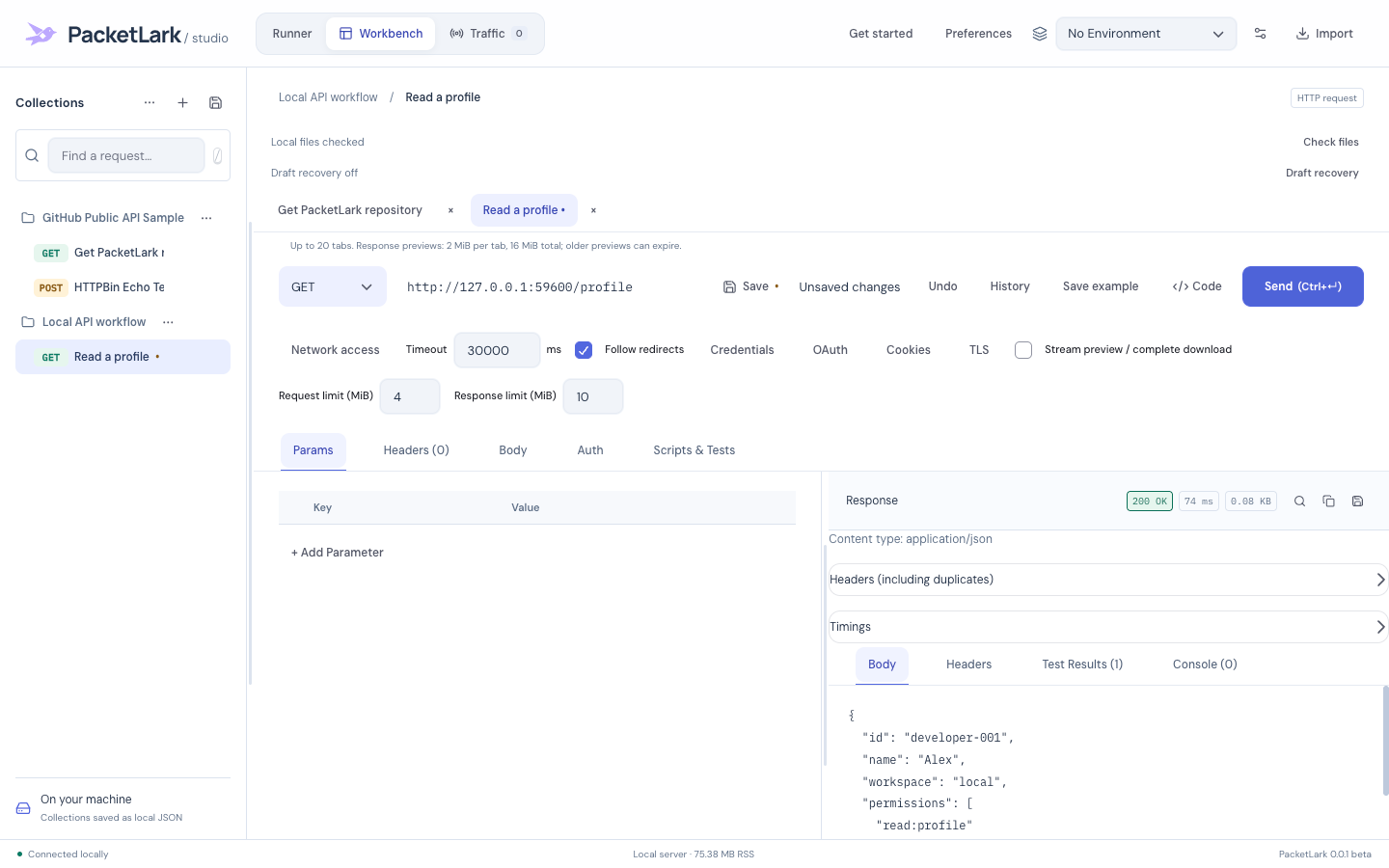
Figure 1: PacketLark desktop Workbench light mode running a local HTTP test against 127.0.0.1:59600/profile, displaying 200 OK in 74 ms, 1 passing assertion, and live footer telemetry (Local server · 75.38 MB RSS).
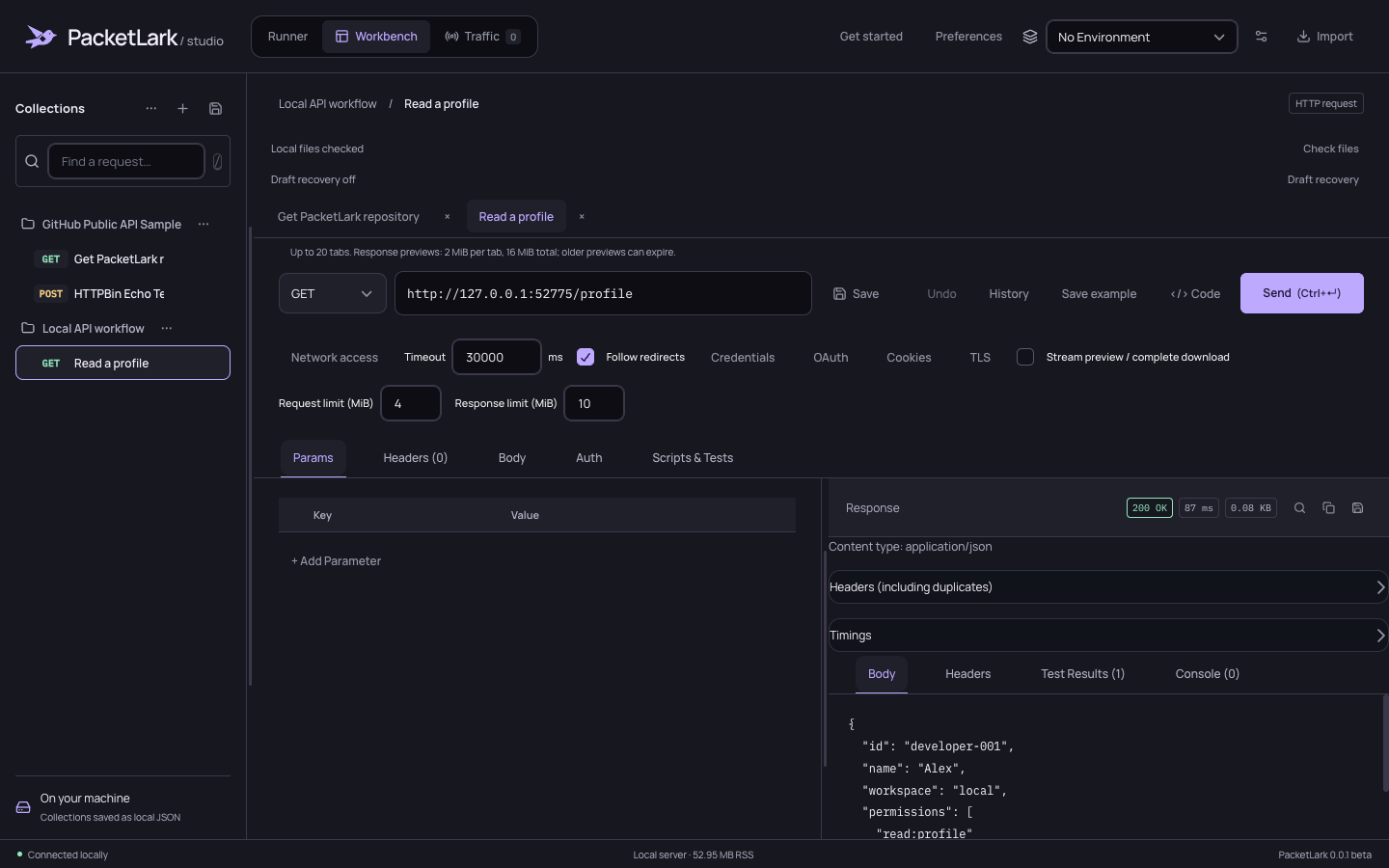
Figure 2: PacketLark Halide-aligned dark UI (workbench-redesign.png) inspecting request/response size bounds (4 MiB / 10 MiB), local tab caps (20 tabs), and 52.95 MB RSS server memory.

Figure 3: Conflict reconciliation modal catching an external modification to a .packetlark/ collection JSON file and presenting a redacted side-by-side comparison (Load disk and discard local drafts, Keep drafts with disk context, or Save recovered collection copy).
5. Verified Performance, Soak Testing, and Honest Gaps
PacketLark has zero patience for fabricated "10x lighter than X" slogans. Earlier exploratory drafts referencing unpinned Postman RAM comparisons were explicitly purged from the repository (docs/PRODUCT_ASSESSMENT.md) in favor of reproducible, source-pinned measurements:
| Benchmark / Verification Suite | Measured Result | Scope & Explicit Caveats |
|---|---|---|
| P4 Full Automated Regression | 405 / 405 tests across 48 files passed (0 skips) | Includes real loopback servers, QuickJS workers, OpenAPI validation, and live compiled Go snippet execution |
| Targeted Chromium UI Suite | 16 / 16 workflows passed (7 exact server hits) | Captures, fixture replays, cancellation, exported OpenAPI + TS client CLI drift check |
| Loopback Microbenchmark (200 runs, Node 24 / M4) | Direct P95 0.163 ms; Proxy P95 0.591 ms; List 0.667 ms |
Single-machine sequential 1 KiB payload; measures server overhead, not remote network latency |
| Fresh CLI Cold Start (30 processes) | P95 readiness 85.62 ms; backend RSS 71.41 MiB |
Warm OS filesystem caches; excludes external Chromium browser tab memory |
| Live Server RSS Observed in UI | 52.95 MB (dark redesign) to 75.38 MB (desktop capture) |
Live Node server footprint shown in Workbench footer |
| 10-Minute Sustained Capture Soak | 41,000 requests; 0.887 MiB post-GC median heap growth |
Held 64,370 retained bytes, 0 leaked forwards (200.7 MiB combined client+target+proxy test tree) |
| 10,004-Row Browser Stress Test | Readiness 490 ms; Filter 801 ms; Select 805.5 ms |
Candidly flagged above the 100 ms UI target, motivating P1 list virtualization |
Where does PacketLark intentionally fall short of mature enterprise platforms today? Let the missing checklist speak plainly:
- No HTTPS
CONNECTMITM Interception: Forwarding proxy inspects plain local HTTP traffic only; browser HTTPS capture extensions remain deferred. - HTTP-Only Core: Native schema-aware GraphQL explorers, gRPC/protobuf reflection, WebSockets, MQTT, and webhook listeners are absent (GraphQL payloads go as plain JSON POSTs).
- Preview-Only Editor & MCP Maturity: A packagable VS Code extension exists (
@vscode/vsceverified cleanly) alongside localstdioand bearer HTTP MCP tools (get, list, bounded runs with body/secret omission), yet full VS Code extension-host QA and multi-user cloud workspaces remain deferred.
6. Comparison Against Postman, Insomnia, Bruno, and Hoppscotch
| Capability | PacketLark (Abrar Akhunji) | Postman | Insomnia (Kong) | Bruno | Hoppscotch |
|---|---|---|---|---|---|
| License & Pricing | $0 MIT Open Source | Free (1 user), $9 Solo, $19 Team, $49/user/mo Enterprise | Free (Git <=3 users), $10 to $12/mo Pro, $45/mo Ent | Free MIT (2 workspaces), ~$6/mo Pro, ~$11/mo Ult | Free cloud / Docker OSS, ~$6-$8/mo Biz, ~$11-$14/mo Ent |
| Workspace Storage | .packetlark/ JSON (If-Match ETag + 0600 fsync) |
Cloud workspaces default (v12 added YAML Git mode) | Local, Cloud, or Native YAML Git sync | Native .bru plain text files inside Git folders |
Cloud DB / self-hosted Docker DB |
| Script Isolation | QuickJS worker (64 MiB, 2s-30s cap, no Node globals) |
Node / Postman Sandbox runtime | Insomnia plugins + Mocha/Chai test runtime | Bru CLI / JavaScript sandbox | Web / desktop JS script runner |
| SSRF / Origin Guard | Explicit DestinationGrant + Socket DNS Pinning |
Standard desktop proxy / CA config | Standard app networking | Standard app networking | CORS / proxy agent config |
| Traffic -> OpenAPI 3.1 | Built-in capture proxy (:8085) -> OpenAPI + TS/Go |
API Builder + spec sync (paid tiers for scale) | Spec-first Design + Git sync | OpenAPI import / export | OpenAPI import / collections |
| Protocol Breadth | HTTP/1.1 & HTTPS (JSON/binary/multipart); Stdio + HTTP MCP | Broadest: HTTP, GraphQL, gRPC, WebSocket, Socket.IO, MQTT | HTTP, GraphQL, gRPC, WebSockets | HTTP, GraphQL, gRPC (emerging), WebSockets | HTTP, GraphQL, WebSocket, SSE, MQTT |
| Sweet Spot | Security-conscious local REST dev, traffic inference, AI agent MCP | Full enterprise API governance, mocks, flows, teams | Kong gateway workflows + YAML spec design | Lightweight Git-native team collections | Fast browser-first open-source multi-protocol UI |
7. Engineering Rules of Thumb for Local API Toolchains
- Quarantine Collection Scripts Like Untrusted Code: Anyone importing a stranger's OpenAPI or Postman collection into an Electron or Node backend must never run tests via
vm.runInNewContext. Enforce an out-of-process bytecode engine (such as QuickJS) with hard millisecond timers and explicit IPC byte caps. - Validate DNS Resolutions Inside the Socket Connect Hook: Preflight domain blacklists fail against zero-TTL DNS rebinding. Pin resolved IP addresses at
createLookup()right before TCP socket establishment and strip authorization headers across origin redirects. - Require Explicit Human Sign-Off Before Turning Logs into Specs: Captured production or staging traffic misses optional fields and rare error codes. Treat traffic-inferred OpenAPI 3.1 documents strictly as checksum-bound drafts paired with drift-detection fixtures rather than unquestioned truth.
- Expose Bounded Read/Run Primitives Over MCP Rather Than Raw Shells: Giving coding agents a dedicated
stdioMCP adapter over local HTTP collections lets Claude Code or Codex run integration assertions directly while keeping secret environment keys masked from model context windows.
Sources
- Project Repository & Documentation: PacketLark GitHub Repository (Abrar Akhunji) and PacketLark Overview Site
- Execution Sandbox & DNS Security Spec: PacketLark docs/P3_EXECUTION_SECURITY.md
- OpenAPI Inference & Capture Architecture: PacketLark docs/P4_PROGRESS.md
- Verification & Honest Product Audit: PacketLark docs/VERIFICATION.md and docs/PRODUCT_ASSESSMENT.md
- Competitor Pricing & Feature References: Postman Pricing, Insomnia Plans, Bruno, Hoppscotch