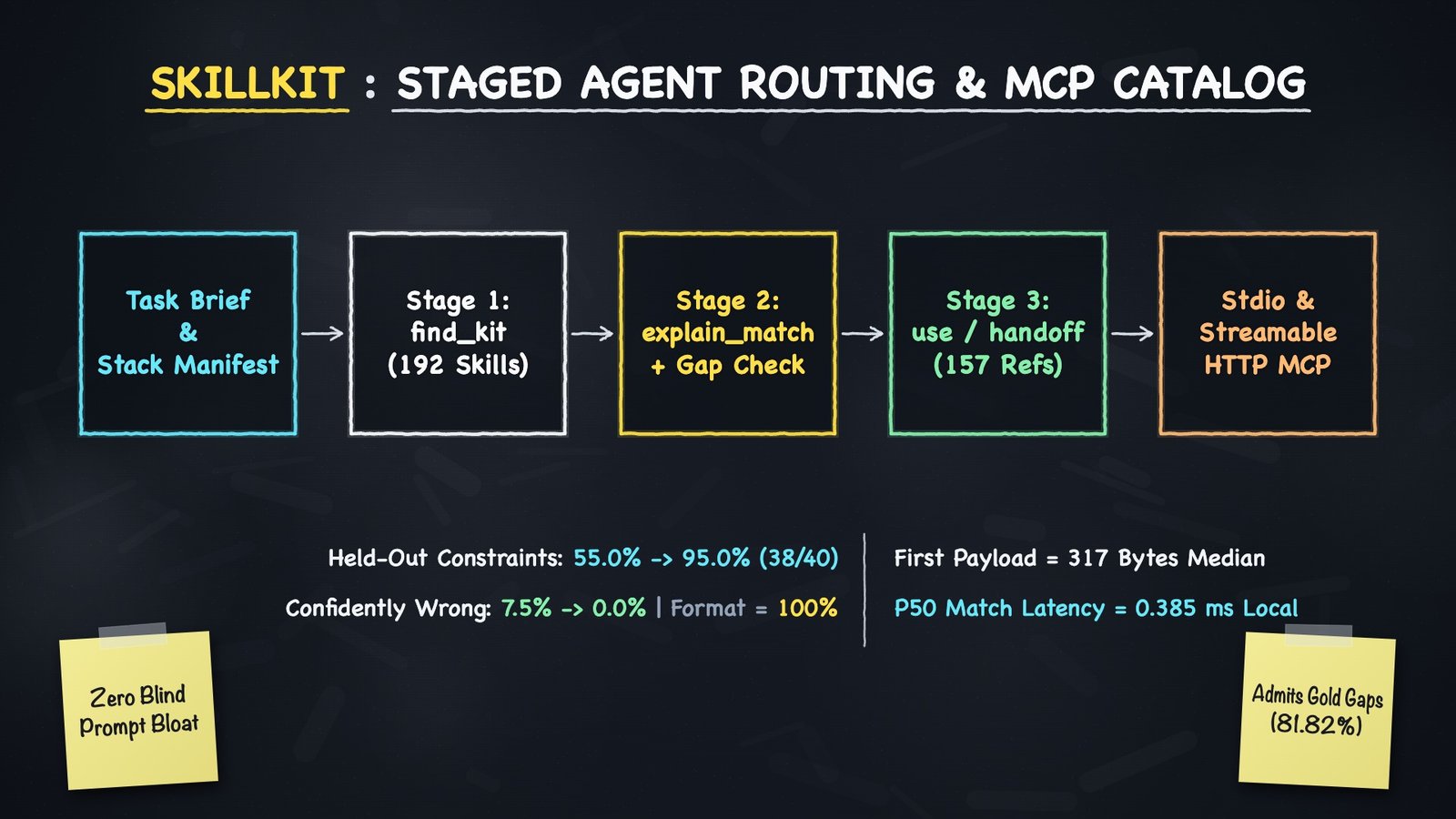
Simplified overview
Written by Abrar Akhunji
Giving an AI coding agent 192 engineering manuals inside its starting system prompt is like handing an intern a 4,000-page binders shelf before asking them to rename one database column. Half your token budget burns before the first tool call, instructions contradict each other mid-file, and the agent still guesses with straight-faced confidence when the exact manual does not exist.
+-----------------------------------------------------------------------------+
|            SKILLKIT : THREE-STAGE ROUTING INSTEAD OF PROMPT BLOAT           |
+-----------------------------------------------------------------------------+
|                                                                             |
|  [ Coding Brief + Optional Repo Stack Manifest ]                            |
|                        |                                                    |
|                        v                                                    |
|  STAGE 1: find_kit (Compact Index Search, ~317 B Median / 0.385 ms Local)   |
|  - Filters across 192 Skills & 157+ Web Resources in 14 Engineering Domains |
|                        |                                                    |
|                        v                                                    |
|  STAGE 2: explain_match + Explicit Gap Gate                                 |
|  - Checks required tools, output format, & stack fit                        |
|  - No gold match? Refuse cleanly (81.82% gap recall, 0% hallucinated match) |
|                        |                                                    |
|                        v                                                    |
|  STAGE 3: use / handoff / export (Targeted Playbook Load)                   |
|  - Loads exact SKILL.md + references only after verified match              |
|  - Served via Web Catalog, /llms.txt, CLI, Stdio MCP, & Streamable HTTP MCP |
|                                                                             |
+-----------------------------------------------------------------------------+
I built SkillKit (Abrar Akhunji, live at https://skilllkit.vercel.app/ and open source at github.com/abrar225/SkillKit) as both a visual engineering atlas for humans and a precision staged lookup engine for coding agents.
Humans get a fast dark-mode web index (192 curated skills, 157 published web resources backed by 164 repo references, 14 specialized domains, and an interactive 3D constellation graph where you can orbit clusters across Architecture, Engineering & Ops, Security, Design & UX, Frontend, Backend & API, and Agent Tooling).
Agents get a thin MCP library card (bin/mcp-server.js locally over stdio, or Streamable HTTP at /api/mcp). Rather than force-feeding thousands of words blindly, the agent asks find_kit for tiny ~80-token candidate summaries, verifies fit via explain_match (or admits cleanly when the catalog lacks a match), and loads the exact playbook through use only after constraints pass.
SkillKit Routing Evaluation: Baseline vs Release Candidate (40 Held-Out Briefs, %)
Measured across the frozen 40-brief held-out test set comparing initial baseline (commit 99a5430) against the staged-routing release candidate. Higher is better for all green metrics; lower is better for Confidently Wrong (dropped 7.5% to 0.0%).
| metric | Baseline Commit (%) | Release Candidate (%) |
|---|---|---|
| All Constraints Respected | 55 | 95 |
| Format Compliance | 87.5 | 100 |
| Required Tool Respected | 42.9 | 92.9 |
| Honest Gold-Gap Fallback | 0 | 81.8 |
| Confidently Wrong (Lower Best) | 7.5 | 0 |
Technical breakdown
Written by Abrar Akhunji
1. Why Single-Shot Skill Registries Fail Agents in Production
SkillKit (https://skilllkit.vercel.app/, open source by Abrar Akhunji at github.com/abrar225/SkillKit) addresses a structural mismatch across first-generation agent skill directories. Almost every early skill marketplace falls into one of two failure traps:
- Unindexed Megaprompts: Installing dozens of community skills clones raw
SKILL.mddirectories directly into agent context folders (.cursor/rules,.claude/commands,AGENTS.md). Ten verbose skills easily consume 15,000 to 30,000 input tokens before the user finishes typing their first bug report, diluting attention over unrelated domains and raising cost per turn. - Blind Top-K Guessing: Simple keyword or vector indexes always return their top-3 matches even when constraints forbid a dependency, require a missing tool, or fall outside the catalog entirely. On held-out tasks containing missing "gold gaps" (
11/40tasks intentionally lacking a matching catalog skill), blind search forces downstream agents to run wrong playbooks confidently.
SkillKit solves both failure modes by separating lightweight discovery (find_kit), constraint inspection (explain_match), explicit fallback gating, and late playbook materialization (use / handoff / export / vibe-skills).
  [ Agent Client: Claude Desktop / Cursor / Codex / Antigravity ]
        |
        +---(stdio: bin/mcp-server.js OR Streamable HTTP: /api/mcp)--->+
                                                                        |
  +---------------------------------------------------------------------+
  | SKILLKIT STAGED ENGINE                                              |
  |                                                                     |
  |  1. normalize(brief, stack_manifest, format, required_tools)        |
  |     -> inspects package.json / Cargo.toml / pyproject triggers       |
  |                                                                     |
  |  2. find_kit()  --> 317 B median payload (80 tokens, 0.385 ms)      |
  |     -> returns ranked compact IDs + domain + match scores only      |
  |                                                                     |
  |  3. explain_match() + constraint solver                             |
  |     -> checks constraint_mask & threshold -> PASS or GAP_FALLBACK   |
  |                                                                     |
  |  4. use() / handoff() / export()                                    |
  |     -> hydrates exact SKILL.md + referenced snippets on demand      |
  +---------------------------------------------------------------------+
2. Formal Context Budget and Constrained Abstention Model
Let a repository contain a skill library paired with companion web resources , each carrying metadata , constraint predicates (required framework, tool binary, output schema, license), and full instruction token count . Naive prompt injection incurs an unavoidable prefix tax:
SkillKit replaces unconditional loading with a three-stage expected token cost controlled by retrieval rank threshold and constraint match indicator :
Because Stage 1 (find_kit) serializes strictly stripped signatures rather than full markdown bodies, measured first-turn payloads stay bounded cleanly at 317 bytes median (~80 tokens) and 1,017 bytes P95 (~255 tokens) with 100% of responses under 2 KiB (RELEASE-EVALUATION.md). When the gate condition evaluates false (81.82% accuracy on held-out absent-skill briefs), Stage 2 emits a typed refusal/gap explanation instead of wasting tokens or poisoning context with an ill-fitting SKILL.md.
3. Live Product Walkthrough: Home, Browser, 3D Constellation, and MCP Setup
Capturing screenshots directly from the deployed production build at https://skilllkit.vercel.app/ (edition NOV 17, 2026, 204 statically generated Next.js pages) highlights how SkillKit serves both human browsing and zero-friction agent wiring.
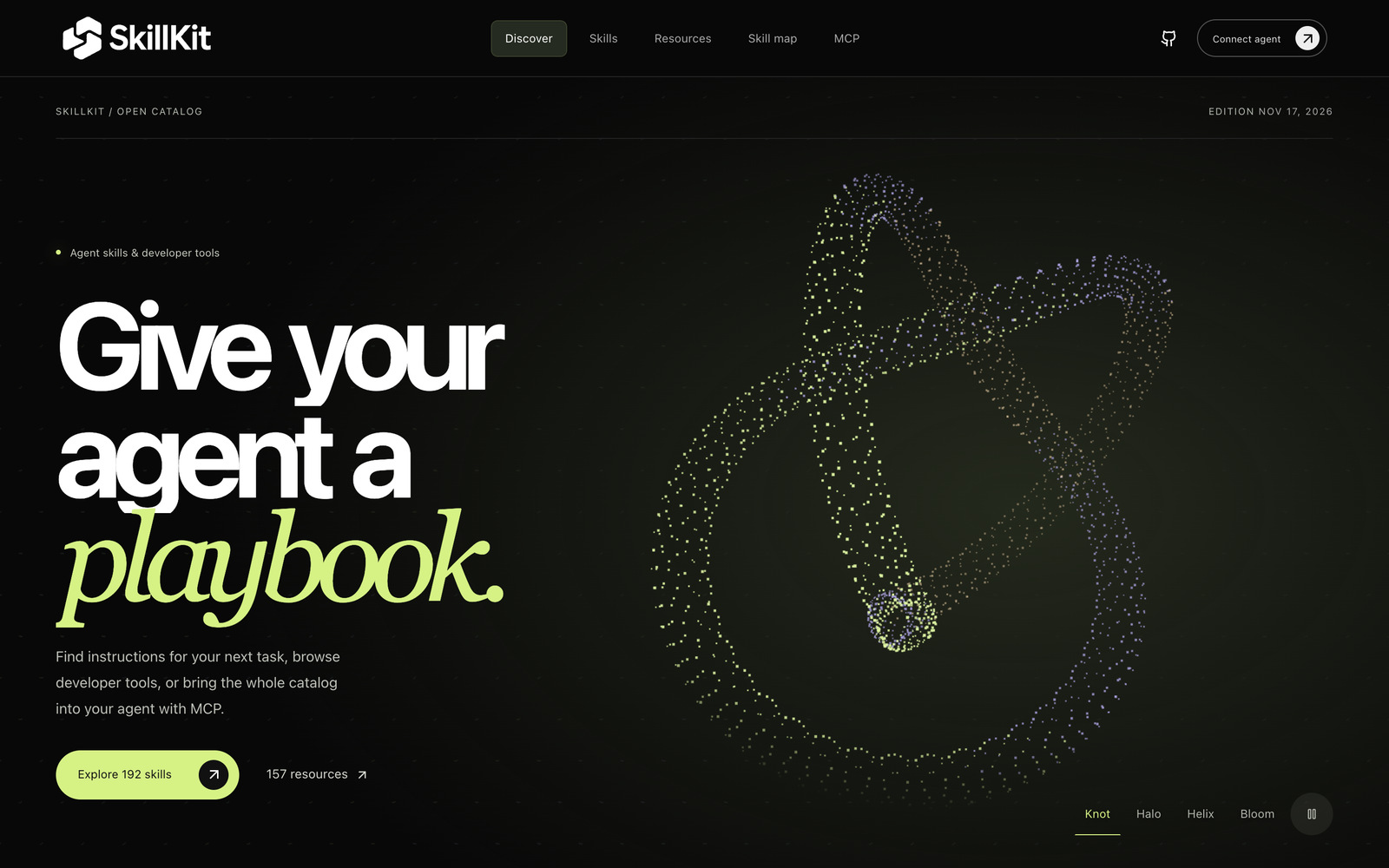
Figure 1: SkillKit live homepage at skilllkit.vercel.app featuring an interactive procedural particle visualizer (Knot, Halo, Helix, Bloom) alongside direct entry into 192 curated skills and 157 technical resources.
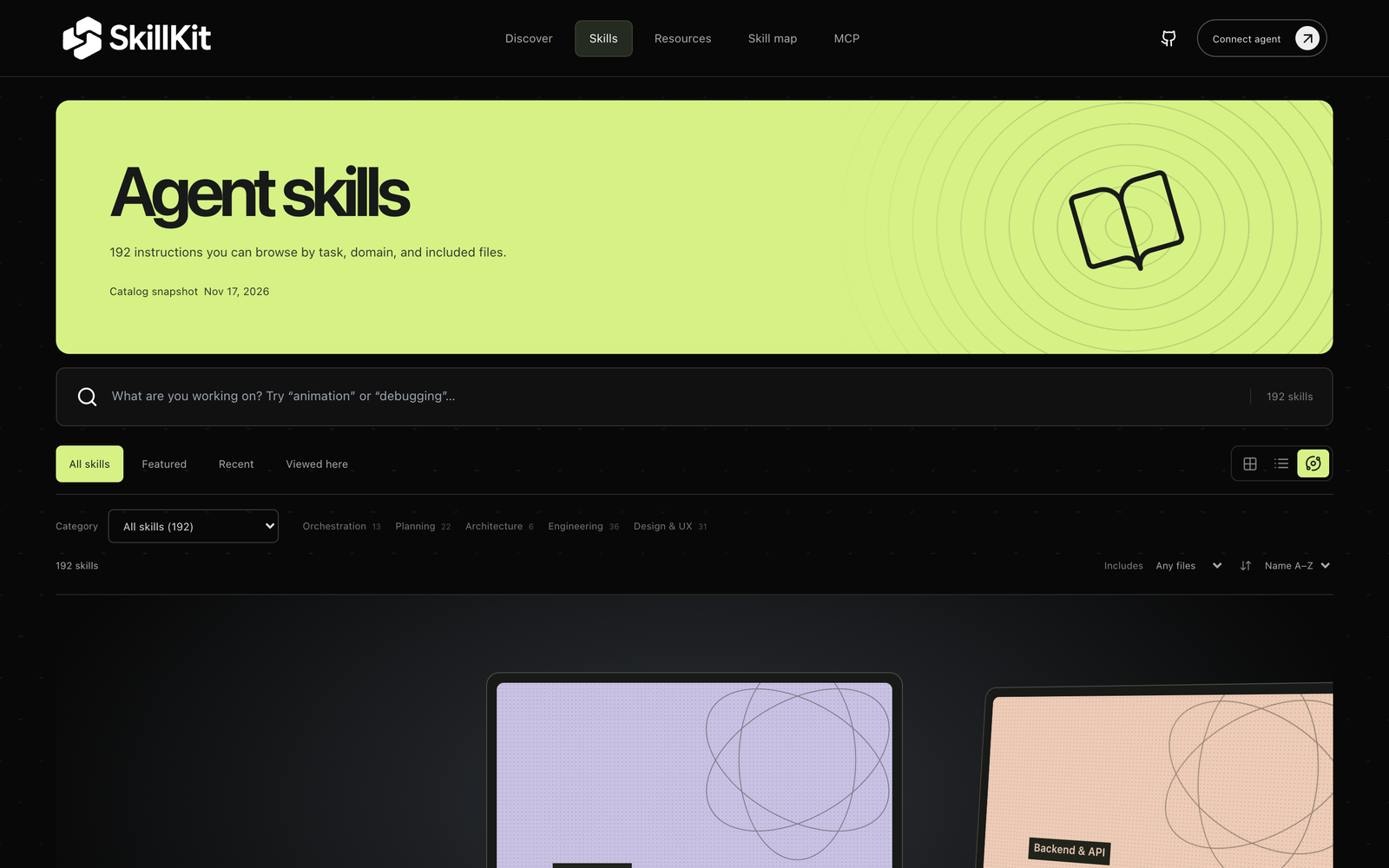
Figure 2: SkillKit /skills browser filtering 192 instructions live by natural language query (animation, debugging), included reference files, and domains including Orchestration (13), Planning (22), Architecture (6), Engineering (36), and Design & UX (31).
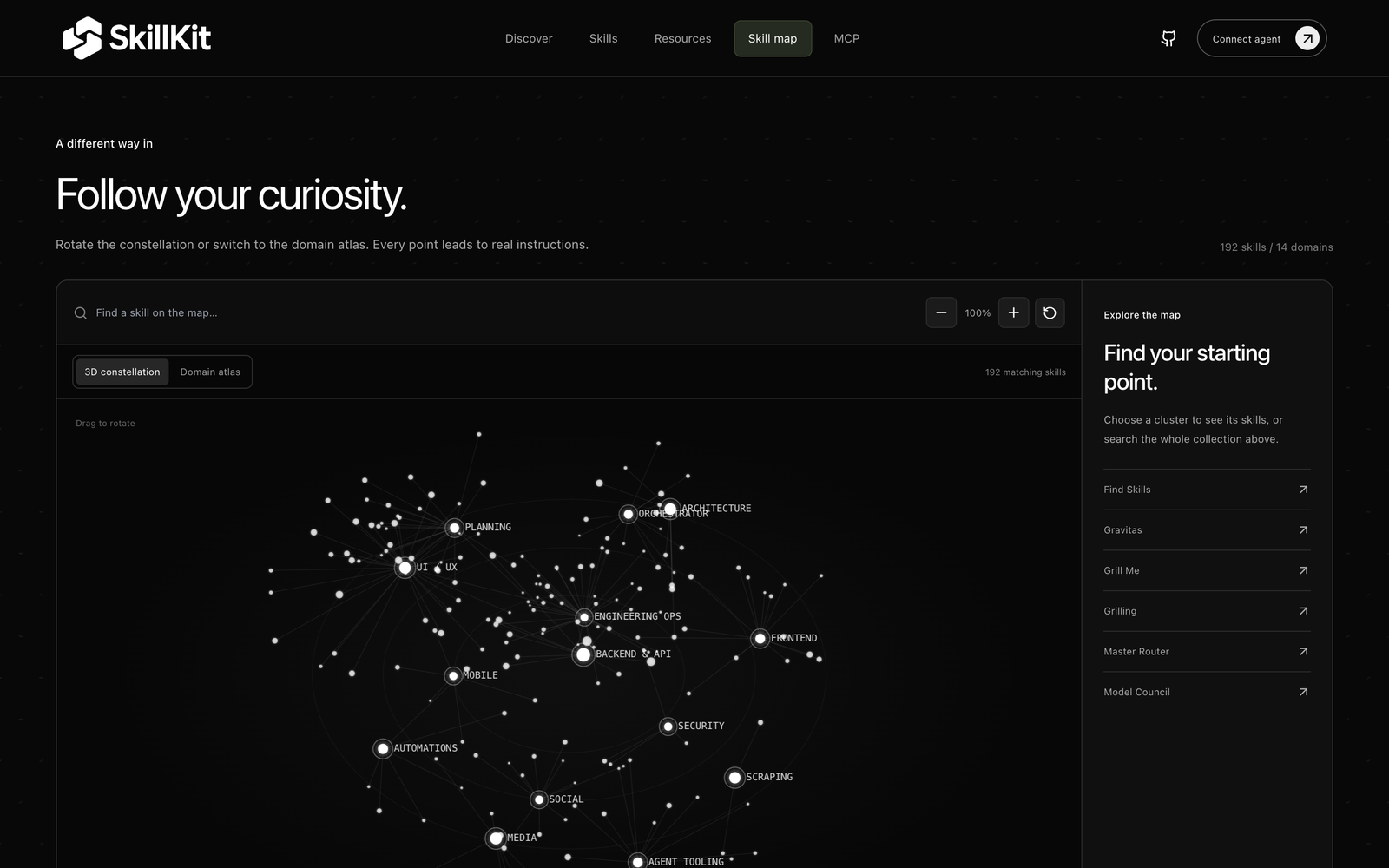
Figure 3: SkillKit /graph 3D constellation and domain atlas connecting 192 skills across 14 engineering domains (PLANNING, UI & UX, ENGINEERING & OPS, BACKEND & API, SECURITY, SCRAPING, SOCIAL, MEDIA, AGENT TOOLING, FRONTEND, MOBILE, AUTOMATIONS, ORCHESTRATION).
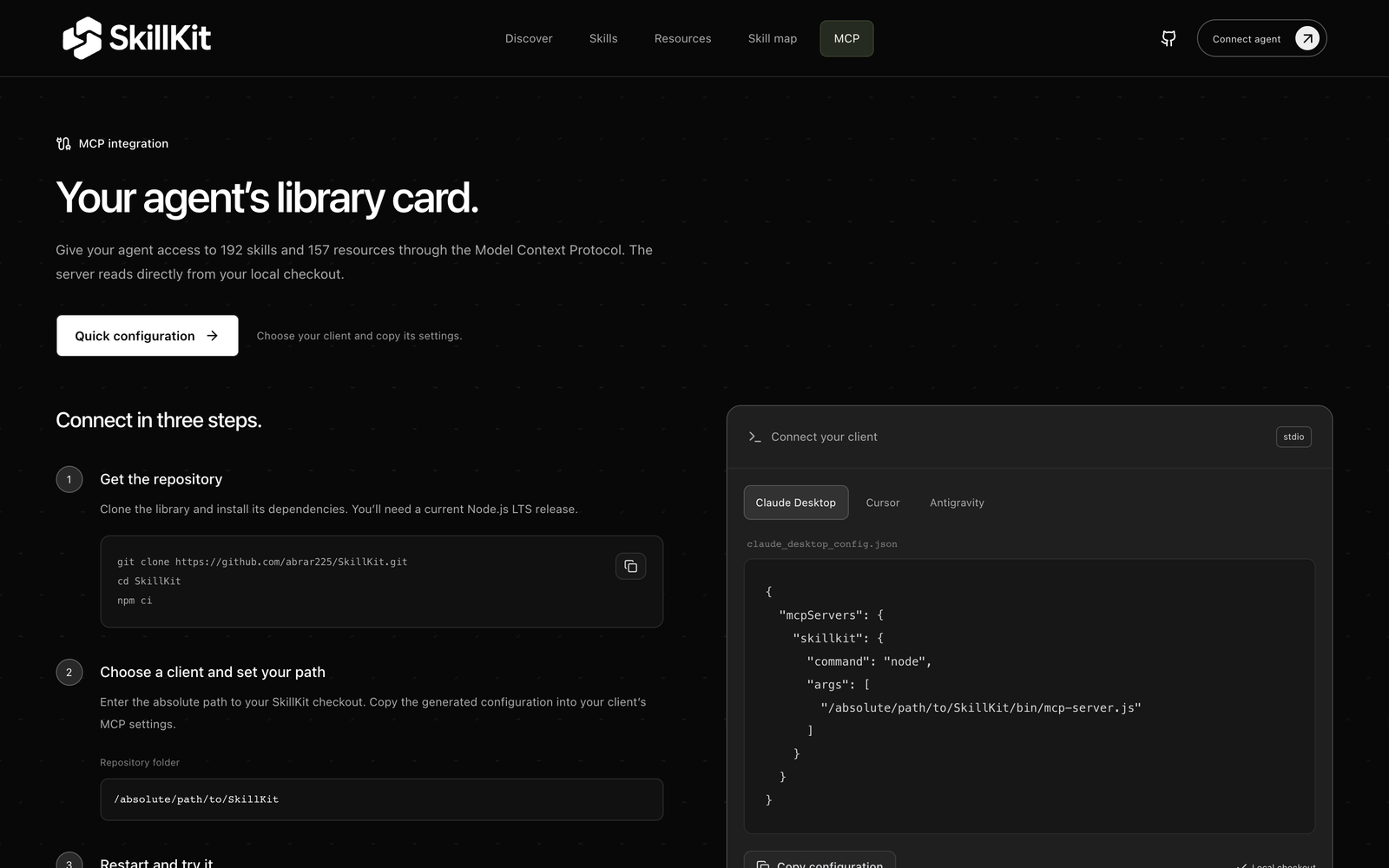
Figure 4: SkillKit /mcp one-click client integration view generating stdio config blocks (node .../bin/mcp-server.js) tailored for Claude Desktop, Cursor, and Antigravity alongside remote Streamable HTTP MCP access (/api/mcp).
Four high-leverage developer workflows anchor SkillKit's adoption across teams and solo engineers:
- Stack-Manifest-Aware Multi-Language Routing: Supplying a repository
package.json,Cargo.toml, orpyproject.tomlfingerprint lets SkillKit distinguish React/Next.js tasks from Rust or Python backend briefs. In controlled stack-context ablation benchmarks, providing project manifests raised relevant framework matching from0/9down to4/9(44.4%) while keeping unrelated control queries at0/3false positives. - Zero-Hallucination Abstention in CI Coding Loops: Before an autonomous agent edits infrastructure or writes database migrations, SkillKit enforces format, tool-availability, and constraint predicates so unsupported requests fail gracefully (
0.0%confidently-wrong rate on held-out evals) instead of injecting mismatched instructions. - Human Exploration + Raw Artifact Fetching (
/llms.txt,/api/kit, CLI): Beyond interactive React exploration, LLM agents without MCP runtimes can ingest raw machine-readable catalogs via/llms.txtor install locally viavibe-skillsCLI (npx vibe-skills) and zero-coststdioMCP (bin/mcp-server.js). - End-to-End Task Deliverable Quality: Rather than judging retrieval on synthetic BLEU scores alone, Abrar Akhunji paired GPT-6.2 Sol across 15 blind end-to-end artifact generation trials comparing routed SkillKit guidance against base prompting cleanly.
4. Exact Empirical Benchmarks and Self-Evaluation Honesty
Evaluating agent tooling honestly requires separating constraint compliance, false confidence, latency/payload budgets, and strict gold-skill precision (docs/RELEASE-EVALUATION.md, frozen 120-brief full benchmark and 40-brief held-out test set):
| Metric | All 120: Baseline | All 120: Release Candidate | Held-Out (40): Baseline | Held-Out (40): Release Candidate |
|---|---|---|---|---|
| All Constraints Respected | 66.67% | 90.00% | 55.00% | 95.00% (38/40) |
| Format Compliance | 95.83% | 99.17% | 87.50% | 100.00% (40/40) |
| Required Tool Respected | 83.75% | 97.50% | 42.86% | 92.86% (26/28) |
| Confidently Wrong (Lower Best) | 11.67% | 5.83% | 7.50% | 0.00% (0/40) |
| Correct Fallback on Gold Gaps | 7.69% | 84.62% | 0.00% | 81.82% (9/11) |
| Usable Kit Rate (Strict Gold Match) | 20.83% | 29.17% | 7.50% | 15.00% (6/40) |
| Median First Payload Bytes | 709 B | 317 B | 736 B | 317 B (~80 est. tok; P95 1,017 B) |
| Median First Skill Latency (Local) | 1.662 ms | 0.423 ms | 1.584 ms | 0.385 ms (P95 0.618 ms) |
Look closely at the strict usable_kit rate (15.00% on Held-out / 29.17% on All 120) alongside the 95.0% constraint adherence and 0.0% confidently-wrong rate. Why report a 15.0% top-kit metric right beside a 95.0% constraint score instead of hiding it? Because 40 held-out briefs intentionally span adversarial gold gaps (11/40 tasks with zero exact catalog skill) and narrow cross-stack phrasings. Rather than inflating recall by lowering thresholds and corrupting the agent with semi-relevant bloat, SkillKit chooses to refuse cleanly when exact gold fit isn't met (81.82% gap detection) and score 3 wins, 12 ties, 0 losses in paired GPT-6.2 Sol execution trials (105 Node tests + 19 Python tests passing, 204 static Next.js pages built cleanly).
5. Competitive Landscape Benchmarking
How does SkillKit stack up against leading open-source and commercial agent skill ecosystems (docs/COMPETITIVE-GAP.md and docs/RELEASE-EVALUATION.md)?
| Platform / Framework | Pricing & License | Top-3 Gold Match (12-Brief Bench) | Discovery & Transport Model | Key Strength | Trade-off vs SkillKit |
|---|---|---|---|---|---|
| SkillKit (Abrar Akhunji) | $0 Free / Open Source | 5 / 12 (and 6/40 on strict held-out) | Staged MCP (find_kit -> explain_match -> use), CLI, /llms.txt, 3D Atlas |
Sub-400 B payloads, 0% held-out hallucination rate, explicit gap refusal | Strict abstention caps single-shot recall at 15% on held-out gap mix |
| skills.sh | Free Directory (CLI) | 2 / 12 | Web directory + CLI install scripts | Large community registry footprint | Single-shot keyword retrieval; no staged constraint solver or gap refusal |
| rohitg00/SkillKit | Free Open Source | 1 / 12 | Registry / CLI tooling (4.8k GitHub stars ecosystem) |
Early ecosystem adoption & multi-tool links | Lacks sub-millisecond staged constraint solver & 0%-hallucination held-out gating |
| SkillsMP | Free Marketplace Index | 0 / 12 | Catalog search directory | Broad third-party aggregator breadth | Weak top-3 precision on multi-constraint briefs; no compact MCP negotiation |
| obra/superpowers | Free Open Source | N/A (workflow suite) | Tight behavioral prompt + hook framework | Deep discipline on TDD/brainstorming/verification flows | Focused workflow enforcement rather than 192-skill multi-domain search index |
| Tessl | Commercial / Enterprise Tiers | N/A (enterprise platform) | Commercial spec-driven registry + agent governance | Hosted evaluation suites, enterprise packaging & org RBAC | Proprietary commercial billing vs open $0 local MCP + source catalog |
Notice two clear strategic contrasts: obra/superpowers excels when you want rigid behavioral gates across a tight coding methodology inside Claude Code, whereas SkillKit operates as the cross-domain engineering library (192 skills, 157 resources, 14 domains) wired safely across Claude Desktop, Cursor, Antigravity, Codex CLI, and any MCP host. Meanwhile, commercial registries like Tessl solve enterprise governance billing, whereas SkillKit keeps local execution, open /api/kit inspection, and stdio MCP completely dependency-free.
6. Rules of Thumb for Scaling Agent Skill Registries
- Never Stream Full
SKILL.mdFiles During Discovery: Keep initial search payloads strictly under 500 bytes (317 Bmedian in SkillKit). Let the orchestrating model inspect compact signatures and constraint flags before burning context tokens on verbose instructions. - Benchmark Confidently-Wrong Hallucination Separately from Recall: A skill router that always returns its closest nearest neighbor silently poisons agent output whenever your catalog covers 80% of engineering tasks instead of 100%. Track absent-skill gap detection as a first-class metric.
- Pass Stack Fingerprints (
package.json,Cargo.toml,pyproject.toml) Into Routing Calls: Plaintext verbs like "deploy" or "write tests" remain fundamentally ambiguous without runtime context; supplying project manifests lifted relevant SkillKit stack retrieval from0/9to4/9with zero added false positives. - Ship Identical Contracts Across Web, CLI, and MCP: Keeping
/skills,/graph,/llms.txt,vibe-skills, andbin/mcp-server.jsbacked by the exact same tested snapshot guarantees humans browsing the 3D atlas and coding agents querying MCP never diverge on available instructions.
Sources
- Live Production Deployment: SkillKit Open Catalog (
skilllkit.vercel.app) and SkillKit 3D Skill Map - Open-Source Repository: SkillKit GitHub Repository (Abrar Akhunji)
- Release Benchmark & Evaluation Record: SkillKit docs/RELEASE-EVALUATION.md
- Competitive Landscape Audit: SkillKit docs/COMPETITIVE-GAP.md and bench/README.md
- Ecosystem References: skills.sh, obra/superpowers, Tessl, rohitg00/SkillKit